
Scandals & Feuds · 1980s
The Colts’ Midnight Move and the Stadium Power Game
When Robert Irsay’s Baltimore Colts left for Indianapolis in 1983–1984, the franchise became another entry in the NFL’s history of owners using stadium demands and financial leverage to move teams. Baltimore’s loss also exposed how little power cities and fans possessed once a league owner controlled the institution’s most valuable asset: the team itself.
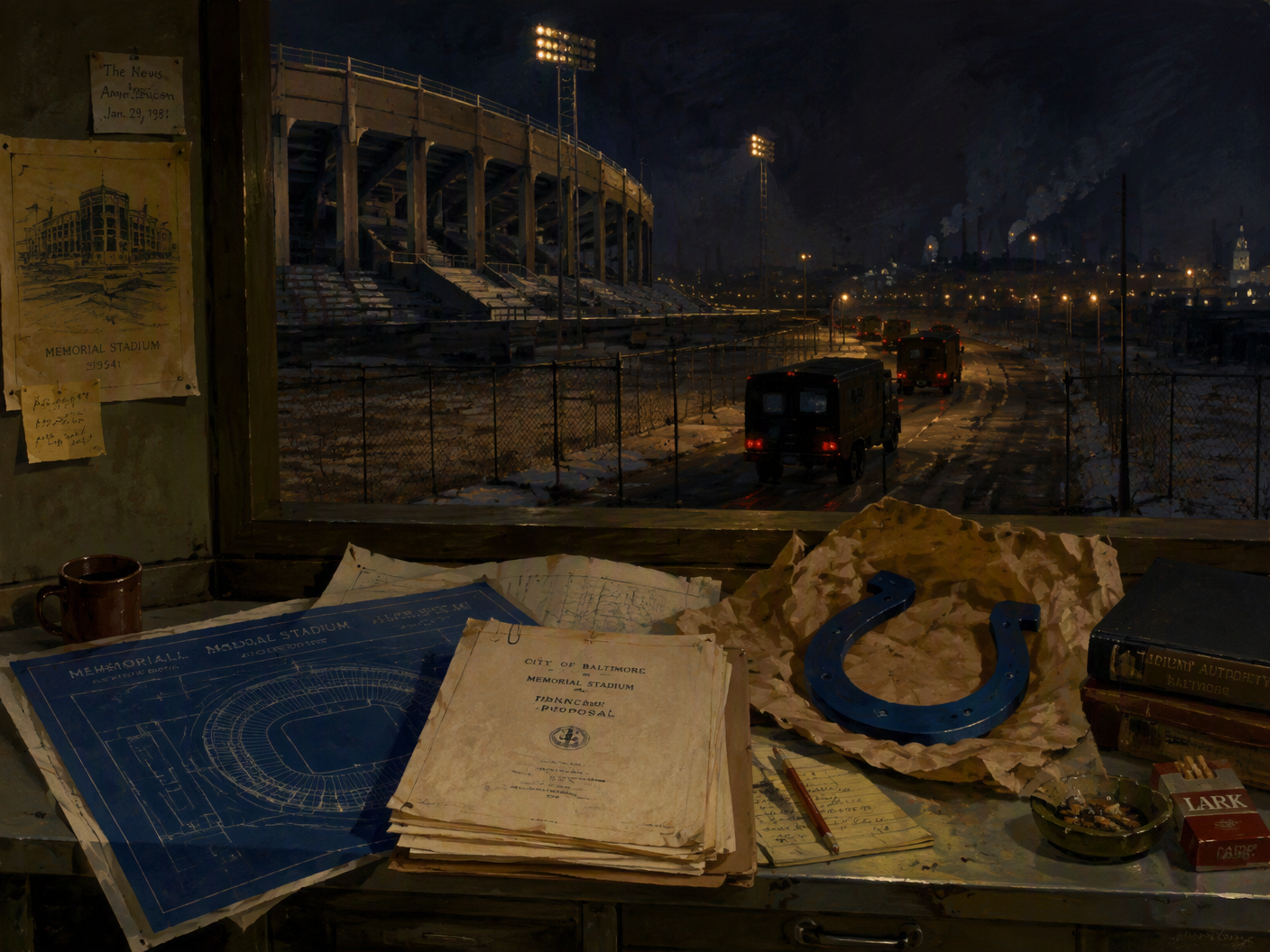
Baltimore did not lose the Colts during a trade, a bankruptcy, or a vote by its supporters. It lost them when the franchise crossed state lines and became Indianapolis’s team in the 1983–1984 relocation. The change severed an attachment built through championships, cold Sundays, and the blue horseshoe that had given Baltimore a place in professional football. By the time the city understood that the Colts were leaving, the argument over a stadium had become something larger: a contest over who owned the future of a civic identity.
Robert Irsay had spent years pressing Baltimore for renovations or a replacement for Memorial Stadium. The building was more than concrete and steel, but it was also an aging business proposition, a place where the team’s demands met the city’s obligations. A proposed renovation package valued at $175 million did not satisfy Irsay. The negotiation narrowed into a familiar language of modern suites, revenue, infrastructure, and control. Behind each term stood the same question: whether Baltimore would pay enough to keep an NFL owner from looking elsewhere.
The Colts’ dispute belonged to a larger NFL pattern. Owners had moved franchises while invoking attendance, finances, markets, or stadium conditions; local officials and fans regularly challenged those explanations, arguing that public money was being used to protect private leverage. A team could be presented as a public institution on Sunday and treated as a portable corporate asset on Monday. The stadium became the pressure point. Cities had to decide how much tax money, land, and political capital they would spend to retain a business that could still leave.
In Baltimore, the argument ended with departure rather than compromise. The Colts moved to Indianapolis, leaving behind a city whose relationship with the franchise had been measured in generations. The destination offered a new market and a new building plan; Baltimore was left with the practical consequences of losing an NFL tenant and the emotional fact of being rejected. The team’s name, colors, and history continued elsewhere. The people who had supplied the attachment remained where they were, facing an empty place in the city’s calendar.
The move did not end Baltimore’s pursuit of professional football. It redirected the city’s energy toward replacement. Officials and business interests worked to bring another NFL team to town, and the Maryland Stadium Authority secured stadium financing for a relocating franchise. Public construction became part of the courtship. The lesson was written in steel and debt: if a city wanted a team, it needed a building capable of satisfying the owner, the league, and the economics that had driven the previous franchise away.
That machinery made the fan’s loyalty strangely vulnerable. Supporters could fill seats, buy jerseys, preserve old photographs, and still have no formal claim on the team’s location. The owner negotiated with officials; the league protected its collective commercial structure; the city tried to convert public investment into stability. Fans were present in every calculation but absent from the decision. Their grief became evidence of the team’s importance, while their lack of power became evidence of how the system worked.
The NFL’s power over its participants appeared in another form during the 2011 lockout, when the league canceled the Hall of Fame exhibition game between the Chicago Bears and St. Louis Rams. That canceled game was unrelated to the Colts’ relocation, but it revealed the same institutional capacity: the league and its owners could suspend the spectacle while negotiating the terms under which everyone else worked. Even an exhibition could become collateral in a dispute over control, money, and labor.
Players confronted that structure from the other side of the business. In 1992, a federal jury found that the NFL’s Plan B free-agency system violated antitrust laws by substantially harming competition for players’ services. The case turned the league’s rules into a legal question about restraint: how far could a cartel-like sports organization limit an athlete’s ability to sell his labor? Owners had used collective power to manage franchises. Players challenged the same power when it narrowed their choices after contracts ended.
The people who made the league valuable also carried its physical cost. Boston University researchers later reported CTE in 345 of 376 donated brains from former NFL players they studied. The number came from a selected group, not from every player who had ever taken the field, but it placed a human body beneath the league’s commercial arguments. Stadiums could be renovated, franchises transported, and labor systems redesigned. Brain tissue could not be restored by a new lease or a different city.
The Colts’ departure remains a story about ownership, but not necessarily about criminality. It was an owner-led relocation shaped by stadium demands, league customs, and the absence of a mechanism that allowed Baltimore’s public attachment to overrule the franchise’s private control. The city eventually pursued another team and another stadium. Indianapolis gained the Colts. Baltimore gained a permanent example of the bargain cities are asked to make: invest in the institution, love the institution, and accept that the institution may still leave in the night.
Companion notes
What the Colts’ Relocation Reveals About NFL Power
The available sources establish the Colts’ move from Baltimore to Indianapolis within the 1983–1984 period, the preceding stadium dispute, and the subsequent effort to restore NFL football to Baltimore. They also place the episode within broader disputes over franchise mobility, player labor, and the physical cost of football, while leaving important procedural and evidentiary limits intact.
The relocation and the stadium dispute
The New York Times’ 1995 report on Baltimore’s effort to obtain another NFL franchise supplies context for the city’s loss of the Colts and the later stadium campaign. The NFL controversies reference describes the Colts’ move to Indianapolis, but the captured materials are not consistent on the precise year: one account places the departure in 1983, while another frames the move as occurring in 1984. The safest date for the event is therefore the 1983–1984 period rather than a single unverified day. [S1], [S4]
The same materials support the claim that Robert Irsay lobbied for renovations or replacement of Memorial Stadium. The New York Times account refers to a proposed $175 million renovation package that Irsay regarded as insufficient. Neither source establishes private negotiations, undisclosed motives, or a complete chronology of the stadium talks. The evidence supports a documented stadium dispute, not a reconstruction of Irsay’s internal decision-making. [S1], [S4]
Relocation as league machinery
The NFL franchise-moves reference and the NFL controversies reference provide broad historical context: owners have cited financial, market, and stadium conditions when relocating teams, while fans and local officials have often disputed those rationales. That context supports an institutional pattern but does not prove that the Colts’ stated explanation was false, pretextual, or unlawful. The sources also do not establish that the NFL’s relocation practices operated under one uniform rule across every historical move. [S1], [S2]
The New York Times article documents the aftermath in Baltimore, including efforts to place another NFL team there and financing secured by the Maryland Stadium Authority for a relocating franchise. Its publication date, November 1995, places the account before the later resolution that produced the Baltimore Ravens. It demonstrates continued civic and financial efforts to regain NFL football, but it does not establish that the Colts’ departure itself violated law. [S4]
Labor power beyond the Colts
The Chicago Tribune archive documents the NFL’s cancellation of the 2011 Hall of Fame exhibition game between the Chicago Bears and St. Louis Rams during the league lockout. This event is useful only as later labor-dispute context. It is not evidence about the Colts’ relocation, the Baltimore stadium negotiations, or the legality of the 1983–1984 move. [S3]
A 1992 report in The Tech describes a federal jury’s finding that the NFL’s Plan B free-agency system violated antitrust laws by substantially harming competition for players’ services. The report also states that the league planned to appeal and could devise a different system. The captured material does not establish the final appellate disposition, so the jury verdict should not be presented as the last word on the legal status of Plan B. [S6]
The health evidence and its limits
Boston University’s Chobanian & Avedisian School of Medicine reports that researchers found CTE in 345 of 376 donated brains from former NFL players studied. The figure is significant but cannot estimate CTE prevalence among all current or former players because the sample was selected through brain donation. CTE can currently be definitively diagnosed only after death, which further limits what this study can establish about living athletes or the league-wide population. [S5]
What the sources do not establish
The NFL controversies reference describes secrecy surrounding the Colts’ nighttime relocation, including an account that the move was conducted to confuse Maryland State Police and fans. The captured non-Wikipedia sources do not independently corroborate that detail. Across the provided material, there is no established basis for calling the relocation criminal, legally actionable deception, or an unlawful act. The evidence supports a secretive owner-led move amid a stadium dispute, while the legal characterization remains unproven in these sources. [S1], [S2], [S4]
Source key
The associated evidence packet contains visible source URLs, source roles and the complete claim ledger.