
Violence & Brawls · 2000s
The Široki Brijeg Shooting and the Split Acquittal
Vedran Puljić was killed by gunfire during the 4 October 2009 football riots in Široki Brijeg. Oliver Knezović was arrested, escaped custody, faced changing charges in Croatia, and received a non-final acquittal on attempted murder in Split fourteen years later.
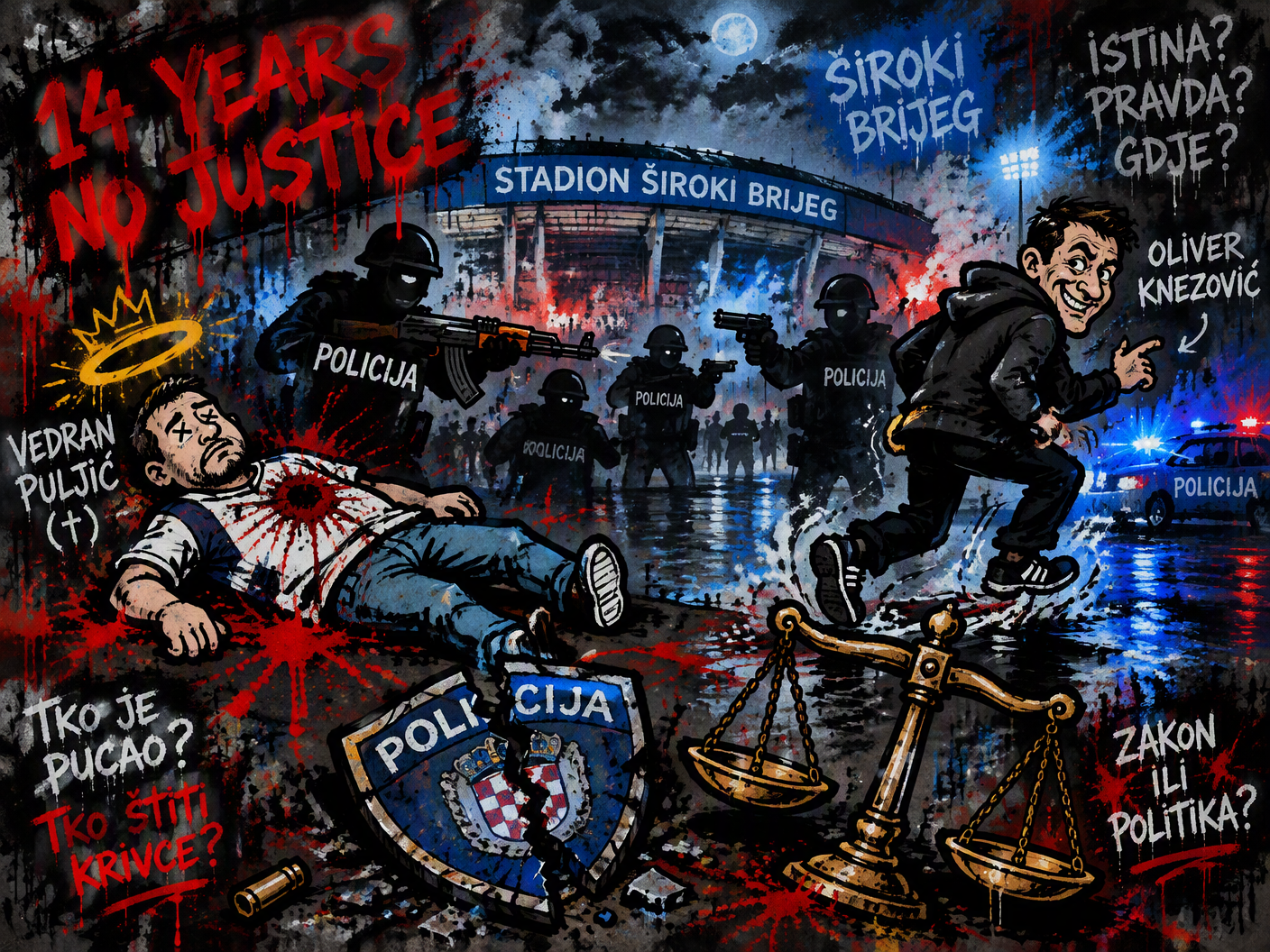
Vedran Puljić was shot during clashes before the Široki Brijeg–FK Sarajevo match on 4 October 2009. He died in the stadium area as disorder spread between Sarajevo supporters, Široki Brijeg supporters, and police. The killing transformed a football crowd into a homicide scene and placed the conduct of the police alongside the question of who fired the fatal round. The match became secondary. Puljić’s death became the fixed point around which arrests, conflicting weapon accounts, a custody escape, and fourteen years of criminal litigation would turn.
The identity of the shooter did not settle with the death. An autopsy attributed the fatal bullet to a police pistol, while another account placed an AK-47 in Knezović’s hands during the violence. Those two descriptions assigned the weapon to different actors and carried different implications for the investigation. One pointed toward police gunfire; the other toward the man who would become the central suspect. The disagreement entered the case at its most consequential point: the moment investigators tried to connect a recovered weapon, a projectile, and a dead supporter.
By about 5 October, police in Široki Brijeg had arrested Oliver Knezović in connection with Puljić’s killing. He was not initially processed through the narrower charge that later defined the Croatian proceedings. The first suspicion was direct: that Knezović had killed Puljić. His arrest gave investigators a named suspect and gave the authorities physical control of the person whose alleged role had to be tested against the scene, the weapons, and the competing accounts of the riot.
That control lasted only a few hours. Knezović escaped from police or judicial custody, converting the shooting investigation into an inquiry into the conduct of the officers assigned to hold him. The escape created a second institutional question with its own chain of responsibility: who had custody, what safeguards failed, and how a suspect in a killing case was able to leave. Authorities detained eight policemen in connection with the escape. The number mattered because the failure was treated as a custodial event, not merely as the disappearance of one defendant.
The escape also changed the practical shape of the prosecution. The state had to pursue a suspect whose departure had become part of the public story while continuing to investigate a death whose ballistic account remained disputed. Knezović’s case crossed jurisdictions and eventually moved into Croatian courtrooms. The original suspicion of killing Puljić did not remain the sole legal frame. Prosecutors later amended the indictment to include general danger and attempted murder, separating the alleged violence of the riot from the more specific question of whether Knezović had caused Puljić’s death.
The Croatian proceedings produced an earlier conviction for a general-danger offense. That finding addressed conduct capable of endangering people, but it was not a murder conviction for Puljić’s death. Croatia’s High Criminal Court later reduced the sentence. The adjustment narrowed the practical consequence of the earlier judgment while leaving the central death unresolved. Knezović’s legal position therefore depended on distinctions that were easy to blur in public discussion: a conviction for creating danger was not the same as proof that he fired the fatal shot.
On 1 December 2023, Judge Zoran Ivanišević presided over the retrial at Split County Court. The court acquitted Knezović on the attempted-murder charge. The acquittal was non-final, leaving the prosecution with the possibility of further legal action and preventing the ruling from becoming the last procedural word. It also ended that stage of the case without a Croatian murder conviction. The defendant who had once been arrested in relation to Puljić’s killing left the retrial with the most serious charge before the court defeated.
The Split case had never supplied a single uncontested answer to the weapon question. The autopsy’s attribution to a police pistol stood against accounts that Knezović had been shooting an AK-47. Those accounts did not merely differ over background details. They placed responsibility on opposite sides of the riot and altered the meaning of every later procedural step: the arrest, the indictment, the general-danger conviction, and the attempted-murder retrial.
The institutions involved did produce decisions, but the decisions answered different questions. Police arrested Knezović after the killing. Authorities detained eight officers after his escape. Prosecutors amended the charges. A Croatian court convicted him of a general-danger offense, and the High Criminal Court reduced the sentence. Then the Split retrial ended in a non-final acquittal on attempted murder. None of those steps converted the disputed weapon accounts into a final judicial finding that Knezović killed Puljić.
Puljić’s death remains the established beginning of the case; Knezović’s arrest, escape, changing charges, and Split acquittal define its legal afterlife. The fourteen-year interval did not produce a murder conviction in the Croatian proceedings. It produced a custody scandal, a reduced sentence for general danger, and a ruling that remained open to appeal. The fatal bullet retained its disputed provenance. What the courts finally resolved was Knezović’s liability under particular charges—not the full question that began in the streets outside the Široki Brijeg stadium.
Investigative Dossier & Evidence
Read the companion investigation notes, verified source claims, and primary documents.
Read the Companion Notes & Evidence Record →