
Scandals & Feuds · 1990s
The Private Fines Behind Australian Cricket’s Bookmaker Affair
Mark Waugh and Shane Warne admitted taking money or gifts from an Indian bookmaker for pitch and weather information during the 1994–95 season. The Australian Cricket Board fined them privately, then disclosed the matter after journalist Malcolm Conn said he intended to publish, prompting a broader inquiry that criticized the original discipline without finding that either player fixed a match.
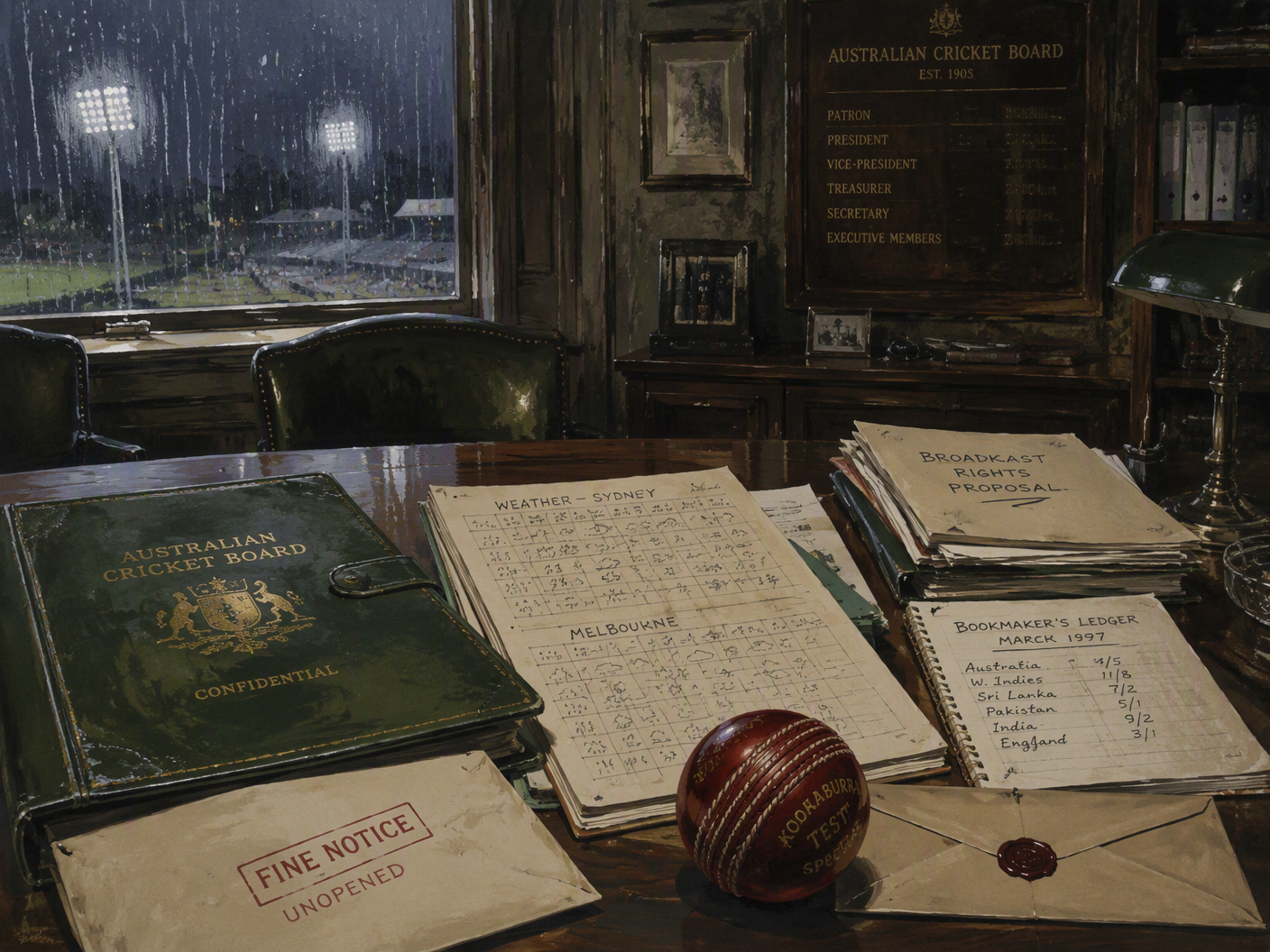
On 8 December 1998, the Australian Cricket Board learned that journalist Malcolm Conn was about to publish a story the board had kept from the public for nearly four years. The subject was a private disciplinary decision involving two of Australia’s leading cricketers, Mark Waugh and Shane Warne. The board issued its own statement before Conn’s report appeared, acknowledging that both players had admitted dealings with an Indian bookmaker during the 1994–95 season and had been fined in February 1995. Disclosure turned an internal penalty into a public examination of the board’s judgment.
The conduct at issue was narrower than the mythology that grew around it. The sources describe Waugh and Warne receiving money or gifts in exchange for pitch and weather information. Waugh received a payment; Warne received a gift and later supplied information about playing conditions. Those details established contact with a bookmaker and a breach of the board’s expectations about players’ dealings with gambling interests. They did not establish that either man supplied team tactics, selection information, deliberately bowled badly, or altered the result of a match.
The admissions came on 20 February 1995, when the players acknowledged their involvement to Australian cricket authorities. The response was financial and private: Waugh was fined A$10,000 and Warne A$8,000. The Australian Cricket Board did not announce the penalties at the time. Several senior figures, including captain Mark Taylor, vice-captain Ian Healy, and Steve Waugh, knew about the issue, but the wider cricket public did not know that the players had accepted benefits from a bookmaker.
The sources describe the information exchanged as involving conditions surrounding play, including the pitch and weather. They also describe the board’s response: fines imposed privately in February 1995 rather than penalties announced at the time. The record supports those facts without establishing that the bookmaker relationship produced a match-fixing arrangement or that the board’s process caused a broader failure in cricket governance.
The board’s public position changed only when publication was imminent. According to the account of the disclosure, Conn notified the ACB on 8 December 1998 that he intended to publish the story. The board then pre-empted the report with its own admission. The sequence made control of information part of the episode: the fines had been imposed years earlier, while the public learned of them only after an outside journalist notified the board that he intended to publish the matter.
A few days after the disclosure, Waugh was widely jeered by an Australian crowd when he came out to bat. Warne was injured and did not play in that match. The record also describes press and public condemnation and statements from public figures before the jeering, making the crowd reaction an early visible response rather than the first public one.
The ACB then established the Player Conduct Inquiry under Rob O’Regan QC. Its mandate reached beyond the two Australians. The inquiry examined gambling, match-fixing, bribery-related matters, and contact between players and gambling interests across Australian cricket. Its remit therefore covered a wider set of incidents and conduct than the Waugh-Warne bookmaker matter alone.
O’Regan criticized the penalties imposed in 1995. His conclusion was not that the two players had fixed a match; it was that the original response was inadequate to the seriousness of their offences. He recommended a review of disciplinary procedures and consideration of suspensions, including life suspensions for serious match-fixing or bribery offences. Those recommendations addressed future disciplinary practice and did not impose a later suspension on either player.
The inquiry also drew a boundary around the Australian case. O’Regan ruled out further charges against Waugh and Warne for the offences they had committed four years earlier. The ruling did not erase his criticism of the private fines, and it did not convert the bookmaker relationship into a match-fixing finding. The record left a narrower judgment: the players had crossed a disciplinary line, and the board had responded behind closed doors.
The Australian disclosures also became connected to allegations involving Saleem Malik, the former Pakistan captain. On 8 January 1999, Waugh and Warne gave evidence to a Pakistani Judicial Commission hearing in Melbourne. Warne testified that Malik had offered him money to bowl badly. That allegation entered the public record as testimony by a player, not as an adjudicated fact established against Malik. The Australian inquiries and the Pakistani proceedings therefore intersected without producing a single finding that Waugh or Warne had manipulated a match.
Companion notes
What the 1999 Cricket Inquiries Established
The documentary record separates three issues often collapsed into one: bookmaker contact by Waugh and Warne, the ACB’s confidential discipline, and the allegation involving Saleem Malik. Each carries a different evidentiary and procedural status.
The bookmaker contact
The detailed chronology comes from the reference account of the John the bookmaker controversy, while the BBC’s chronology independently confirms the February 1995 fines and the December 1998 public admission. Together, those sources describe Waugh receiving money and Warne receiving a gift in return for pitch and weather information during the 1994–95 season. The material does not establish the supply of tactics or selection information, deliberate underperformance, or manipulation of a result. [S1], [S3]
That boundary is substantive rather than semantic. Information about playing conditions can create a prohibited relationship with a bookmaker even when no match result is shown to have changed. The disciplinary record described by the sources therefore supports a finding about contact, benefits, and information—not the stronger conclusion that either player fixed a match. [S1], [S2]
The private discipline
The reference chronology records that both players admitted their involvement on 20 February 1995 and that the ACB imposed fines of A$10,000 on Waugh and A$8,000 on Warne. The BBC chronology independently confirms that the board fined them in February 1995. The contemporaneous handling described in these sources was private, which explains why the public learned of the conduct only in December 1998. [S1], [S3]
The public disclosure was triggered by journalism rather than by a scheduled board announcement. The reference account says Malcolm Conn told the ACB on 8 December 1998 that he would publish, after which the board issued a pre-emptive statement. That sequence documents institutional control over disclosure, but it does not by itself prove the board’s motive beyond the decision to keep the penalties private. [S1]
The O’Regan inquiry
The published findings of the O’Regan Player Conduct Inquiry are the strongest source for the inquiry’s scope and conclusions. The ACB established the inquiry to examine gambling, match-fixing, bribery-related matters, and contact with gambling interests across Australian cricket. Its remit was broader than the conduct of Waugh and Warne, and its conclusions must not be reduced to a judgment about two players alone. [S2]
O’Regan criticized the 1995 penalties and recommended reviewing disciplinary procedures, including consideration of suspensions and life suspensions for serious match-fixing or bribery offences. He also ruled out further charges against Waugh and Warne for their earlier offences. That combination establishes criticism of the board’s response without establishing a later suspension or a finding that the Australians fixed a match. [S2], [S1]
The Malik allegation and evidentiary limits
The reference account reports that Waugh and Warne testified before a Pakistani Judicial Commission hearing in Melbourne on 8 January 1999. Warne said Saleem Malik had offered him money to bowl badly; the BBC chronology independently confirms the January evidence and allegation. In the public record, the claim remains testimony attributed to Warne. The sources do not provide an adjudicated finding establishing that Malik made the offer. [S1], [S3]
The players’ denials of deliberately underperforming or fixing matches must be read alongside, not substituted for, the inquiry findings. A denial is not exoneration, but neither is a bookmaker relationship proof of result manipulation. The record supports a disciplined conclusion: Waugh and Warne admitted prohibited contact involving conditions information, the ACB handled it privately, O’Regan criticized that response and ruled out further charges, and the Malik allegation was reported as testimony rather than established fact. [S1], [S2], [S3]
Source key
The associated evidence packet contains visible source URLs, source roles and the complete claim ledger.