
Scandals & Feuds · 2000s
The Christchurch Hotel Allegation and Matthew Johns’s 2009 Broadcast Fallout
A 19-year-old woman complained to Christchurch Police after alleging group sex with Cronulla players during the club’s 2002 pre-season trip. Seven years later, the police position that no criminal charges were supported collided with a revived public controversy, ending Johns’s broadcasting role and Melbourne Storm coaching position.
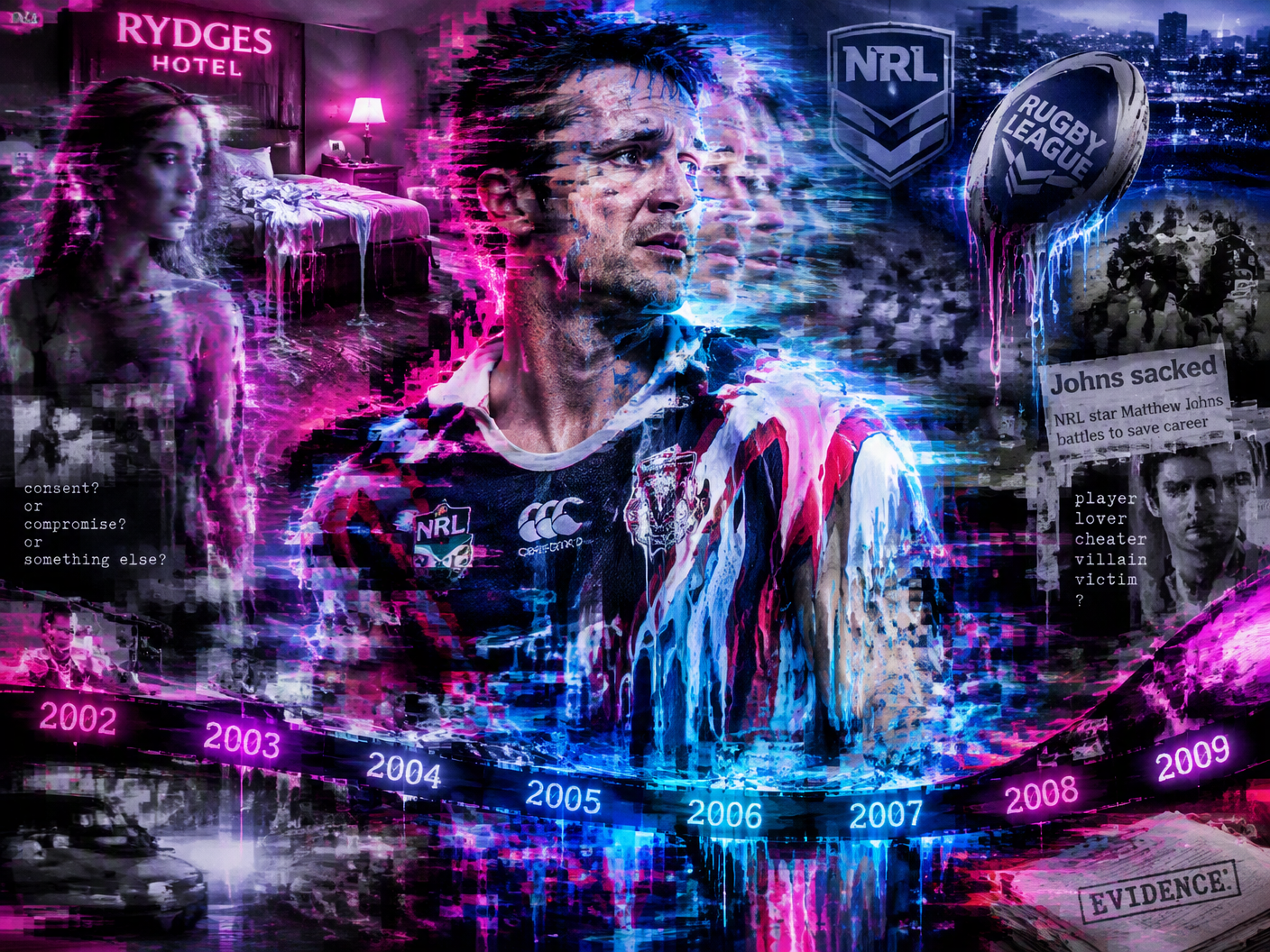
In February 2002, a 19-year-old woman went to police in Christchurch after alleging that she had group sex with several Cronulla Sharks players in a hotel room. Matthew Johns was playing for Cronulla during the club’s pre-season trip to New Zealand. The complaint placed a private encounter inside the public economy of professional sport, where a touring team carried its own hierarchy, its own wages, and the protection that followed recognizable names. Christchurch Police opened an inquiry involving the players and the wider Sharks party. The woman’s account became a police matter before it became a national sports story.
The investigation reached beyond the men alleged to have been in the room. Christchurch Police interviewed Cronulla players, staff, and management—about 40 people connected with the touring group—as they examined the complaint. That scale mattered because the question was not only what happened between individuals but how a professional club behaved while traveling together. A rugby league squad was also a workplace, with coaches, administrators, senior players, and younger employees sharing accommodation, transport, meals, and authority. The inquiry entered that closed working environment through the woman’s complaint and tested what the club’s people knew.
The police inquiry did not become a criminal prosecution. In later statements, Christchurch Police said no evidence had been established that would support charges against any person. They also said the complainant had been fully advised of the outcome and accepted it. That conclusion gave the matter a formal legal endpoint, but not the kind of public narrative that sport usually prefers: there was no indictment, trial, or verdict to organize the memory of the event. The allegation remained attached to an investigation that had occurred, and to a woman whose complaint had set it in motion.
For seven years, the incident stayed outside the center of Australian rugby league’s public conversation. Johns continued to exist in two professional worlds: first as a former player whose career had placed him inside the Christchurch trip, and later as a media personality whose work depended on familiarity, access, and public trust. The same sport that had made him valuable as a commentator also gave the old allegation a larger audience when it returned. His status did not erase the police inquiry; it determined how widely the consequences could travel once the story was broadcast.
On 11 May 2009, the ABC program Four Corners broadcast a report about the Christchurch incident and broader allegations concerning player behavior. The program moved the matter from a closed police file and scattered recollections into national television, where rugby league’s employment arrangements and public image became inseparable. David Gallop, the National Rugby League’s chief executive, apologized for the behavior shown and said it was unacceptable. His response treated the episode as a question of professional standards, not merely an old private dispute resurfacing around a prominent former player.
Johns publicly said that the sex had been consensual. That statement established his account of the encounter and became the central answer offered by the man most visibly connected to it. It did not produce a new police proceeding. The controversy instead divided into two tracks: the original allegation, which had already been investigated, and the institutional judgment being made in 2009 about what a broadcaster, a club, and a national sport could accept from one of its public representatives. The distinction shaped the week that followed without dissolving the human dispute at its center.
Christchurch Police then intervened in the renewed public argument. In statements issued in New Zealand and Australia between 12 and 14 May, police said they would not reopen the investigation because no new information had emerged. They repeated that the earlier inquiry had found no evidence supporting criminal charges. The announcement closed off one possible path for the revived story: the 2002 complaint would not be converted into a fresh criminal case by the attention generated in 2009. Police had investigated it, communicated the outcome to the complainant, and declined to begin again.
The employment consequences moved faster than the legal process because they belonged to different institutions. David Gyngell, the Nine Network’s chief executive, announced that Johns had been stood down or suspended from his role as a rugby league commentator and co-host, and publicly apologized to the woman. Nine was not deciding whether a criminal offense had occurred; it was deciding whether Johns could remain a trusted television employee while the controversy occupied its broadcasts and public standing. The network’s decision transferred the immediate cost of the renewed dispute onto Johns’s career, even as the police position remained unchanged.
Johns also quit his assistant coaching position at the Melbourne Storm. The separation showed how one person’s professional value could be distributed across several institutions and then withdrawn by each of them in sequence. Nine controlled his television platform. Melbourne Storm controlled his coaching employment. The NRL controlled the sport’s public response. None of those bodies could alter what Christchurch Police had concluded in 2002, but each could decide what Johns’s continued presence meant for its own workplace, audience, sponsors, and credibility.
The woman who complained in Christchurch was not the person who controlled the later conversation. In 2002, her report brought police into a hotel-room allegation involving a touring professional club. In 2009, television executives, league officials, police spokespeople, and a former player determined the public shape of the aftermath. Gallop apologized for conduct displayed by players; Gyngell apologized to the woman while removing Johns from Nine; Johns maintained that the sex was consensual; police said the case would not be reopened. The institutions could assign consequences, but none could return the matter to the privacy it had before the complaint.
By mid-May 2009, the Christchurch hotel room had produced two different kinds of official consequence. Police had investigated the allegation and found no evidentiary basis for criminal charges. Broadcasting and rugby league authorities, confronted with the story’s return, imposed professional penalties and public apologies. Johns lost his Nine role and left Melbourne Storm’s coaching staff. The complainant’s 2002 report remained the event from which both paths began: one ending in a police decision, the other in a career separation seven years later. What she carried into that first interview was a complaint; what the institutions carried away was a question of who could still be employed, trusted, and heard.
Investigative Dossier & Evidence
Read the companion investigation notes, verified source claims, and primary documents.
Read the Companion Notes & Evidence Record →