
Tragedy · 1994
Ayrton Senna at Tamburello: The Imola Weekend That Ended on Lap Seven
Ayrton Senna was killed at Imola on May 1, 1994, when his Williams left the racing line at Tamburello and struck a concrete wall during the San Marino Grand Prix. His death followed a qualifying fatality, a serious qualifying accident, and a morning conversation about restoring the drivers’ safety association.
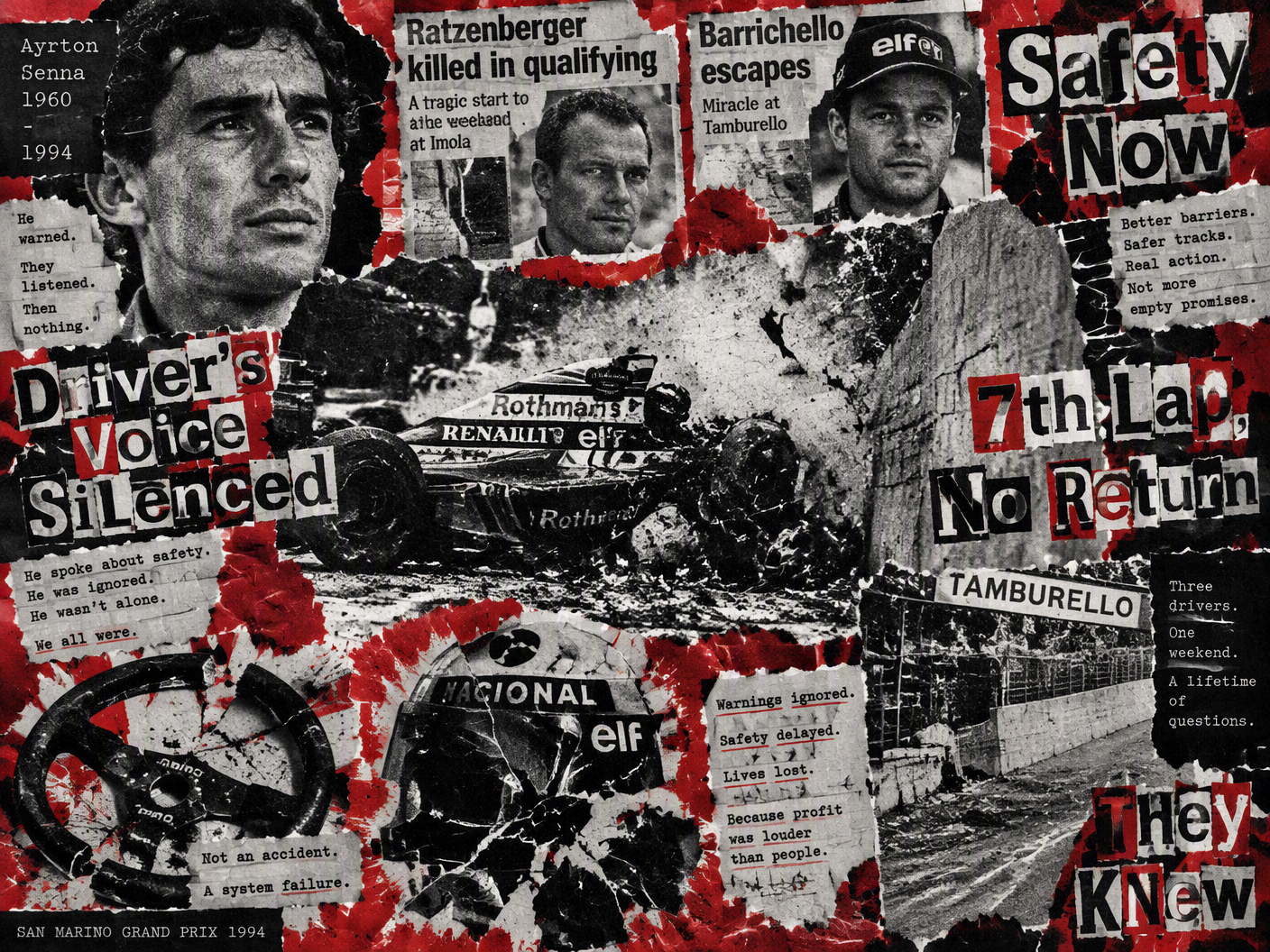
On May 1, 1994, during the San Marino Grand Prix at Imola, Ayrton Senna’s Williams left the racing line at Tamburello and crossed the short distance to the concrete wall. The car departed at approximately 307 kilometers per hour. It reached the wall at about 233. Senna was killed in the crash. The decisive moment came on the seventh lap, before the race had completed even a small portion of its distance, and it transformed a Formula One event already marked by injury and death into a weekend defined by the loss of its leading driver.
The danger had become visible before the race began. During qualifying at the same San Marino Grand Prix weekend, Roland Ratzenberger died. Rubens Barrichello also suffered a qualifying accident and withdrew from the event. These were not distant incidents separated by a season or a different circuit. They occupied the same weekend at Imola, placing the drivers inside an unfolding sequence in which the ordinary progression from practice to qualifying to race was repeatedly interrupted by consequences that could not be reversed.
Senna arrived at Imola as Williams’s driver and the holder of pole position, the place at the front of the starting grid. The position carried its usual competitive meaning, but the weekend around it had altered the terms of attention. Ratzenberger’s death had occurred in qualifying. Barrichello’s accident had removed another driver from the race. By Sunday morning, the risks were not an abstract part of the profession; they were part of the immediate setting in which the remaining drivers prepared to compete.
That morning, Senna spoke with Alain Prost about re-establishing the Grand Prix Drivers’ Association. Prost had been Senna’s former rival and fellow driver, and the conversation placed safety within the responsibilities of the competitors themselves. The association had existed as a means for drivers to address common concerns, and Senna was prepared to take a leadership role beginning at the next race, the Monaco Grand Prix. The plan belonged to the future still visible to them that morning.
The race then proceeded at Imola. Senna started from pole, and on lap seven his car approached Tamburello at a speed recorded in the contemporary account at roughly 307 kilometers per hour. The Williams left the racing line. The account places the impact against the concrete wall at approximately 233 kilometers per hour. Those figures give the incident its physical scale without supplying a larger explanation: they show the short sequence from departure to impact, the speed that remained when the car reached the barrier, and the violence of the event that followed.
Senna did not survive the crash. His death came two days after Ratzenberger’s fatal qualifying accident and within the same weekend as Barrichello’s qualifying crash and withdrawal. The sequence mattered to those present because each incident changed the conditions under which the next session took place. By race day, Imola was no longer only a circuit on the championship calendar. It was the place where the risks of Formula One had accumulated in public, first during qualifying and then at the race’s most consequential corner.
The conversation with Prost now stands beside the crash as part of the weekend’s human context. Senna had discussed restoring a collective voice for the drivers and had offered to lead it from Monaco onward. The proposal was practical rather than ceremonial: a way for competitors to address the conditions under which they drove. Senna’s death ended the immediate possibility of his taking that role. The association discussion, begun before the race, became inseparable from the events that made the question of safety impossible to postpone.
Imola has often been reduced to a single image: a famous driver, a fast corner, and a concrete wall. The fuller sequence is less simple and more exact. A driver had secured pole. Another had died in qualifying. A third had crashed and withdrawn. On the morning of the race, Senna and Prost had discussed rebuilding an organization through which drivers could act together. Then, on the seventh lap, Senna’s Williams left the line at Tamburello and struck the barrier.
The immediate racing context therefore contains two parallel movements. The first was competitive: Senna began from the front and entered the race as Williams’s driver. The second was institutional: the drivers were considering how to speak collectively about safety after a qualifying session that had already taken Ratzenberger’s life and removed Barrichello from the weekend. The crash joined those movements. It ended Senna’s race and his life, while leaving the proposed Monaco leadership as an unfinished commitment.
The next race was supposed to be Monaco, where Senna intended to begin leading the re-established Grand Prix Drivers’ Association. He never arrived to assume that role. Instead, the association conversation remains attached to the final morning at Imola, and Tamburello remains attached to the seventh lap of the San Marino Grand Prix. The enduring account is not only of a car reaching a wall at high speed, but of a safety discussion that had begun before the race and outlived the driver who was prepared to carry it forward.
Investigative Dossier & Evidence
Read the companion investigation notes, verified source claims, and primary documents.
Read the Companion Notes & Evidence Record →