
Scandals & Feuds · 1950s
Ferenc Deák’s Forced Transfer from Ferencváros to Újpest
Ferenc Deák’s 1950 move from Ferencváros to Újpesti Dózsa placed one of Hungary’s most prolific scorers inside a politically charged club rivalry. The transfer story survives through the account of a pub incident, a banned anthem, and an ÁVH officer, followed months later by Deák’s winning goal against his former club.
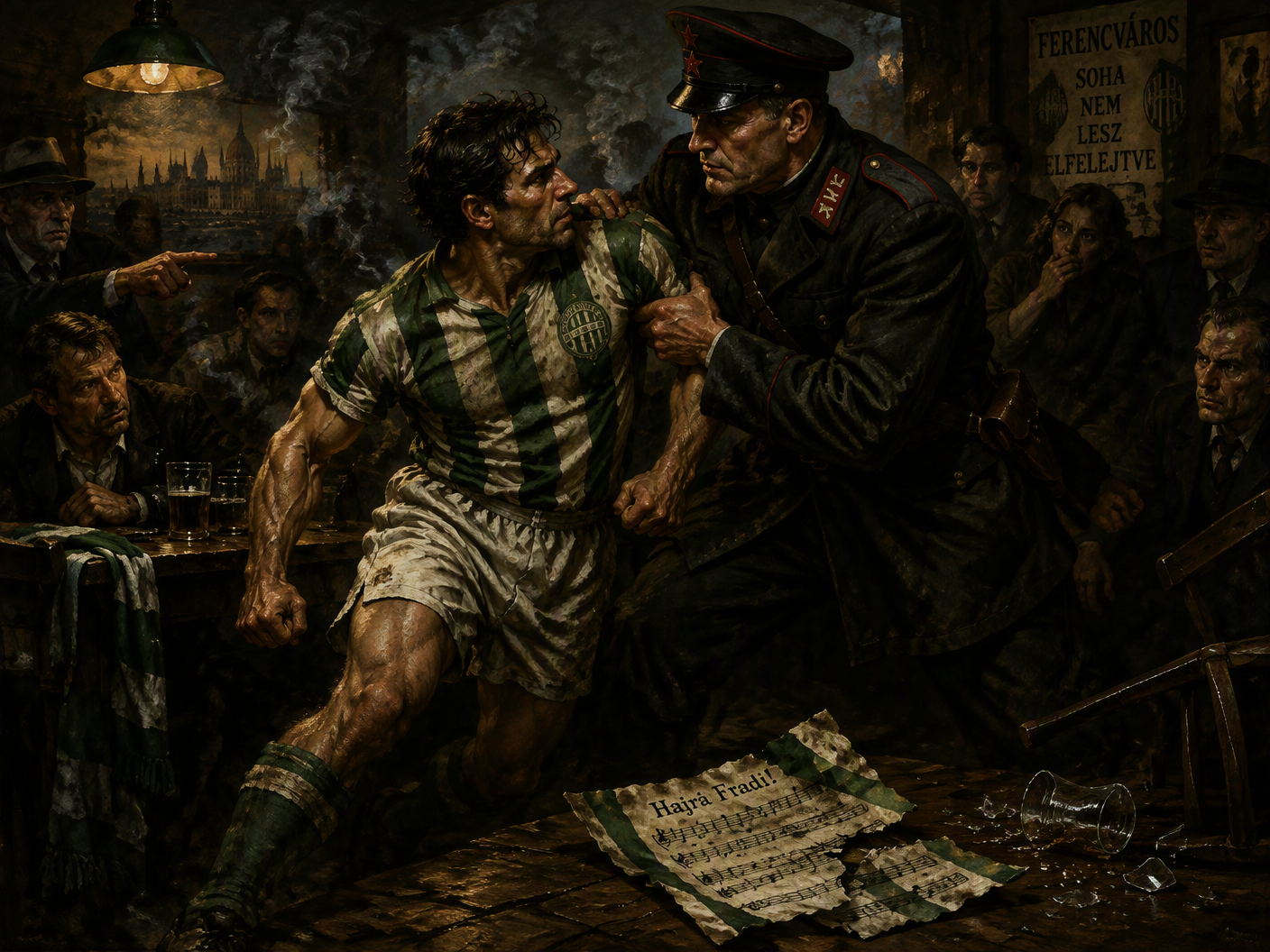
In the summer of 1950, Ferenc Deák changed clubs under pressure. The Hungarian striker left Ferencvárosi TC and signed for Újpesti Dózsa, the club across one of Budapest football’s oldest rivalries. The episode was tied to a pub, an anthem that authorities had banned, and a physical confrontation involving an officer of the ÁVH, Hungary’s state security service. Deák’s transfer was not remembered as an ordinary movement between employers. It became a story about how political authority could reach into a footballer’s career and turn a club allegiance into a liability.
The player at the center of that dispute was not an obscure reserve or a fading veteran. Ferenc Deák was a Hungarian footballer whose value had already been measured in goals. In the 1948–49 season, he played for Ferencvárosi TC and established himself among Hungary’s leading scorers. The club’s name attached to him was part of his sporting identity: Ferencváros was not simply the employer from which he would depart, but the side against which Újpest would later place him in the most personal fixture available to Budapest football.
The numbers from that season explain why the transfer carried such weight. Deák was credited with 83 goals in official matches during 1948–49. A separate Hungarian scoring table placed him first in the country that season, with 59 goals for Ferencvárosi TC. Those totals belonged to the period before his name became fixed to the Újpest episode. They show the scale of the footballer being moved: a striker at the height of his production, already associated with a club whose colors and history had made him a visible figure in the capital.
The circumstances that brought the transfer remain bound to the incident in the pub. An anthem associated with Ferencváros had been banned, and Deák became involved in an encounter with an ÁVH officer after it was played or invoked. The officer and the footballer were said to have exchanged blows. From that confrontation came the consequence that shaped the rest of Deák’s 1950: he was forced to sign for Újpesti Dózsa. The movement was therefore described not as a sporting choice but as the result of pressure applied through the political order surrounding the clubs.
In Hungary after the war, football clubs existed within institutions larger than the match itself. Their names, affiliations, and public identities could carry political meaning, while state organizations stood close to the administration of public life. The ÁVH officer in Deák’s story represented that authority in its most immediate form—not a referee, selector, or opposing defender, but a security official whose presence changed the consequences of a private confrontation. Deák’s goals had made him valuable to Ferencváros. The same prominence made the direction of his next contract impossible to treat as a private matter.
By the time the transfer was complete, Deák’s old and new clubs had been joined by an arrangement with an obvious sporting consequence. Újpesti Dózsa acquired a proven scorer; Ferencváros lost the forward who had led its attack during the 1948–49 season. The change also prepared a meeting in which Deák would face the team that had made him prominent. Nothing about that fixture required a long explanation for those who followed Budapest football. The striker’s club had changed, but the opponent waiting for him was the club from which the change had begun.
That meeting came in December 1950, when Deák made his first derby appearance for Újpest against Ferencváros. The match ended 1–0 for Újpesti Dózsa. Deák scored the only goal. The sequence gave the transfer a public conclusion that no administrative announcement could have supplied: the player moved under pressure, returned to face his former club, and decided the derby for the side that had received him. His first goal against Ferencváros in Újpest colors became the part of the story that could be carried in a scoreline.
The goal also altered the meaning of the move without resolving its cause. On the field, Deák performed the function for which Újpesti Dózsa had taken him—a decisive scorer in the most closely watched contest between the two clubs. Away from the field, the circumstances remained attached to the pub incident and the ÁVH officer. The sporting fact was clean: Újpest won by one goal, and Deák scored it. The political story was heavier, built from the connection between a banned anthem, a confrontation, and the forced signing that followed.
Later measures of Deák’s career widened the distance between the footballer’s achievement and the narrowness of the transfer file. Statistical compilations place him among the leading official-match scorers of all time, with more than 795 goals. That total does not explain why he left Ferencváros in 1950. It does explain why the transfer could not be reduced to an administrative footnote. A player who had produced 83 official goals in one season, including 59 for Ferencvárosi TC in Hungary’s scoring tables, carried his club identity into every subsequent meeting.
The common retelling has therefore preserved two different kinds of certainty. Deák’s identity, his extraordinary scoring record, his move from Ferencváros to Újpesti Dózsa, and his one-goal derby victory in December 1950 form the durable outline. Around that outline sits the account of state pressure: the pub, the banned anthem, and the ÁVH officer. The transfer endured in Hungarian football memory because those elements placed an individual footballer between the loyalties of a club and the authority of a state.
Investigative Dossier & Evidence
Read the companion investigation notes, verified source claims, and primary documents.
Read the Companion Notes & Evidence Record →