
Tragedy · 2025
The Steelers Careers That Put CTE Into the Public Record
Mike Webster, Justin Strzelczyk, and Terry Long played for Pittsburgh in different eras and died in different circumstances. Their postmortem findings helped move chronic traumatic encephalopathy from an obscure diagnosis attached to individual brains into medical research, public debate, and a question the NFL could no longer contain.
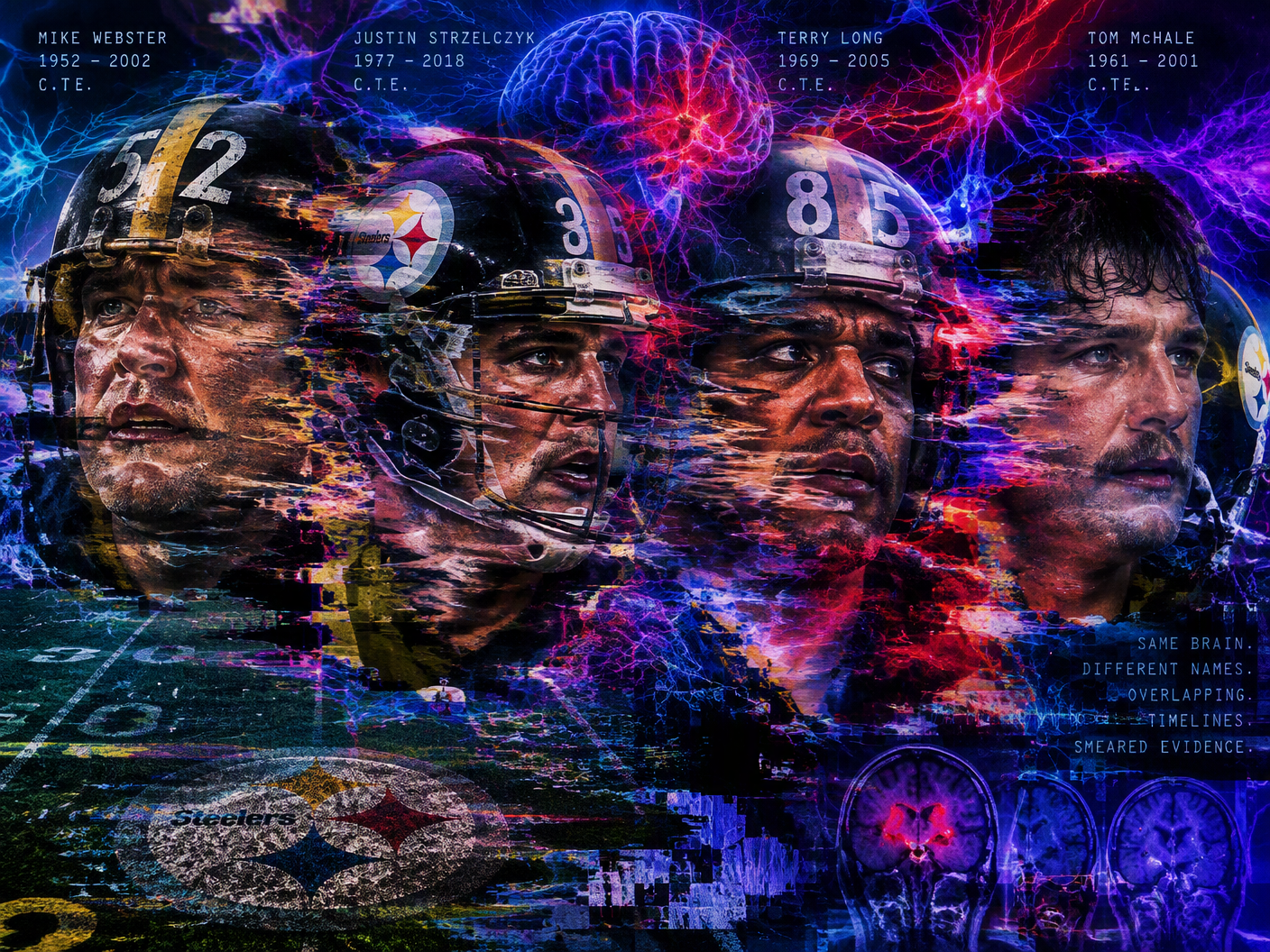
The first case was not a league announcement or a safety campaign. It was a body on an autopsy table. Mike Webster died in 2002 at age 50, after a sixteen-year NFL career with the Pittsburgh Steelers and Kansas City Chiefs that ran from 1974 through 1990. An autopsy found chronic traumatic encephalopathy in his brain. The finding connected the former center to a disease then largely absent from the public language of professional football, and it shifted the argument from whether collisions looked dangerous to what years of those collisions might leave behind.
Webster’s case made the question physical and specific. The diagnosis did not explain every part of his life, nor did it establish a universal cause of death. It established something narrower: tissue examined after his death contained the neuropathological findings identified as CTE. That distinction would matter as other former Steelers reached the postmortem record through different paths, with different official descriptions of how they died and different formulations of what examination found.
Justin Strzelczyk joined Pittsburgh in 1990 and played nine full NFL seasons through 1998. As an offensive tackle, he worked in the repetitive collision zone where blocking requires bodies to absorb and redirect force play after play. On September 30, 2004, Strzelczyk died in a car crash in Herkimer, New York. A postmortem autopsy found brain damage. That finding was not identical to Webster’s CTE diagnosis, and the crash was not Webster’s death. The two cases nevertheless enlarged the problem confronting physicians and the people who had built careers around the sport.
Terry Long’s career overlapped with Webster’s and preceded Strzelczyk’s arrival. Long played for the Steelers from 1984 to 1991. On June 7, 2005, he died after consuming antifreeze; the death was ruled a suicide. Forensic pathologist Bennet Omalu performed an autopsy that found chronic traumatic encephalopathy in Long’s brain. The manner of death and the brain finding were separate facts. One described the final act recorded by authorities. The other described pathology discovered only after Long could no longer report what had happened to him.
The sequence gave the diagnosis a route out of the morgue. Webster died in 2002; Strzelczyk died in the 2004 crash; Long died in 2005. Their careers had ended at different points, and their deaths carried different official descriptions. What accumulated was not a single case with a single explanation but a series of postmortem observations. The common element was the brain examination after death, which converted private loss into a medical question that could be published, challenged, and extended.
In July 2005, the work associated with Omalu, Steven T. DeKosky, and the Webster case appeared in a neurosurgery journal. A diagnosis made in an autopsy could now enter formal medical literature, where its methods and implications were available to specialists beyond Pittsburgh. Long’s examination added another former Steelers player to that developing record. The significance was institutional as much as medical: a condition once encountered in an individual brain acquired a published vocabulary and a trail other researchers could follow.
The subject then moved into public broadcasting. On October 8, 2013, PBS and FRONTLINE aired League of Denial, bringing traumatic brain injury and CTE in the NFL to a mass audience through former players, medical researchers, and the history of the league’s response. The program did not change Webster’s death, Long’s suicide ruling, or Strzelczyk’s crash. It changed the setting in which those facts were discussed. Brain trauma was no longer confined to specialists and families; it had become part of the public history of professional football.
A decade later, the research infrastructure was operating at a different scale. In 2023, the Boston University CTE Center reported diagnosing CTE in 345 of 376 former NFL players studied. The figure placed hundreds of examined brains behind a question that had once centered on Webster and a small number of cases. It also required precision. The studied group was not a random sample of every person who had played in the NFL, so the number describes those examined brains rather than the prevalence of CTE across the entire former-player population.
The larger study did not erase the distinctions among the three Steelers. Webster’s brain was found to contain CTE after a career that stretched from 1974 to 1990. Long’s brain was found to contain CTE after his 2005 death by suicide. Strzelczyk’s postmortem examination found brain damage after the 2004 crash. These findings support different propositions. They do not prove that football definitively caused each man’s death, and they do not turn three lives into one medical narrative. Their force lies in what each examination documented and in the pattern that emerged when the cases were considered together.
Career length provides context, not a medical equation. Webster spent sixteen NFL seasons with two clubs. Strzelczyk completed nine full seasons in Pittsburgh. Long played eight seasons for the Steelers. Those numbers establish the professional setting in which each man accumulated football experience, but they do not reconstruct every impact, symptom, treatment decision, or private struggle that followed. The postmortem findings cannot be converted into a precise count of collisions or a definitive explanation for every consequence of an NFL career.
By 2023, the public history of NFL brain trauma held several layers: careers recorded in team and league biographies, deaths recorded in separate circumstances, autopsies that identified CTE or brain damage, Omalu’s medical work, the 2013 broadcast, and a Boston University program examining hundreds of former players. The narrowest conclusion is also the most durable. Webster and Long had CTE identified in their brains; Strzelczyk’s autopsy found brain damage. Those facts helped build a research field and forced an institution built on repeated collision to confront what could remain after the applause ended.
Investigative Dossier & Evidence
Read the companion investigation notes, verified source claims, and primary documents.
Read the Companion Notes & Evidence Record →