
Violence & Brawls · 2020s
The Frying-Pan Assault at Michinoku Stable
In May 2023, senior wrestler Kirinofuji was reported to have assaulted young wrestler Yasunishi with a frying pan and jump rope. Stablemaster Michinoku said he had informed the Japan Sumo Association, while the association’s own anti-yakuza policy gave the episode a standard against which its response could be judged.
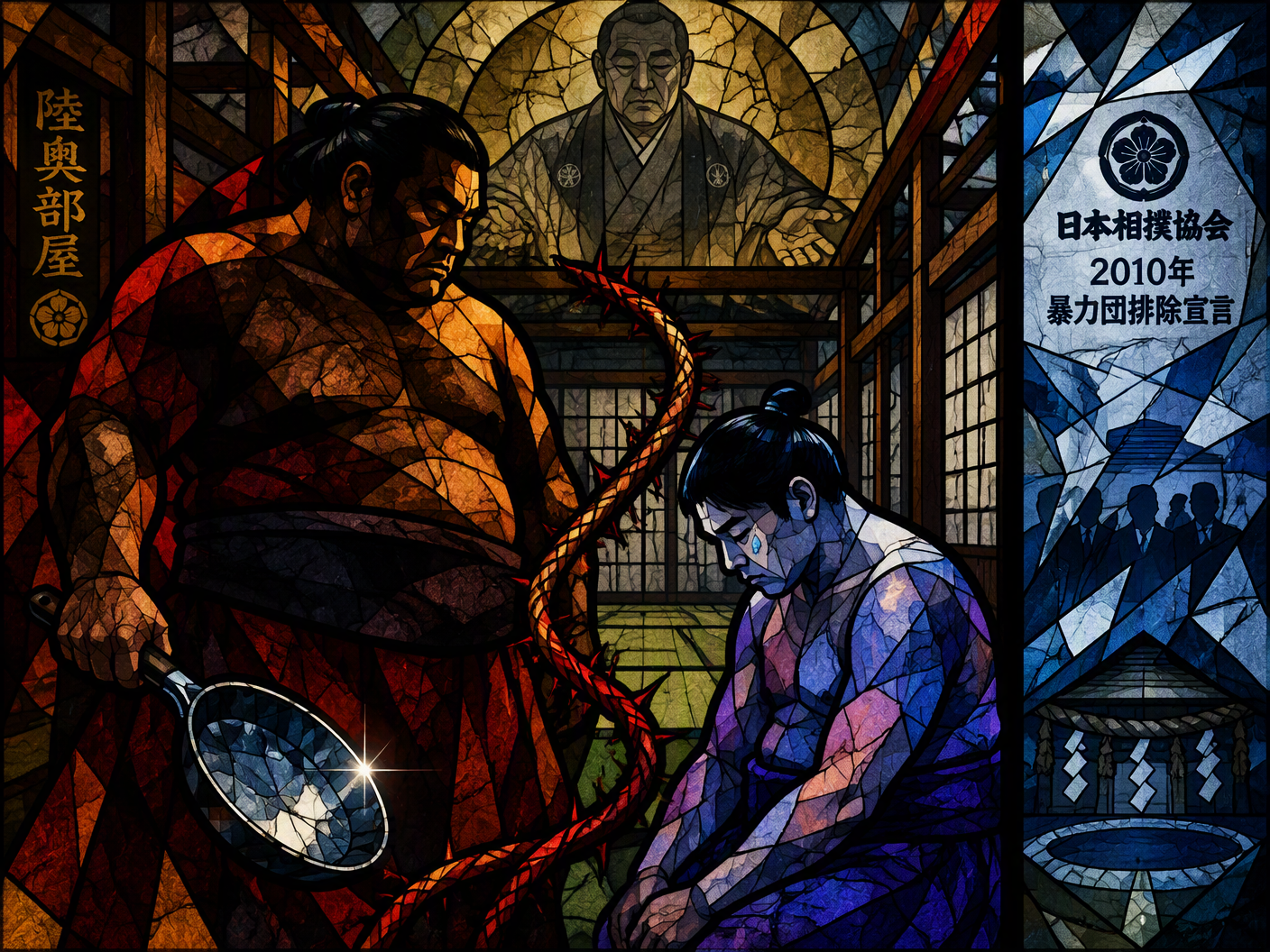
Kirinofuji used a frying pan against Yasunishi inside Michinoku stable. A jump rope was part of the assault as well. Yasunishi was the younger wrestler. Kirinofuji was the senior man. The episode placed a familiar imbalance inside the tiled world of a sumo stable, where rank follows a man from the ring to the sleeping quarters and the training floor. The account reached public view in May 2023. It carried no tournament crowd, no referee, no clean boundary between competition and private discipline. There was only an older wrestler, a younger one, and an object meant for a kitchen.
Michinoku stable was not an anonymous room in the sport. It was the place where the stablemaster held responsibility for wrestlers under his roof, including the young man who received the blows. That arrangement gives a stable its shape and its danger. A senior wrestler can command space before anyone writes down a rule. A junior wrestler can depend on the same household for food, work, housing, and a path toward the next bout. When violence enters such a room, the injured wrestler does not stand apart from the institution. He stands inside it.
The objects mattered because they stripped the incident of sporting language. A frying pan is not a training implement. A jump rope is not a belt or a practice weapon. They belonged to the stable’s ordinary life, then became instruments in a reported assault. The public account did not turn Yasunishi into a symbol or reduce Kirinofuji to a headline. It named two wrestlers and one domestic space. That was enough to move the matter from the private discipline of a stable into the public conduct of professional sumo.
On May 9, Michinoku gave his answer. He said he had informed the Japan Sumo Association about the matter. He also said he was not hiding anything. Those were the important sentences because they placed the stablemaster between the incident and the governing body. The question was no longer only what Kirinofuji had done to Yasunishi. It was also when Michinoku knew, what he passed upward, and what the association did after receiving that information.
Michinoku’s position was a denial of concealment, stated in plain terms. He did not describe a private settlement or claim that the matter belonged only to the stable. He said the association had been told. That response gave the episode two competing lines: violence inside the stable, and an assertion that the governing office had not been kept outside the door. The difference between disclosure and action would become the central pressure point. Telling an institution about misconduct is one act. Showing what the institution did next is another.
Kirinofuji then left sumo. The May 9 account reported that the assailant retired. Retirement closed his active place in the stable and removed him from the daily contests that had made his rank visible. It did not answer every question about the episode. It did establish the most concrete consequence attached to Kirinofuji in the available public account: the senior wrestler was no longer continuing as a professional sumo wrestler after the assault was reported.
The association had already written its standard years earlier. On August 30, 2010, the Japan Sumo Association issued a declaration against yakuza and other antisocial forces. The policy barred those forces from tournament venues, training stables, and related facilities. It was a statement about who could enter sumo’s physical spaces and what sort of conduct the association said it would reject. The stable was therefore not outside the association’s declared concern. Its policy reached the places where wrestlers lived and trained, not only the raised ring beneath the tournament lights.
The 2010 declaration also promised strict action against association members who violated the policy, including possible dismissal. That language gave the association a sharp public posture. It claimed the authority to remove members when conduct crossed its line. The May 2023 episode was not an anti-yakuza case, but the declaration still mattered as a measure of institutional responsibility. The association had announced that misconduct in sumo’s connected facilities could demand more than quiet handling. Its words supplied the standard against which the later response was examined.
That examination produced accusations that Michinoku and the association had covered up the incident. The accusation attached itself to the gap between the alleged assault and the public understanding of the response. Michinoku said he had reported the matter. Kirinofuji retired. But a retirement is not the same thing as a public disciplinary decision, and a statement that an association was informed does not show how its officials investigated, judged, or recorded the case. The allegation of concealment remained focused on the handling, not merely on the violence itself.
The public account turns on the sequence it records: an assault involving Kirinofuji and Yasunishi, Michinoku’s statement that he had informed the Japan Sumo Association, and the reported retirement of the assailant. Alongside those events stood the association’s 2010 promise of strict action, including possible dismissal, for members who violated its stated standards. That policy supplied institutional context, not a ruling on the 2023 episode. The known facts therefore remain tied to the stable, the stablemaster’s response, the wrestler’s retirement, and the governing body’s earlier written declaration.
The boundaries of the episode are therefore hard and narrow. The May violence allegation is established in the captured reporting: Kirinofuji was reported to have attacked Yasunishi with a frying pan and jump rope. Michinoku was reported to have said he notified the association and was hiding nothing. Kirinofuji was reported to have retired. The association’s 2010 declaration is established as well. What is not established in the supplied material is a criminal charge, a court ruling, or a formal association finding of wrongdoing in the handling.
For Yasunishi, the residue was not a policy statement. It was the fact of being the young wrestler named as the recipient of the assault inside the stable where he trained. For Kirinofuji, the residue was retirement. For Michinoku, it was the public declaration that he had told the association and concealed nothing. For the association, it was an old promise about strict action meeting a new allegation about what happened under its authority. The frying pan disappeared from the account. The unanswered question did not.
Investigative Dossier & Evidence
Read the companion investigation notes, verified source claims, and primary documents.
Read the Companion Notes & Evidence Record →