
Tragedy · 2000s
Greg Page’s 2001 Brain Injury and the $1.2 Million Kentucky Settlement
Greg Page went down after ten rounds against Dale Crowe in Erlanger, Kentucky, and never returned to ordinary life. A brain injury, coma, stroke, paralysis, and a later $1.2 million settlement kept the consequences of that fight alive for eight years.
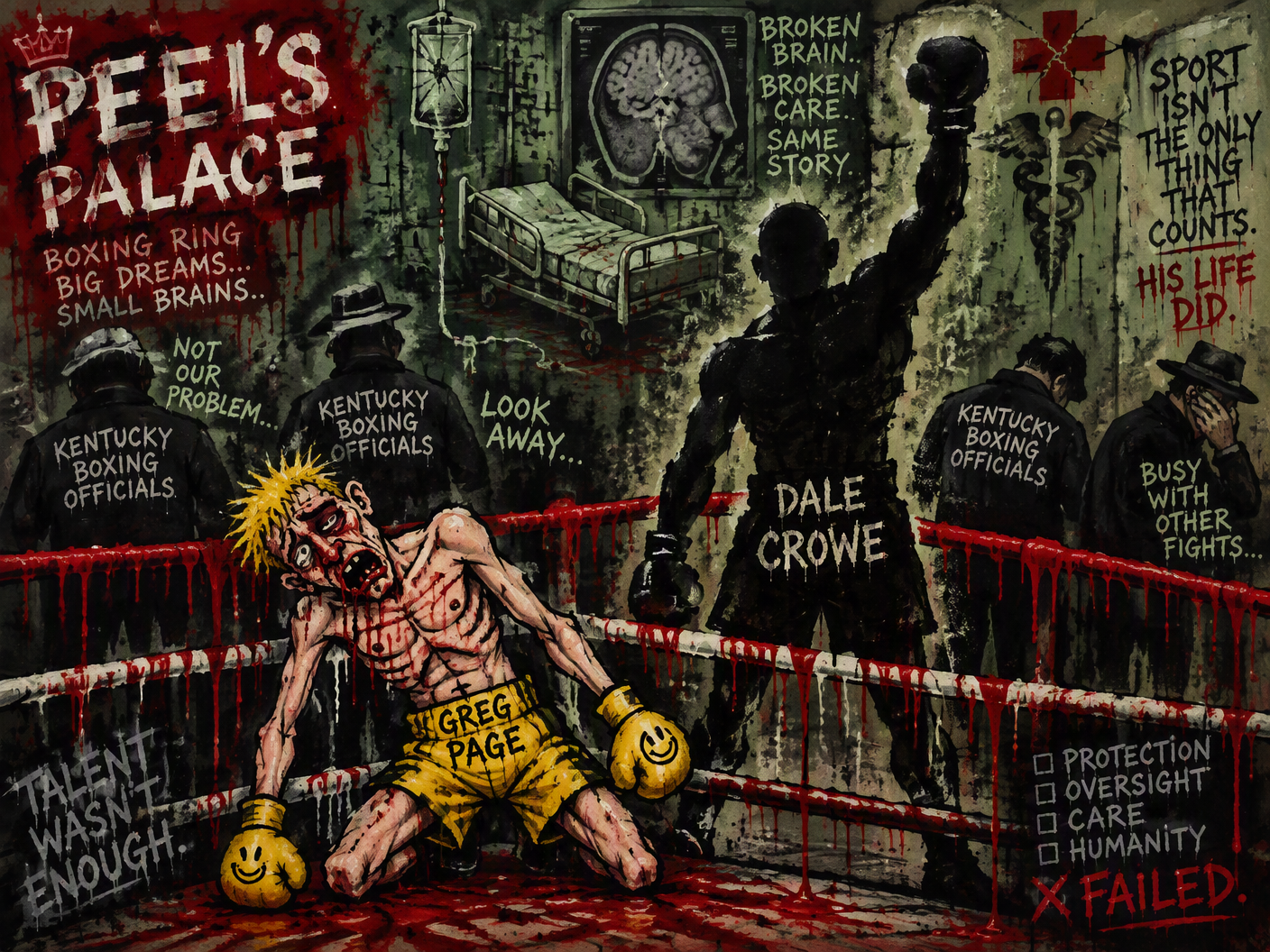
After ten rounds at Peels Palace in Erlanger, Kentucky, Greg Page went down and did not get up. The opponent was Dale Crowe. Page, a former World Boxing Association heavyweight champion, had entered the ring as a professional boxer; he left it with a brain injury that would govern the rest of his life. The bout ended on March 9, 2001. Its consequences moved from the ring to a Cincinnati hospital, then into a dispute involving Kentucky boxing officials, and finally into Page’s death eight years later.
Page was admitted to a Cincinnati hospital after the fight. The injury was not confined to the moment when his body struck the canvas. During post-fight surgery, he suffered a stroke. He remained in a coma for nearly a week, while the medical crisis that began in the arena continued under hospital care. The sequence fixed the event’s character: this was not a short recovery from a bout, but a neurological catastrophe followed by prolonged incapacitation.
When Page emerged from the coma, the damage had left a permanent physical consequence. He was paralyzed on his left side. The former champion now carried the outcome of the fight in the simplest movements of daily life, with the injury extending beyond his athletic career and into the structure of his body. The public account of the bout therefore has two separate points of impact: the fall after the tenth round and the medical sequence that followed it.
The setting mattered because boxing depends on more than the two men exchanging punches. A regulated bout requires officials, medical oversight, and a response capable of recognizing when a fighter has suffered a serious injury. Later accounts linked Page’s 2007 settlement to the lack of medical personnel at the fight. That connection placed Kentucky boxing officials inside the aftermath—not as participants in the contest, but as authorities whose responsibilities became part of the legal dispute.
Page’s injury also altered the meaning of the final bell. In a conventional account of a boxing match, the contest ends when a referee stops it, a fighter remains down, or the scheduled rounds conclude. Page’s bout ended in the ring, but the medical event continued through surgery, stroke, coma, and paralysis. The boundary between sporting contest and institutional responsibility became the central issue. A fighter had been injured; the questions that followed concerned what protection had been present when he needed it.
For years, Page lived with the consequences of that night. The available public account does not reduce his condition to a single diagnosis or a single instant. It describes an injury that produced a chain of outcomes: hospitalization, a stroke during surgery, nearly a week in a coma, and paralysis on the left side. Each stage narrowed the distance between the original blow and the obligations of the people and institutions responsible for staging a professional fight.
In 2007, Page reached a $1.2 million settlement with Kentucky boxing officials. The payment created a financial endpoint to the claims arising from the fight, although it did not restore the functions Page had lost. It also showed how the responsibility for a professional contest could be measured after the event—in dollars, agreements, and the names of regulatory officials connected to the resolution. The fight had lasted ten rounds. The dispute lasted six years.
A settlement is not the same instrument as a criminal conviction or a trial judgment. Its significance here was practical and specific: Page obtained compensation in connection with the injury, and Kentucky boxing officials were part of the agreement reached in 2007. The public account establishes that outcome without turning the bout into a criminal case against a named person. The money marked recognition of a claim’s consequence, not a new version of what happened inside the ring.
The settlement did not close Page’s medical history. The neurological damage remained tied to the fight in later accounts, and Page continued to live with the physical consequences until his death in Louisville on April 27, 2009. He was 50. Patricia Page later said she found him in his bed that morning. His death was reported as resulting from complications related to the 2001 injury, extending the event’s human cost long after the settlement had been signed.
Greg Page’s story begins with a fall that lasted seconds and ends with consequences measured in years. Dale Crowe was the opponent at Peels Palace; the hospital, the stroke, the coma, and the paralysis followed. In 2007, Kentucky boxing officials became parties to a $1.2 million settlement linked to the absence of medical personnel at the fight. On April 27, 2009, Page died from complications related to the injury. The final consequence was not recorded by a referee. It was carried by Page’s body until it failed.
Investigative Dossier & Evidence
Read the companion investigation notes, verified source claims, and primary documents.
Read the Companion Notes & Evidence Record →