
Tragedy · 1998
The Two Falls of Mankind at Hell in a Cell
On June 28, 1998, Mankind and The Undertaker turned a WWF match inside Pittsburgh’s Civic Arena into a sequence of two major falls, emergency intervention, and continued combat. The contest ended not at the first impact or the second, but with The Undertaker pinning Mankind after he returned to the cell.
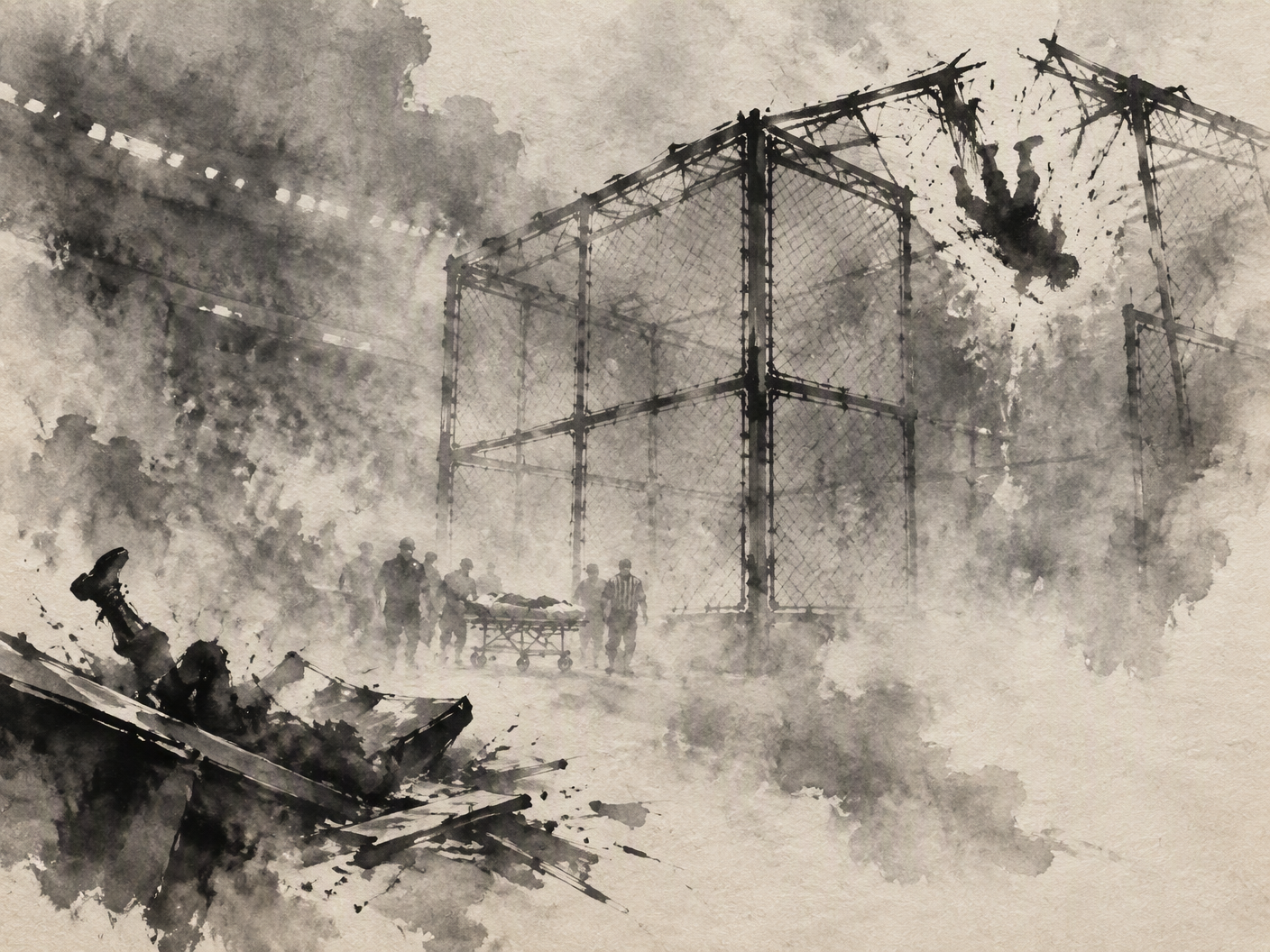
On June 28, 1998, inside Pittsburgh’s Civic Arena, Mick Foley entered as Mankind and climbed the outside of the Hell in a Cell structure before the match had properly begun. The Undertaker followed him upward. What happened next changed the terms of the evening: The Undertaker threw Mankind from the top of the cell, sending him through the Spanish announce table below. The fall was not the end of the contest. It was the first of two, and the first moment when a wrestling match presented itself as an emergency unfolding in real time.
The cell was built to contain the match, but the opening sequence carried both men beyond the ring and onto its roof. Mankind had climbed there during his entrance, making the ascent part of the event’s public spectacle. Once The Undertaker followed, the structure became the setting for a decision with an immediate physical consequence. Mankind went over the edge and down onto the Spanish announce table. The impact left him on the arena floor while the match’s officials and ringside personnel moved toward him.
Jim Ross called the first fall as it happened. His words—“Good God almighty! Good God almighty! That killed him! As God as my witness he is broken in half!”—were a live reaction to the sight before him. The phrase entered the permanent vocabulary of the match because it preserved the alarm of the moment without preparation or distance. Jerry Lawler’s commentary later carried the same perception into the second fall: “That’s it. He’s dead.” The broadcast did not pause to turn the scene into an explanation. It recorded the response of men watching a wrestler fall.
Mankind was placed on a stretcher after the first fall. Vince McMahon appeared at ringside and checked on Foley while the stretcher carried the practical meaning of what had just occurred: the performer was being removed from the immediate action. Tim White was also present as the match moved through its emergency response. Then Mankind rose from the stretcher. The sequence that followed gave the night its defining reversal. Instead of leaving the structure, he returned to it, climbed again, and brought the contest back to the roof.
The return did not restore the match to its earlier condition. Mankind had already gone through the announce table, been placed on a stretcher, and come back into the same enclosed space. The Undertaker was waiting above. When the two men met on the cell a second time, the available choices had narrowed to movement, resistance, and the next planned exchange. The Undertaker seized Mankind and chokeslammed him through the roof of the cell. Mankind dropped through the opening into the ring below, carrying the structure’s second breach with him.
A steel chair fell through the opening during the second fall and struck Mankind. The chair was not a distant prop in the scene; it followed him through the damaged roof and added another impact as he landed inside the ring. Jerry Lawler’s declaration—“That’s it. He’s dead.”—came in the aftermath of that fall, when the broadcast presented the violence as beyond the ordinary scale of the match. The words described the apparent extremity of the moment. They did not change what happened next.
The match continued. Mankind remained in the ring, and the contest proceeded after the second fall rather than ending with medical removal or an immediate stoppage. The decision to continue made the sequence difficult to separate into a single incident: the first fall led to a stretcher, the stretcher led back to the cell, and the second fall led back into the match. The structure had been breached, the chair had come through it, and the wrestlers still had to complete the contest under the rules governing the performance.
The Undertaker eventually pinned Mankind to end the match. That finish supplied the formal boundary the falls had not. The contest had begun with Mankind’s climb, passed through the throw onto the Spanish announce table, moved through a stretcher response, and returned to the cell before the chokeslam through the roof. It concluded inside the ring, with The Undertaker as the winner and Mankind as the wrestler who had absorbed both major falls and remained present until the final count.
The event’s later reputation grew from the collision between what the audience saw and what the match required afterward. Ross’s call made the first fall sound fatal; Lawler’s words did the same after the second. Yet Mankind rose, returned, and finished the contest. The camera-visible sequence therefore preserved two realities at once: severe impacts that prompted an emergency response, and a professional performance that continued through them. No police officers, prosecutors, or courtroom entered the episode. Its authority came from the arena, the broadcast, and the completed match.
The lasting record of June 28, 1998, is not a story of an unverified death, but of a wrestler thrown from a cell, lifted onto a stretcher, returned to the roof, and dropped through it. The Undertaker followed him upward, delivered both decisive attacks, and won by pinfall. Jim Ross and Jerry Lawler supplied the language of immediate alarm; Vince McMahon and Tim White appeared within the ringside response. The match endured in memory because its most consequential moments were not hidden: they were performed, witnessed, and followed by a finish.
Investigative Dossier & Evidence
Read the companion investigation notes, verified source claims, and primary documents.
Read the Companion Notes & Evidence Record →