
Bizarre & Myths ·
The Disputed Play That Became the Holy Roller
Oakland’s last-second touchdown beat San Diego in 1978. The ruling stood; the NFL then restricted who could advance a late-game fumble.
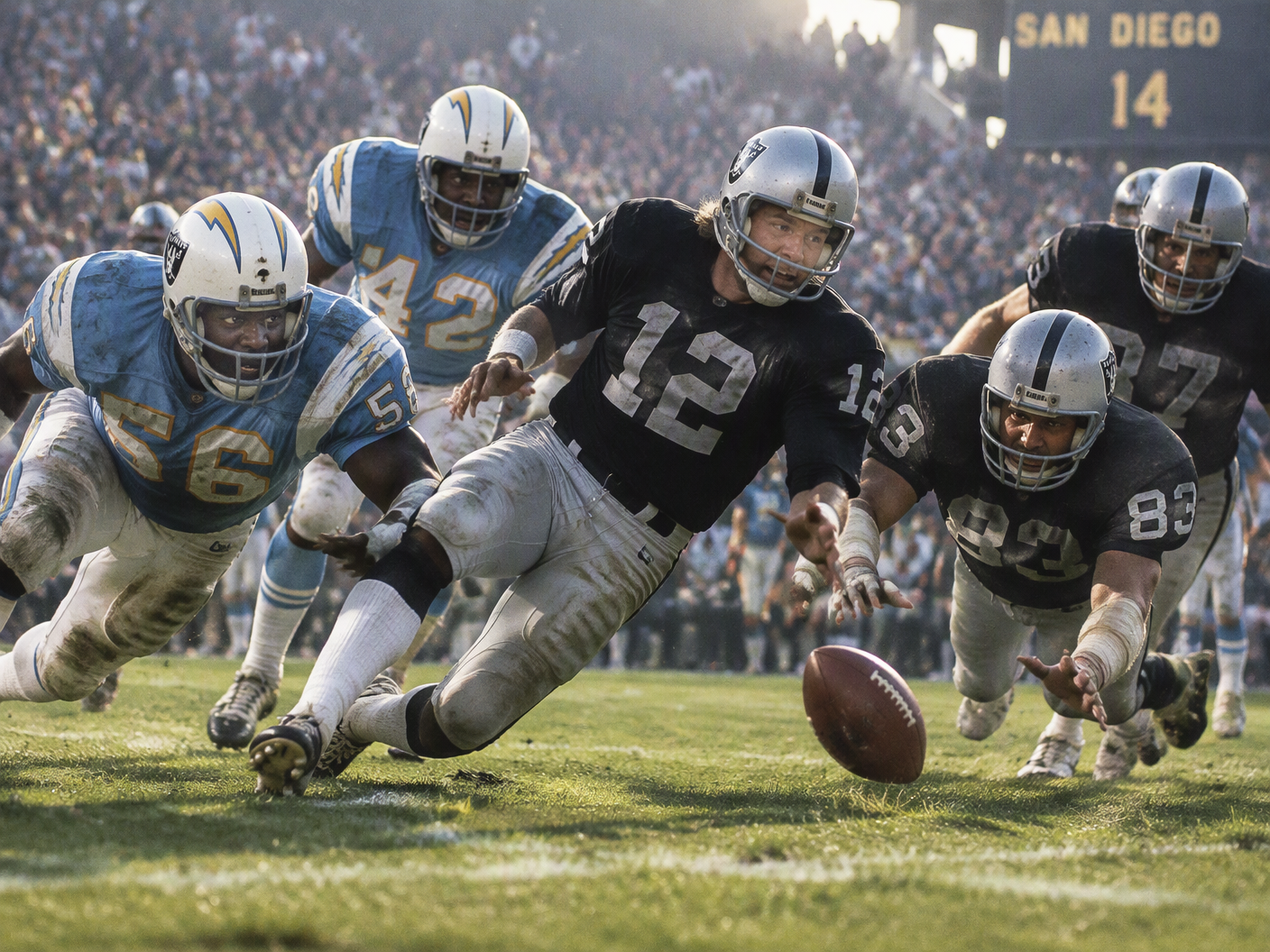
With 10 seconds left in San Diego on September 10, 1978, the Oakland Raiders needed a touchdown from the Chargers’ 14-yard line. Ken Stabler took the snap, rolled right under pressure and lost the ball forward. It bounced toward Pete Banaszak and then Dave Casper before Casper recovered it in the end zone. The officials awarded a touchdown. What became known as the “Holy Roller” turned on whether they had seen a fumble—or something the rules already prohibited.
Oakland had spent much of the afternoon giving away opportunities. Stabler threw three interceptions, and the Chargers led 20–7 in the fourth quarter before his 44-yard touchdown pass to Morris Bradshaw brought the Raiders within six points. Oakland got the ball back at its own 20 with 1:07 remaining. Completions to Bradshaw, Banaszak, Raymond Chester and Fred Biletnikoff carried the Raiders to the San Diego 14. An incomplete pass left time for one more play.
The Raiders’ retrospective describes Banaszak flipping the loose ball ahead, then Casper bending over and kicking it while trying to pick it up. Radio announcer Bill King followed its progress: “The ball, flipped forward, is loose, a wild scramble, two seconds on the clock, Casper grabbing the ball, it is ruled a fumble.” Casper fell on it in the end zone as time expired. The touchdown tied the score at 20–20; it had not yet won the game.
The Chargers protested from their sideline, but referee Jerry Markbreit ruled the play legal. The officials cleared the field for Errol Mann’s extra-point attempt. His kick gave Oakland a 21–20 victory. Casper, who had already caught a touchdown pass that afternoon, had supplied the tying points without receiving a pass on the final play.
The distinction mattered. Deliberately throwing the ball forward would have made it a forward pass, not a fumble; deliberately batting the loose ball forward would also have been illegal. According to the account accompanying an archived rebroadcast, the NFL backed the crew’s judgment that Stabler had fumbled and that the officials could not determine whether Banaszak and Casper had intentionally batted the ball. The ruling allowed the score to stand, but it did not settle what the players had intended.
The Pro Football Hall of Fame’s account quotes Stabler after the game: “I fumbled it on purpose. Yes, I was trying to fumble.” That account calls Markbreit’s ruling correct under the rules then in place. The officiating publication Football Zebras offers a different assessment: with a better view, it says, Markbreit would have ruled an incomplete forward pass. It also quotes his later response to seeing the play again: “Every once in a while, I see the play on television. And I cringe every time I see it.”
The following offseason, the NFL restricted who could advance a fumble after the two-minute warning and on fourth down. Only the player who fumbled could advance the ball; a teammate’s recovery would end the play. Under that restriction, another Raider could still recover Stabler’s loose ball—but could no longer turn it into a last-second touchdown.