
Violence & Brawls · 20th century–2020s
Dambe’s Glass-Hand Tradition and the Rules Built to Replace It
Dambe’s striking hand was once described alongside the outlawed use of glass shards, while its other hand served as a shield. From online promotion to government-backed organization and timed, medically supervised bouts, organizers have worked to move the Hausa combat sport toward formal regulation.
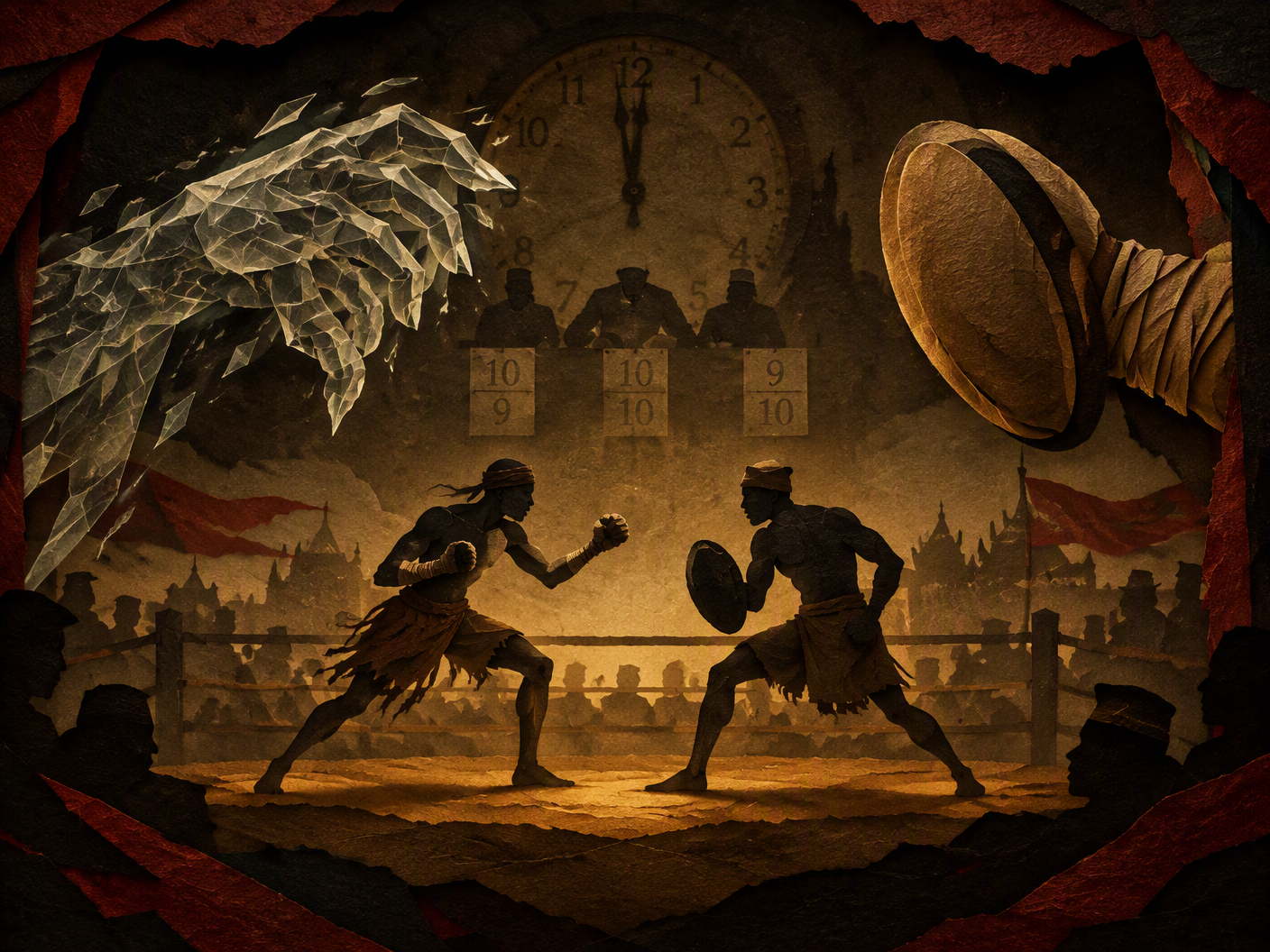
By December 2023, Dambe organizers were no longer presenting every bout as an unstructured test of endurance. At the first Emir Ado Bayero Dambe Championship in Kano, African Warriors used three rounds of three minutes and a points system. Health personnel were available to fighters at match sites. The changes gave judges a clock, gave bouts a measurable scoring framework, and placed medical attention beside the contest. They also marked a response to the older description of Dambe, in which fighters prepared a striking hand for impact and a shield hand for defense.
Dambe is a Hausa boxing style from northern Nigeria, but its structure differs from the glove-based boxing familiar to much of the world. One hand is bound and used to strike. The other remains a shield, positioned to absorb or deflect an opponent’s attack. Maxwell Kalu, the founder of African Warriors, has described the arrangement through the language of a spear and shield: one side projects force, while the other protects the fighter carrying it. That division gives the sport its distinctive geometry and concentrates the physical cost in a single weapon.
The most dangerous element attached to that weapon was glass. Descriptions of traditional Dambe identify glass shards placed in or around the striking hand as an outlawed or illegal practice. The prohibition changes the meaning of the hand itself. A legal fist can bruise, fracture, or break teeth through force alone; a fist carrying shards introduces cutting edges into a contest already organized around concentrated blows. Modern Dambe coverage places the practice on the forbidden side of the sport’s boundary, even as organizers attempt to make that boundary enforceable.
Abubakar Usman entered Dambe in Kebbi in 2002. He later became a decorated fighter, but the sport left an identifiable mark on his mouth: two incisors were lost to heavy blows. His experience gives scale to the physical bargain without requiring an invented spectacle. Dambe’s danger does not depend on a hidden ingredient. The striking hand, the shield hand, and the force of repeated contact already produce injuries that remain visible after a bout ends. Glass would alter that risk, which is why its use is treated as prohibited.
For years, the sport’s public reach was narrower than its local practice. Anthony Okeleke and Chidi Anyina helped launch the Dambe Warriors YouTube channel in January 2017 to showcase Dambe to a wider audience. The channel converted bouts into material that could travel beyond the arenas where the tradition was practiced. That mattered institutionally. Once a combat form is presented to distant viewers, its rules, injuries, equipment, and methods become part of the sport’s public identity rather than remaining matters understood only by participants and local organizers.
By June 2018, online attention had begun to frame Dambe for an international audience. The essential mechanics remained clear: one hand struck and the other shielded. The format was not softened by translation. Its appeal rested partly on the fact that the fighter’s body and tactics were exposed in a compact system, with no conventional pair of padded gloves distributing the burden across both hands. The same visibility that made Dambe accessible also placed pressure on organizers to explain which practices belonged to tradition and which had been excluded from the modern contest.
Kalu has described the earlier use of glass shards and the rules that replaced it. He also identified the newer controls: timed rounds and a points system. These are not decorative changes. A time limit restricts how long fighters can accumulate punishment in a single contest. Scoring gives officials a basis for deciding a bout without treating incapacitation as the only decisive outcome. Together, the rules shift authority from the fighter’s capacity to continue toward a format that judges can administer and organizers can repeat.
The government then attached a national ambition to the reform effort. In December 2019, Sports Minister Sunday Dare received a Dambe delegation and said the Federal Ministry of Youth and Sports Development wanted to create a national league. The ministry also planned to work with the Dambe Sport Association to build a federation. Those plans placed Dambe inside a familiar administrative structure: a league to organize competition, an association to coordinate participants, and a federation to provide a formal governing body.
That shift changed the interests surrounding the sport. A local bout can rely on custom, reputation, and the judgment of people who know the fighters. A national league requires rules that can be communicated across locations and applied to strangers. A federation requires officials, eligibility standards, and procedures capable of surviving disagreement. The prohibition on glass therefore becomes more than a statement about equipment. It becomes a test of whether organizers can define the legal hand, inspect the fighting hand, control the contest, and intervene when a traditional practice crosses the line drawn by modern regulation.
At African Warriors match sites, medical personnel were made consistently available to fighters. That decision recognized an obligation created by the sport’s central design: one hand is built to strike, while the other is used to shield, leaving the body to absorb the consequences of a highly concentrated exchange. The medical presence does not erase the injuries experienced by fighters such as Usman, who lost two incisors after heavy blows. It establishes a different operating principle—damage must be monitored as part of the event, not treated as proof that the event succeeded.
The result, by the Kano championship in December 2023, was a sport being presented through controls that could be seen and repeated: three three-minute rounds, points, and medical personnel at the site. The older glass-shard practice remained part of Dambe’s public history as an illegal method attached to the striking hand. No named fighter was formally tied to a specific glass-laced bout in the documented events, and no arrest, prosecution, or criminal case forms part of this account. What remains visible is the institutional exposure: once Dambe seeks a national league and federation, the rule against glass must move from description into enforcement.
Investigative Dossier & Evidence
Read the companion investigation notes, verified source claims, and primary documents.
Read the Companion Notes & Evidence Record →