
Doping & Drugs · 2000s
Roberto Barbi and the Suspension That Ran to 2047
Roberto Barbi’s anti-doping sanctions began with a three-month suspension in 1996 and escalated through an EPO ban, a lifetime sanction, and tribunal findings that he competed while ineligible. By 2020, those successive rulings had extended the end of his ineligibility to 28 July 2047.
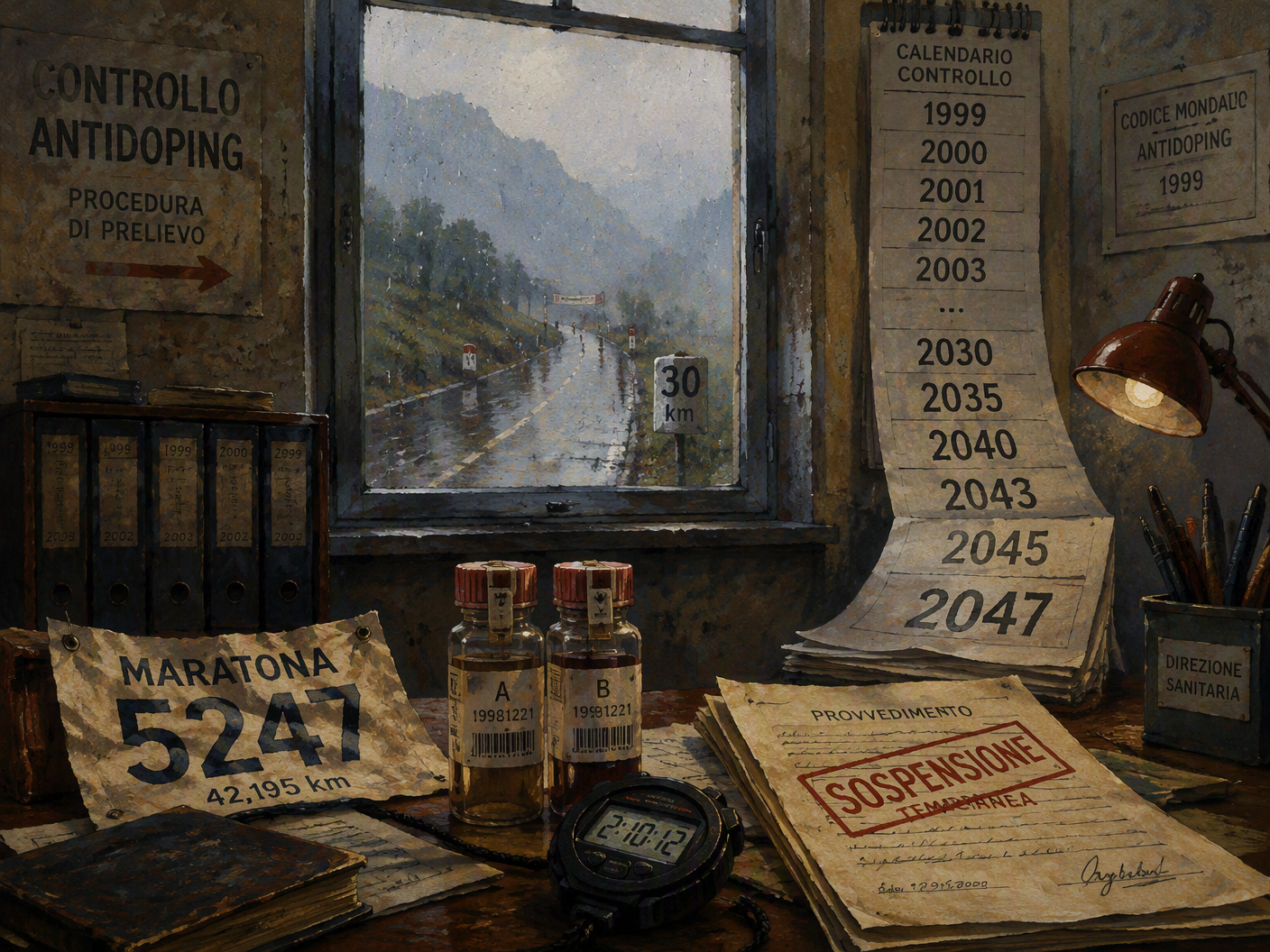
In 2017, Roberto Barbi entered the Porretta Terme-Corno alle Scale race in northern Italy while a lifetime suspension barred him from sporting activity. The Italian National Anti-Doping Tribunal found that participation itself violated the ban. It restarted his pending suspension on 30 July 2017 and set a new end date: 29 July 2032. A race lasting hours therefore altered the next fifteen years of Barbi’s legal sporting status. The tribunal treated the start line not as a minor breach of an old penalty, but as a new disciplinary act.
Barbi had once occupied a serious place in Italian distance running. World Athletics lists his marathon personal best as 2:10:12, set in Venice in 2000. That time supplies the athletic context for the sanctions that followed: a runner capable of sustaining elite pace over 42.195 kilometers, then repeatedly confronting rules designed to keep sanctioned competitors away from races. The number remains fixed. The career around it became increasingly governed by eligibility dates, tribunal orders, and the consequences of returning after exclusion.
The first sanction arrived in 1996, when Barbi produced a positive test for ephedrine. Authorities suspended him for three months. The penalty ended quickly enough to permit a return, but it established the first formal break between his competitive career and the rules governing prohibited substances. In endurance sport, a short ban can look temporary on a calendar. It still changes the relationship among athlete, federation, organizers, and rivals: each later result must coexist with a prior disciplinary record.
In 2001, an EPO case produced a much harsher response. Barbi received a four-year ban, later reduced to 25 months. EPO mattered to marathon regulation because it could alter oxygen transport and endurance, the physiological foundation of the event. The dispute consequently reached beyond a prohibited substance on a test sheet. It concerned whether an athlete could obtain a biological advantage through a medical intervention that competitors could not fairly accept without entering the same chemical economy.
The numbers also describe a psychological burden without diagnosing Barbi’s private state. A three-month suspension became a 25-month exclusion after the EPO case; the next sanction removed a return date altogether. Each reduction or extension changed the horizon an athlete would use to plan training, income, identity, and public life. Doping can turn performance into a source of suspicion and recovery into a negotiation with institutions. Barbi’s chronology offers no clinical testimony about his mental health, but the arithmetic shows how the system replaced finish times with waiting periods, and how every attempted return carried a larger risk of permanent exclusion.
By 2008, the disciplinary machinery no longer imposed a temporary interruption. An anti-doping case resulted in a lifetime suspension against Barbi. The sanction removed the next return date and placed every future sporting appearance outside his eligibility. It also transferred enforcement beyond the laboratory. Governing bodies could issue the order, but race organizers, officials, and participants had to decide whether a barred athlete could still enter, appear, or run. The punishment depended not only on its length, but on whether the sporting network treated ineligibility as operational fact.
The lifetime ban did not sever Barbi’s connection to races. Podisti.net reported that he participated in or appeared at several events during suspension, including the Valencia Marathon in 2011 and races in Tuscany in 2016 and 2017. Those appearances brought a barred athlete back into the setting from which the sanction sought to exclude him. They also exposed the practical limit of a written penalty. A governing body can name the rule and calculate the consequence; the road, the entry desk, and the local organizers determine whether that rule reaches the event in real time.
The Porretta race converted that practical conflict into a formal case. The tribunal found that Barbi had violated the prohibition on participating while suspended. It restarted the pending sanction from 30 July 2017 and fixed the new end date at 29 July 2032. The decision turned a mountain race into an administrative calculation. A single appearance did not merely add another result to a disputed career; it extended the period during which the institutions would recognize Barbi as ineligible.
In 2018, Barbi asked the Italian National Anti-Doping Tribunal to suspend or reduce the remaining sanction. The tribunal rejected the request. Its decision invoked the consent framework required for that form of relief and negative opinions from the World Anti-Doping Agency and the International Association of Athletics Federations. The ruling closed another route back into competition. The case now involved more than the substances that had produced the original sanctions; it also involved the consequences of treating participation during suspension as an independent violation.
In 2020, the tribunal found another violation of the prohibition on participating while suspended. It restarted the pending suspension from 29 July 2032 and extended Barbi’s ineligibility to 28 July 2047. The new date reaches beyond the ordinary span of an athletic career. Taken together, the chronology runs from three months in 1996, to 25 months after the reduced EPO penalty, to a lifetime suspension in 2008, and finally to a date twenty-seven years after the first participation finding. Barbi’s 2:10:12 records how fast he once ran. The 2047 date records how an anti-doping system lengthened exclusion when he ran after it began.
Companion notes
How Barbi’s Successive Sanctions Extended His Ineligibility
The available material establishes the major sanctions and the 2017 and 2020 participation findings, but it does not provide a complete tribunal file. The chronology is strongest at its formal outcomes; the surrounding circumstances require narrower treatment.
Athletic background and the first sanction
World Athletics provides the strongest institutional source for Barbi’s athletic profile and lists his marathon best as 2:10:12 in Venice in 2000. That result supplies background, not evidence of wrongdoing. The Wikipedia biography and Podisti.net identify the 1996 positive as ephedrine and the resulting suspension as three months. Together, they support the narrow sanction claim. They do not establish the circumstances of the test, the product’s source, or a medical explanation for the result. [S1], [S3], [S4]
The EPO penalty and its human pressure
The Wikipedia biography and Podisti.net report that the 2001 EPO case produced an initial four-year ban, later reduced to 25 months. Both accounts also mention cooperation with anti-doping authorities without defining its scope or content. The penalty sequence remains supportable; the procedural explanation does not. The numerical progression matters analytically: the case moved from a three-month exclusion to a four-year order and then to 25 months, creating repeated disruptions to training, livelihood, and athletic identity. No supplied source provides testimony or clinical assessment of Barbi’s psychological response, so the impact can be examined only as institutional pressure, not as a personal diagnosis. [S1], [S4]
The 2008 lifetime suspension
The Associated Press report carried by ESPN, the Wikipedia biography, and Podisti.net identify a lifetime suspension in 2008. They do not agree on the substances associated with that case. The defensible conclusion therefore stops at the sanction itself. The supplied material contains no complete primary decision, laboratory file, medical protocol, or hearing transcript that would justify a more specific account of the testing or the substance findings. [S1], [S2], [S4]
Appearances during suspension
Podisti.net reported that Barbi participated in or appeared at several running events during suspension, including the Valencia Marathon in 2011 and races in Tuscany in 2016 and 2017. The Wikipedia entry repeats portions of that chronology. Those reports establish contextual documentation, not a separate adjudication for every appearance. The formally established participation violations are the 2017 Porretta Terme-Corno alle Scale case and the additional finding issued in 2020. [S1], [S4]
The tribunal chronology
Podisti.net and Queen Atletica describe the 2017 finding connected to the Porretta Terme-Corno alle Scale race. The tribunal restarted the pending suspension from 30 July 2017 and set its end date at 29 July 2032. The 2018 decision rejected Barbi’s request to suspend or reduce the remaining sanction, citing the required consent framework and negative opinions from WADA and IAAF. In 2020, the tribunal found another participation violation, restarted the suspension from 29 July 2032, and extended ineligibility to 28 July 2047. The reporting preserves the outcomes, but not a complete docket, transcript, or full procedural record. [S1], [S4], [S5]
Source key
The associated evidence packet contains visible source URLs, source roles and the complete claim ledger.