
Violence & Brawls ·
Boban’s Kick and the Memory of Maksimir
The riot at an unplayed Dinamo–Red Star match became a symbol for Croatian supporters. Its place in the war that followed remains disputed.
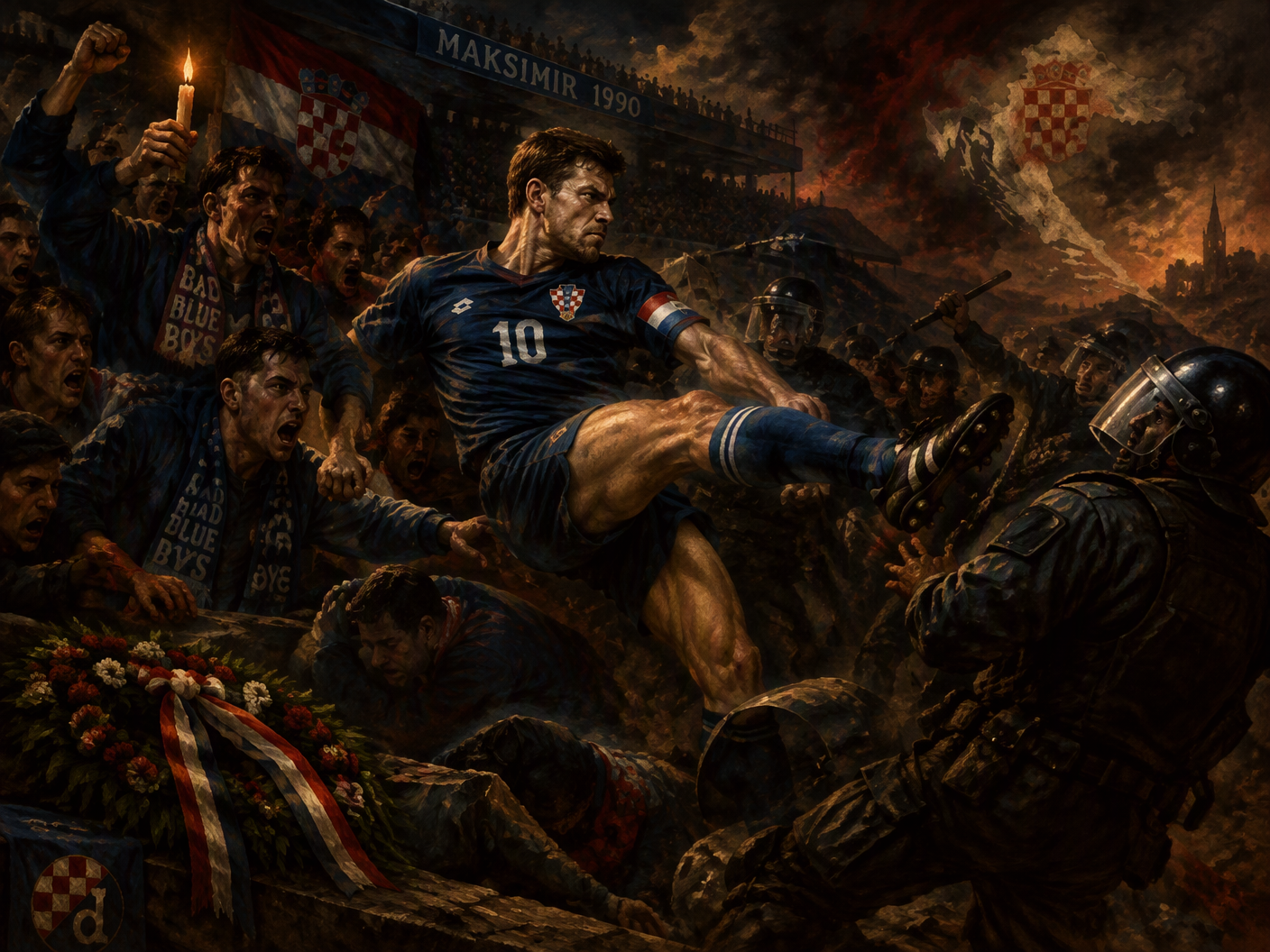
On May 13, 1990, with a riot spreading through Zagreb’s Maksimir stadium, Dinamo captain Zvonimir Boban kicked a police officer who was allegedly mistreating a Dinamo supporter. Red Star Belgrade’s players had left for the dressing rooms; several Dinamo players remained on the pitch. Members of Dinamo’s hardcore supporters, the Bad Blue Boys, gathered around Boban to shield him. The match was never played. The kick became an enduring image of a day some supporters would later call the beginning of the war that broke out the following year.
Violence had already broken out in Zagreb’s streets after Red Star’s Delije supporters arrived by train. Inside the stadium, fans fought one another and clashed with police. More than 60 people were wounded. In Croatia, a popular account held that police had acted against Croatian supporters while leaving Red Star’s fans alone. That perception became part of the riot’s political meaning, but it did not settle who had instigated the violence.
Boban received a six-month suspension from the Yugoslav Football Association and missed the 1990 World Cup. He was celebrated as a national hero in Croatia. Boban later described the moment in explicitly national terms: “Here I was, a public face prepared to risk his life, career, and everything that fame could have brought, all because of one ideal, one cause; the Croatian cause.”
The riot came a week after the second round of Croatia’s first multiparty elections in almost 50 years, won by Franjo Tuđman’s Croatian Democratic Union. Rising ethnic tensions had sharpened the football rivalry. War followed in 1991, and members of both the Bad Blue Boys and the Delije went to fight. Some Red Star supporters joined the paramilitary unit commanded by Željko Ražnatović, known as Arkan.
The Bad Blue Boys made the stadium a place of remembrance. Each May 13, they gather to light candles and lay wreaths for supporters killed in the war. A monument outside carries the inscription: “To all the Dinamo fans for whom the war started on May 13, 1990 and ended with them laying down their lives on the altar of the Croatian homeland.”
Claims of a planned provocation also persisted. Croatian public television aired a documentary advancing unsubstantiated theories that blamed Yugoslav secret services and Serb police chiefs. Its director, Miljenko Manjkas, nevertheless acknowledged that the instigators remained unknown and that the riot’s effect on the subsequent conflict was open to question.
Dario Brentin, a University of Graz scholar of sport and nationalism, described the riot as one of Croatia’s “founding myths.” He also pointed to what happened afterward: another season of Yugoslav league football was played, and Boban continued representing Yugoslavia until 1991, when armed clashes had already begun. Refik Ahmetović, the officer Boban kicked, publicly forgave him several years after the incident.