
Scandals & Feuds · 2010s
The Turkish Match-Fixing Case and the Sanctions That Outlasted Its Verdicts
A nationwide police operation became a layered football scandal involving player bans, a prison sentence for Fenerbahçe chairman Aziz Yıldırım, European exclusions for two clubs, and a retrial that ended in acquittals. The sequence left criminal judgments, sporting penalties, and unresolved institutional consequences moving on separate tracks.
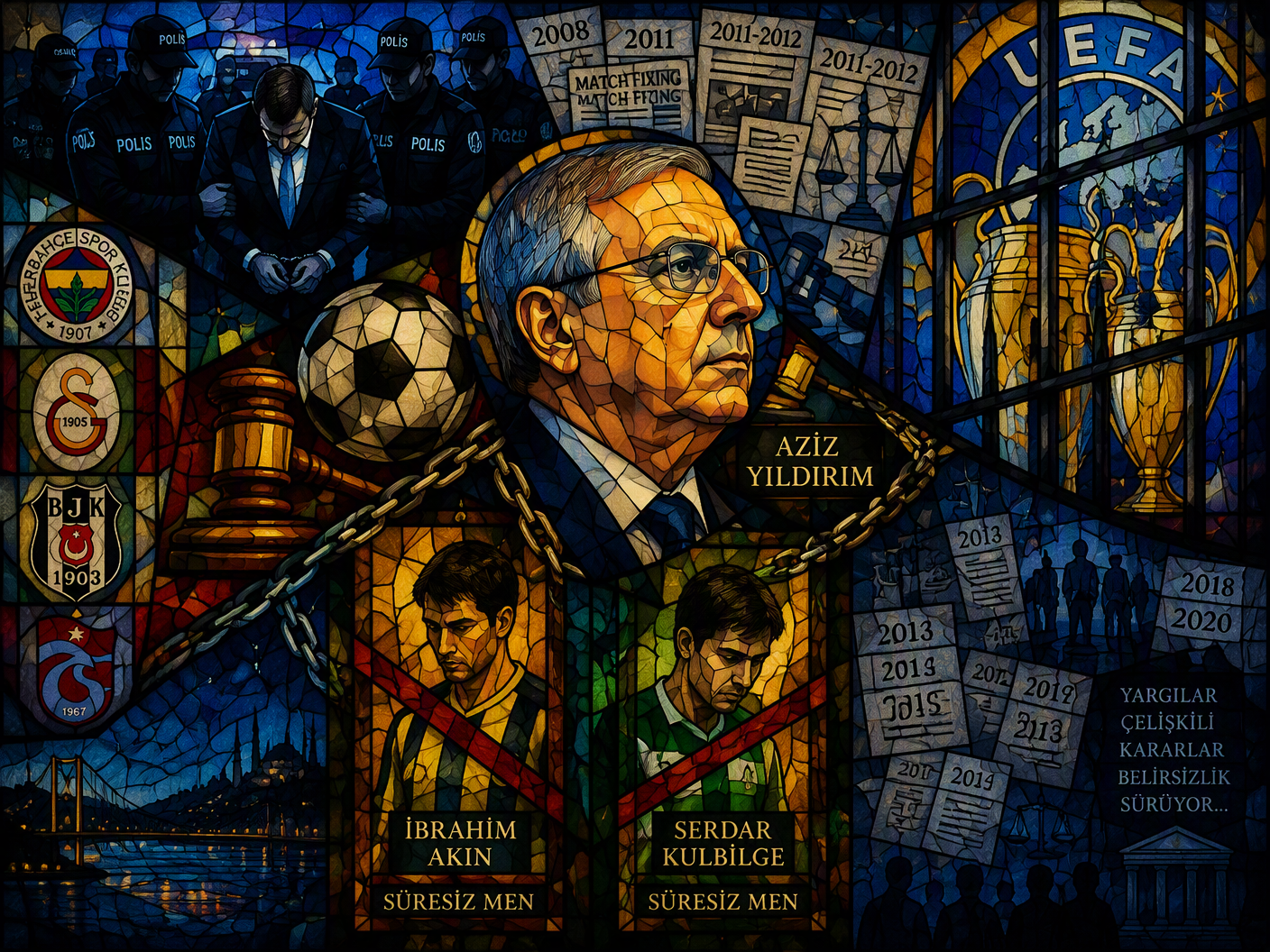
On the morning of 24 March 2010, Turkish police moved through 26 towns and cities with warrants tied to a football match-fixing probe. By the time the arrests were counted, 46 people were in custody. The operation did not begin in a stadium, beneath floodlights or in front of a television audience. It began in addresses scattered across the country: doors opened, names were written down, vehicles searched, telephones collected. Football had supplied the motive and the money. The first visible act was procedural—the police taking suspects away.
The investigation widened during the following summer. Club managers and Turkish national-team players entered the expanding circle of suspicion, and by 10 July 2011 the number of detainees had reached 61. The figure carried its own cold arithmetic. It measured the distance between an isolated allegation and a national operation, but it did not turn every detention into a finding of guilt. In the football economy, where reputations traveled faster than court papers, arrest itself became a sentence imposed in public long before a judge had finished reading the file.
Among the players drawn into the case was İbrahim Akın, an İstanbul BB player. In 2011, he was reported to have admitted participating in match fixing. The admission placed a human voice inside an investigation otherwise dominated by police figures, club names, and legal machinery. Serdar Kulbilge, a Gençlerbirliği goalkeeper, stood on a separate branch of the same disciplinary tree. Neither player controlled the institutions that would later judge the conduct, yet both carried consequences that reached beyond a single match and into employment, reputation, and the ordinary life of a professional athlete.
The football authorities altered the governing terrain on 30 April 2012, when the Turkish Football Federation changed its match-fixing disciplinary rules. Seventeen days later, on 7 May, the federation banned Akın for three years and Kulbilge for two. The sanctions arrived through a channel distinct from the criminal courts. A player could face federation discipline while prosecutors pursued a separate case, each institution applying its own rules and carrying its own authority. The paperwork multiplied: suspension notices, criminal indictments, club statements, appeals. The sport was no longer dealing with one proceeding, but with several systems running at once.
At the center of the criminal case stood Aziz Yıldırım, chairman of Fenerbahçe, one of Turkey’s largest and most powerful football clubs. On 2 July 2012, a specially authorized court in Istanbul sentenced him to six years and three months in prison on match-fixing charges. The conviction also included forming an unarmed criminal gang for that purpose. The sentence converted the investigation from a police operation into a judgment with a measured term of years. Outside the courthouse, the club’s institutional identity and the chairman’s personal fate had become difficult to separate.
The case did not end with the sentence. Yıldırım appealed, and the appeal became part of the public struggle over what the prosecution had proved and why the case had taken its particular shape. In January 2014, speaking in France, he said the sentence was politically motivated and linked the proceedings to a wider corruption scandal. That was Yıldırım’s position, not a ruling by the court. Yet it entered the story because criminal cases involving powerful clubs rarely remain confined to legal language. They become arguments about government, loyalty, institutional capture, and the price paid by the person who refuses to accept the verdict.
Football’s European authorities imposed their own answer before the criminal dispute had settled. On 25 June 2013, UEFA banned Fenerbahçe and Beşiktaş from European competitions over match-fixing allegations. The exclusion reached beyond the defendants named in court. It affected clubs, players, supporters, executives, and the commercial calendar that bound Turkish football to the continent. A domestic investigation had acquired an international consequence. European competition was governed by a separate gatekeeper, and that gatekeeper did not need to wait for every criminal appeal to conclude before closing the door.
For the clubs, the sanctions were not abstract. A European fixture is planned months in advance: travel arranged, tickets printed, players registered, television contracts activated. A ban removes all of it with a decision measured in pages. For supporters, the damage traveled through empty schedules and missing opponents. For the accused, the sequence created a second judgment in the sporting world, one that operated alongside the courts rather than beneath them. A criminal conviction could be challenged; a federation suspension could expire; a UEFA exclusion could alter a club’s finances and competitive standing long after the legal arguments changed.
The original criminal outcome later gave way to a new proceeding. On 9 October 2015, the retried match-fixing case ended with acquittals for Yıldırım and the other defendants. The courtroom’s language changed from conviction to release. A sentence that had once placed six years and three months beside Yıldırım’s name no longer stood as the final result of that retried case. The acquittals did not travel backward through every office that had acted during the preceding five years. Player bans, federation decisions, and UEFA sanctions belonged to institutions with different rules, different calendars, and different thresholds.
That is why the case remains a collection of overlapping records rather than a single clean verdict. Police arrested 46 people in 2010 and the detention total rose to 61 in 2011. The federation banned two players in 2012. A specially authorized court sentenced a club chairman that July. UEFA barred two clubs the next year. Yıldırım appealed and described the prosecution as political. In 2015, a retrial produced acquittals. Each event is fixed to its own date and institution. Together they show how suspicion can become discipline, discipline can become exclusion, and a later acquittal can still leave the earlier machinery standing in the corridor.
The human cost was carried by people who occupied different levels of the game. Akın and Kulbilge lost seasons to federation bans. Yıldırım endured imprisonment, appeal, and the public burden of a conviction later followed by acquittal. Fenerbahçe and Beşiktaş lost access to European competition, while supporters were left to distinguish between what a court had decided, what a football authority had sanctioned, and what an international governing body had excluded. The match itself disappeared beneath the case file. What remained were names, dates, penalties, and the long silence between one institution’s decision and the next.
Investigative Dossier & Evidence
Read the companion investigation notes, verified source claims, and primary documents.
Read the Companion Notes & Evidence Record →