
Doping & Drugs · 2010s
Sochi, the Testing System, and Russia’s Doping Cover-Up Allegations
Russia hosted the 2014 Winter Paralympics before allegations of an organized doping program widened into claims of state interference, advance test warnings, concealed missed tests, intimidation, and bribery. The sequence produced a federation suspension in 2015 and Richard McLaren’s second independent report in December 2016.
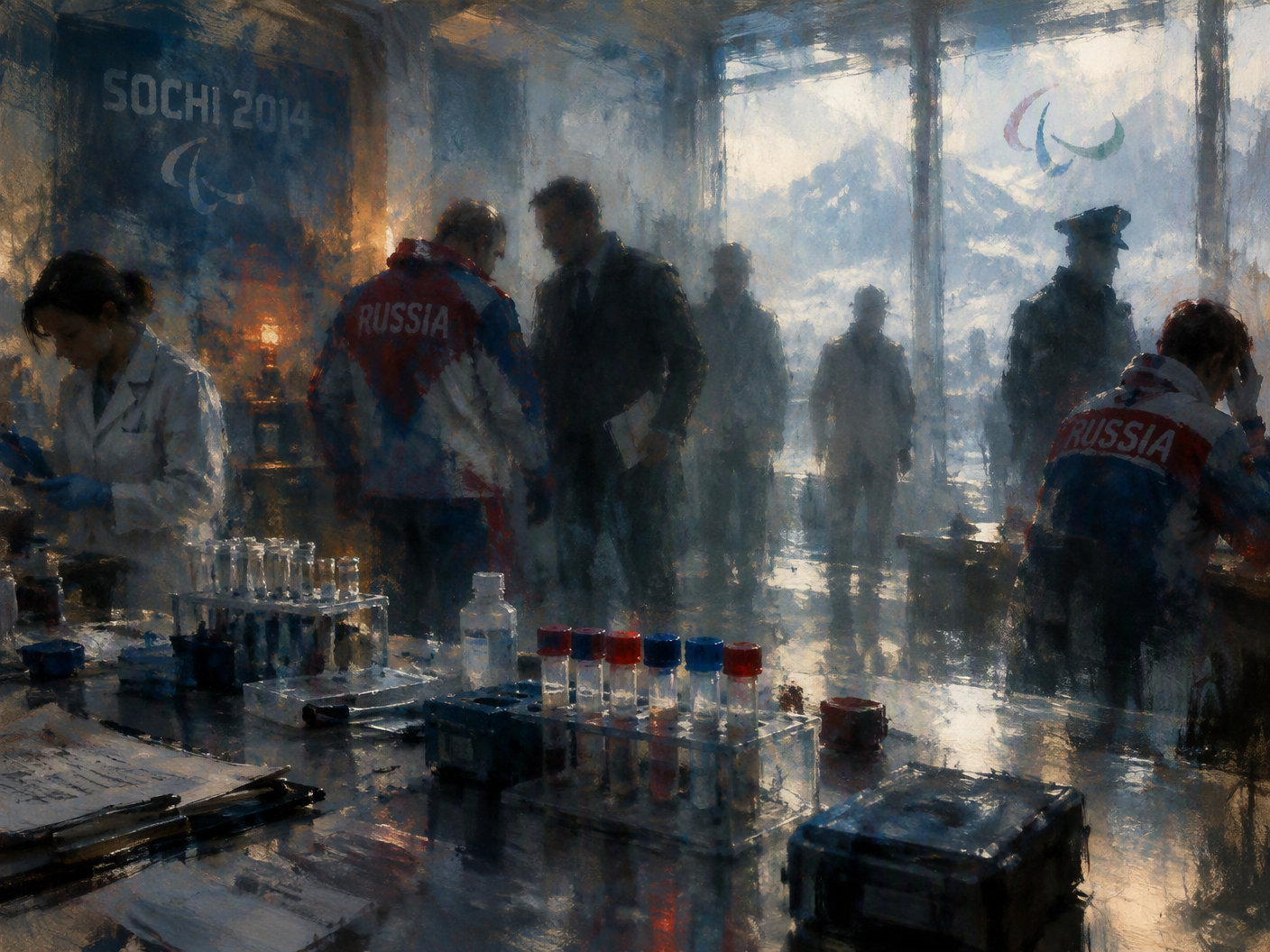
From March 7 to March 16, 2014, Russian athletes competed at the Winter Paralympics in Sochi under the flag of the host nation. The event placed elite disability sport inside a national display of organization, investment, and civic pride. Athletes arrived for competition; officials presented Russia as a functioning sporting state. Within months, that public setting acquired a second meaning. The questions that followed were not limited to whether an individual competitor had taken a prohibited substance. They concerned who controlled testing, who could interfere with it, and how much protection a national sports system could provide when medals and reputation were at stake.
The first major rupture came on December 3, 2014, when German broadcaster MDR aired a documentary alleging that Russia had organized a state-run doping program. The allegation moved the issue away from the familiar image of a solitary athlete making a private choice. It described a public structure in which laboratories, officials, and sporting authorities could serve interests larger than the competitor standing at the start line. For Russian athletes, the consequences were immediate in a practical sense: every result could now be viewed through a dispute over the institutions surrounding the test.
The documentary’s allegations extended into the offices responsible for protecting clean competition. They involved officials at the Russian anti-doping agency, the Moscow doping laboratory, and the International Association of Athletics Federations, or IAAF. The accusation was therefore not simply that banned substances had entered athletes’ bodies. It was that the organizations assigned to detect violations might also have been positioned to delay, conceal, or manage them. That distinction changed the scale of the crisis. A positive test can suspend one person; compromised supervision can place an entire national pathway—from training room to laboratory—under suspicion.
The people carrying that uncertainty were not all situated equally. A famous champion could have lawyers, administrators, and public relations staff. A lower-profile athlete faced the ordinary consequences of a damaged sporting identity: lost invitations, altered eligibility, and the question of whether years of preparation would be judged by a scandal beyond personal control. The Sochi Paralympics had been a competition for athletes whose bodies were already scrutinized by the public. The doping allegations added another layer of examination, shifting attention from performance and access to the credibility of the institutions that certified the contest.
By November 2015, the dispute had reached formal sports governance. On November 13, the IAAF provisionally suspended Russia’s athletics federation from international competition, including the Olympic Games. The suspension targeted the federation, not every athlete in every Russian sport, but its reach was substantial. A governing body had decided that participation could not continue normally while the allegations were being addressed. The cost of that decision traveled downward. Athletes preparing for international competition had to live with uncertainty over selection, eligibility, and the standing of results earned before administrators were sanctioned.
A provisional suspension is an administrative act, not a verdict on every person connected to a national program. Its significance lay elsewhere: it showed that the dispute had crossed from broadcast accusation into institutional restriction. The governing question was no longer whether journalists had raised an uncomfortable story. It was whether international sport could trust the bodies responsible for entering athletes, supervising tests, and certifying that competition had been conducted under common rules. In a system built around national federations, one federation’s failure could rearrange the working lives of competitors who had no authority over its policies.
The WADA commission’s reported findings supplied the allegations with operational detail. It said the Russian state had directly intimidated and interfered with operations at the Moscow laboratory. That claim placed political power inside a facility designed to function as a neutral checkpoint between athlete and result. Laboratories are plain working places—rooms of samples, labels, instruments, and controlled procedures—but their authority depends on independence. If officials outside the laboratory could pressure those inside it, the test ceased to be a settled answer and became another object of administrative control.
The commission also said Rusada gave athletes advance notice of tests, hid missed tests, bullied doping-control officers and their families, and accepted bribes to cover up missed tests. Each practice changed the burden of enforcement. Advance notice gave a prepared athlete time that an unprepared competitor would not receive. A concealed missed test removed an event from the chain of accountability. Threats reached beyond officers into their families, while bribes turned a compliance failure into a transaction. These were allegations about the conditions under which testing occurred, and they described a system capable of protecting access to competition by weakening the people assigned to police it.
For Paralympic athletes, the widening scandal carried a particular institutional tension. Russia had hosted the Winter Paralympics only two years earlier, making the country’s sporting administration part of the event’s public infrastructure. Yet the formal sanction that followed was directed at athletics, while the broader allegations touched Russian sport more generally. That uneven pattern created no simple map from administrative wrongdoing to individual culpability. It did create a difficult working reality: athletes from one national system could be asked to defend results, affiliations, and eligibility while the organizations that governed them faced scrutiny for conduct outside any single starting gate.
On December 9, 2016, Richard McLaren published the second part of his independent report. Its release marked the next stage in the public handling of the scandal: allegations that had begun in a television investigation and widened through governance action were now gathered under an independent inquiry led by a named investigator. The report gave the controversy a durable reference point, but it did not turn every national competitor into a proven violator. The central conflict remained institutional. Sport had promised that testing separated achievement from chemical assistance; the allegations described authorities capable of controlling that separation.
The years after Sochi therefore left two kinds of damage in the same frame. The first belonged to athletes whose eligibility and reputations could be affected by decisions made in laboratories, federations, and government offices. The second belonged to the competition itself, which relies on shared belief that a test is administered without advance warning, coercion, or payment. Russia’s suspension and McLaren’s report did not erase the individual histories of the athletes who competed in Sochi. They followed those athletes into the harder period afterward, when medals remained attached to names but trust had become an additional condition of entry.
Investigative Dossier & Evidence
Read the companion investigation notes, verified source claims, and primary documents.
Read the Companion Notes & Evidence Record →