
Bizarre & Myths · 1980s
The Six-Goal Second Half at Grotenburg
On 19 March 1986, Bayer 05 Uerdingen overturned a two-goal first-leg deficit against Dynamo Dresden after trailing 3–1 at halftime of the return match. Six unanswered goals carried Uerdingen to a 7–5 aggregate victory in the European Cup Winners’ Cup quarter-final, a reversal later known as the “Miracle of the Grotenburg.”
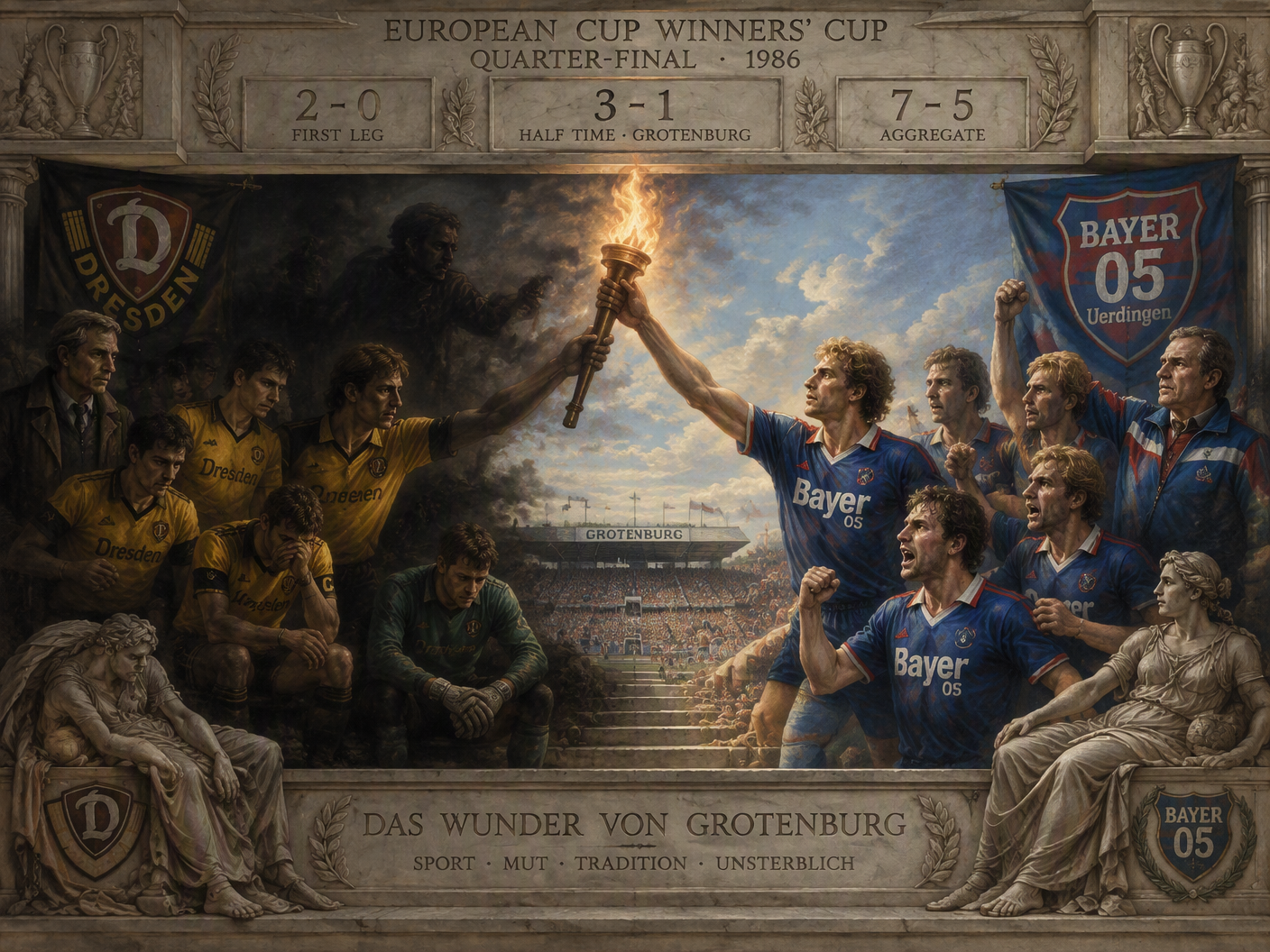
On 19 March 1986, at Grotenburg in Uerdingen, Dynamo Dresden went into halftime with the quarter-final apparently under its control. Dresden led the return leg 3–1, adding to the 2–0 victory it had taken from the first meeting. Across the two matches, the East German club possessed the advantage that knockout football was designed to protect: a lead built over separate nights, measured in goals and carried from one ground to the next. Then the second half began. Bayer 05 Uerdingen scored six unanswered goals, turning a tie that had belonged to Dresden into a 7–5 aggregate victory.
The contest belonged to the European Cup Winners’ Cup, the competition for domestic cup holders, and its quarter-finals were played over two legs. Dynamo Dresden and Bayer 05 Uerdingen were paired in the 1985–86 season, placing an East German club against a West German club at a time when the division between their football systems was also a political boundary. The competition did not settle the matter in a single afternoon. Each side had to survive its opponent’s ground, carry the arithmetic forward, and wait for the second score to determine which club would reach the semi-finals.
The first leg took place in Dresden, where Dynamo won 2–0. That result gave the visitors to Uerdingen a difficult assignment but not an impossible one: two goals separated the clubs, and the return match would be played at Bayer’s home stadium. A 2–0 lead could be defended through the ordinary disciplines of a second leg—possession, caution, and the refusal to concede early. Dresden arrived at Grotenburg with the advantage. Uerdingen had the venue, the remaining ninety minutes, and the obligation to change the tie before the calculation hardened against it.
Grotenburg was not a neutral stage in the contest. It was Uerdingen’s home ground and the setting in which the West German side had to recover the ground lost in Dresden. The match’s later identity would attach itself to that place: the “Miracle of the Grotenburg.” The phrase belongs to the afterlife of the game, a name used to preserve the scale of the reversal. Its force came from the score itself. At the interval, Uerdingen had not merely failed to erase the first-leg deficit; it had fallen further behind on the night.
Dresden’s 3–1 halftime lead made the aggregate position plain. The first leg had ended 2–0, and the return leg had now placed Uerdingen two goals behind again. Taken together, the scores left Dresden ahead by four goals on the night’s running total. The arithmetic was severe because it required Uerdingen not only to score but to keep Dresden from answering. A single goal would not restore the tie. The home side needed a sustained sequence, and the second half supplied one beyond the scale suggested by the first forty-five minutes.
After the interval, Bayer 05 Uerdingen began the sequence that defined the match. The home side scored six times without an intervening Dresden goal. That fact gives the comeback its structure: not a late winner, not a narrow escape, but an entire half in which the direction of the tie changed repeatedly and one side continued to add to its total. Dresden’s halftime advantage disappeared inside that run. The score that had seemed to confirm the first-leg result became the starting point for Uerdingen’s qualification.
The final aggregate score was 7–5 to Bayer 05 Uerdingen. The number contains both halves of the story. Dresden had scored twice in the first meeting and three times before halftime in the return; Uerdingen then produced the six-goal second-half burst that carried its total beyond Dresden’s. The result was therefore not a narrow reversal of a single goal. It was a quarter-final overturned across the interval of one match, after Dresden had held a two-goal first-leg advantage and a two-goal halftime advantage on the return.
For Dynamo Dresden, the defeat came after the club had positioned itself to advance twice: first through the 2–0 win in Dresden, then through the 3–1 halftime lead at Grotenburg. Those advantages were real, recorded in the sequence of the tie, and insufficient. Uerdingen’s six unanswered goals changed the final calculation from a Dresden progression into a home victory. The structure of two-leg football allowed the first match to remain present in every later score, but it could not prevent the return leg from replacing one expectation with another.
The match has endured through the name attached to its venue. “Miracle of the Grotenburg” is the retrospective description used for Uerdingen’s recovery, not an official title of the European Cup Winners’ Cup. The phrase compresses the event into a single image, but the underlying sequence is more exact: a 2–0 Dresden victory in the first leg; a 3–1 Dresden lead at halftime of the second; six consecutive Uerdingen goals after the interval; and a 7–5 aggregate finish. The nickname survives because the chronology requires no embellishment.
The surviving documentation places the tie in the record of football competition, not in a criminal or disciplinary proceeding. It reports the quarter-final pairing, the first-leg result, the halftime score, the six-goal second half, and Uerdingen’s advancement. No arrest, criminal charge, or disciplinary sanction is reported in connection with the match. That boundary matters when later retellings seek a darker explanation for an improbable result. The documented event is already sufficiently unusual: Uerdingen reversed a four-goal aggregate position inside one half and qualified by two.
What remained at Grotenburg was a completed competitive reversal. Dynamo Dresden had entered the return leg carrying a 2–0 lead from home, reached halftime ahead 3–1, and left the two-leg contest behind after Bayer 05 Uerdingen’s six unanswered second-half goals. Uerdingen advanced 7–5 on aggregate. The stadium name became the permanent shorthand, while the competition ledger preserved the harder sequence beneath it. The “Miracle of the Grotenburg” was not a separate official designation; it was the durable language applied to the night when the score changed faster than the old advantage could survive.
Investigative Dossier & Evidence
Read the companion investigation notes, verified source claims, and primary documents.
Read the Companion Notes & Evidence Record →