
Doping & Drugs · 1980s
The Motel-Room Transfusions Behind U.S. Cycling’s Nine 1984 Olympic Medals
Some members of the 1984 U.S. Olympic cycling team received blood transfusions before competition in Los Angeles, where the team won nine medals. In January 1985, the U.S. Cycling Federation banned blood doping and fined coach Eddie Borysewicz and athletics director Ed Burke a month’s pay.
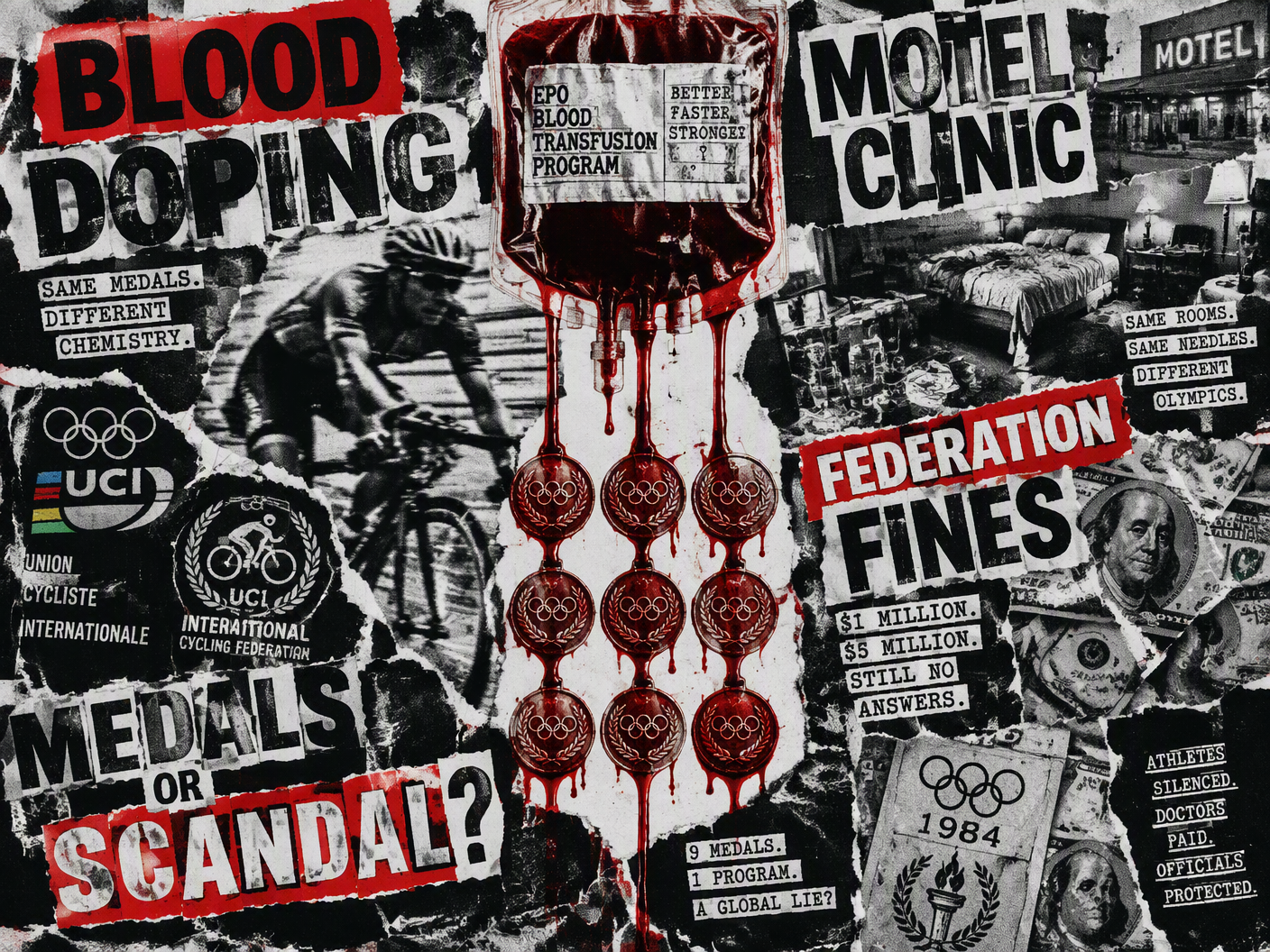
The U.S. Cycling Federation banned blood doping in January 1985 and fined national coach Eddie Borysewicz and athletics director Ed Burke one month’s pay each. The punishment followed the disclosure that some American Olympic cyclists had received blood transfusions before their events at the Los Angeles Games. The transfusions had not violated Olympic rules then in force, although Olympic medical guidelines discouraged them. The federation’s action converted a loosely governed performance practice into a disciplinary offense—and placed two officials on opposite sides of a question that had followed the team out of the velodrome.
Borysewicz had coached the U.S. Cycling team through the 1984 Olympic competition. His riders won nine medals, giving the program its strongest public argument: the preparation had produced measurable results on the largest stage. The medal count also fixed the transfusion controversy to a successful campaign rather than an isolated medical experiment. The athletes competed, collected medals, and returned to a sport whose governing rules had not clearly prohibited blood boosting. Within months, the same practice would become the basis for a federation ban and personal financial penalties.
The method was known by two names. Blood doping referred to the removal and later reinfusion of blood, while blood boosting described the intended performance effect: increasing the available oxygen-carrying capacity before exertion. In Los Angeles, contemporary reporting connected some members of the American team to transfusions before their events. The account did not place every rider inside the practice. It identified a portion of the team and situated the transfusions during the Olympic period, when the difference between a medical procedure and a competitive advantage had not yet been settled by a direct Olympic prohibition.
The practical setting was a clinic established in a Los Angeles motel room. Ed Burke arranged it for athletes receiving transfusions, taking the procedure outside a conventional medical facility and inside the temporary geography of the Games. That detail gave the controversy its operational center: not a laboratory program publicly administered by the team, but a room connected to the Olympic campaign and controlled by a federation athletics director. The setup also created a line of responsibility that Borysewicz later rejected.
Borysewicz denied knowledge of, or approval for, Burke’s motel-room clinic. The denial mattered because the coach occupied the most visible sporting role while Burke handled the federation’s athletics administration. Their positions overlapped around the riders, but authority over the transfusions was contested. The public account assigned the setup to Burke and preserved Borysewicz’s position that he had not ordered or sanctioned it. That distinction separated a coach’s responsibility for Olympic preparation from a proven command decision about a medical procedure.
The Olympic rules created room for the practice to exist. Blood transfusions were not banned by the Games regulations in 1984, even though medical guidance discouraged them. A discouraged procedure could remain outside the reach of an athletic sanction; a prohibited procedure could trigger one. The cyclists and officials therefore operated inside a regulatory gap. The team’s nine medals arrived before the governing body closed it, leaving the federation to decide afterward whether conduct permitted at the Games could still violate the standards of American cycling.
That decision came in January 1985. The U.S. Cycling Federation formally banned blood doping, ending the uncertainty within its own jurisdiction. The ban did not rewrite the Olympic rules that had governed the Los Angeles competition. It established a domestic standard for the federation and attached a financial consequence to the officials held responsible for the episode. Borysewicz and Burke each lost a month’s pay. The sanction was administrative, imposed by the sport’s governing body rather than by a criminal court.
The timing fixed the institutional sequence. The team competed under Borysewicz, won nine medals, and carried the transfusion issue into the aftermath of the Games. Burke’s motel-room clinic supplied the identified site. Borysewicz’s denial limited the claim that he had personally authorized it. The federation then banned blood doping and fined both men. Each step changed the meaning of the previous one: a practice tolerated by Olympic rules became a federation violation, and an internal dispute became a disciplinary case with named penalties.
The controversy also became attached to Borysewicz’s larger coaching legacy. Greg LeMond was one of the riders developed under Borysewicz, and later accounts repeatedly placed LeMond within that coaching lineage. His presence connected the 1984 program to the generation of American cyclists that followed, even though the disciplinary action concerned Borysewicz and Burke and the transfusions linked to some Olympic riders. The episode therefore traveled beyond one motel room: it entered the history of a coaching system that produced elite athletes while confronting an emerging question about medical advantage.
No criminal prosecution or judicial finding followed the transfusions. The consequence recorded in the public account was the federation’s January ban and the month’s pay taken from Borysewicz and Burke. That outcome defined the boundary of what the episode established. Some American riders received transfusions before Olympic events; the practice was called blood doping or blood boosting; Burke was tied to the motel-room clinic; and the federation imposed discipline. Borysewicz’s personal order or approval was not established by the sanction itself.
The Los Angeles medals remained official: nine victories attached to a team whose medical practices had occupied a regulatory space neither fully authorized nor expressly banned. The federation’s response came after competition, when the governing body could no longer treat blood boosting as a private preparation choice. It drew a rule, identified two officials for punishment, and made the cost measurable. The final exposure was not a courtroom verdict but an institutional admission that the standards governing American cycling had been inadequate when the medals were won.
Investigative Dossier & Evidence
Read the companion investigation notes, verified source claims, and primary documents.
Read the Companion Notes & Evidence Record →