
Tragedy · 1970s
Munich’s Failed Rescue and the Custody Decision That Followed
The 1972 Olympic hostage crisis exposed a chain of governmental decisions: an improvised rescue at Fürstenfeldbruck ended with the deaths of all eleven Israeli delegation members, while West Germany later released the three surviving attackers after a hijacked Lufthansa flight. The public record is firm about that sequence and far less certain about the later fate of Adnan Al-Gashey.
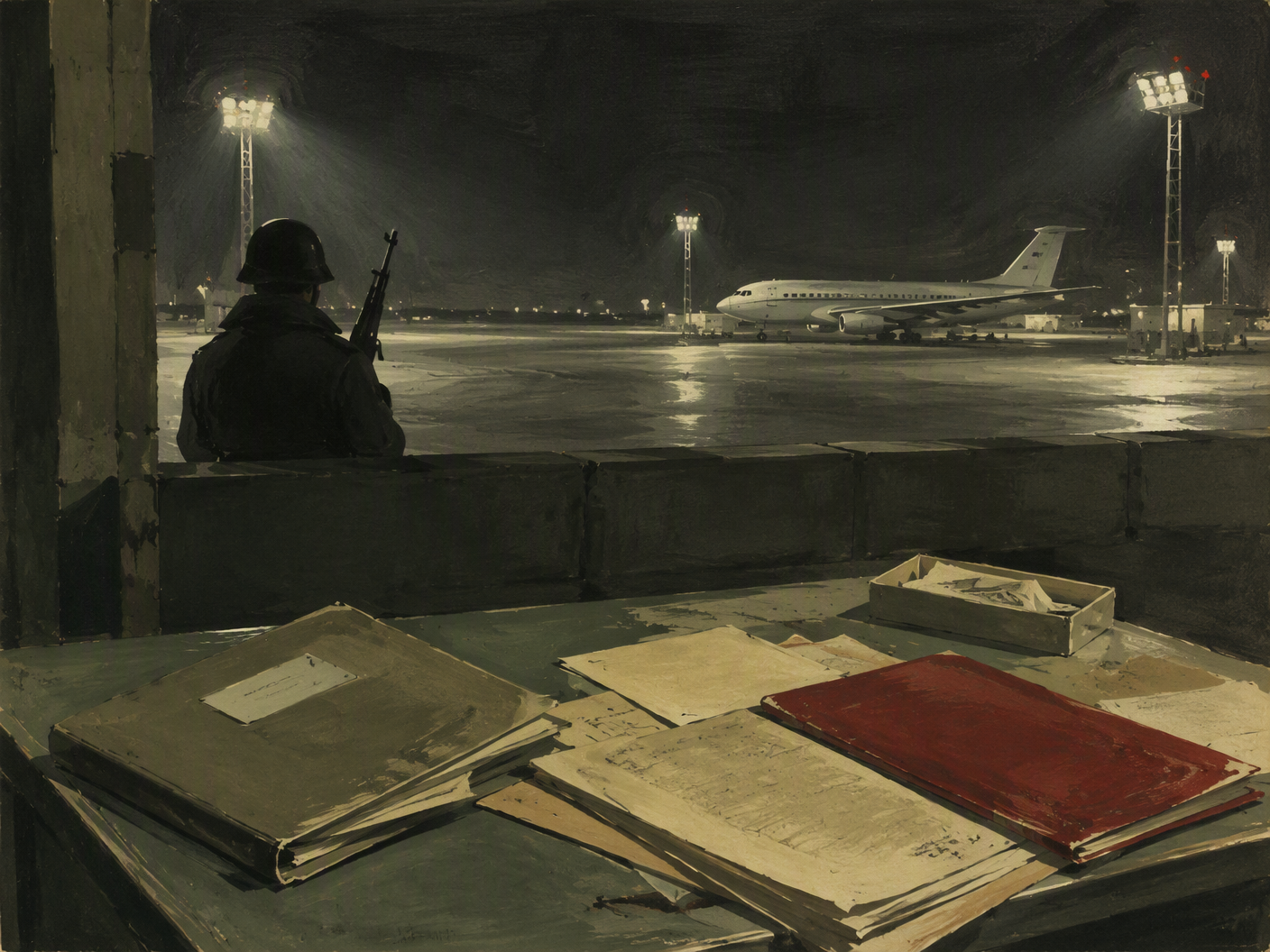
The decisive record from the night of 5–6 September 1972 is not a sporting image but an official contemporaneous assessment. A National Security Council memorandum, preserved by the U.S. Department of State’s Office of the Historian, recorded that the Israeli Olympians held hostage had been killed during the West German rescue operation at Fürstenfeldbruck. The memorandum was a U.S. Diplomatic assessment, not a German adjudicative finding: the rescue had not secured the hostages, and the crisis had ended with all eleven Israeli delegation members dead. It also opened a second institutional question. West Germany had to decide what to do with the attackers who survived the firefight.
The hostage-taking began before dawn on 5 September, when eight members of Black September entered the Olympic Village and reached the quarters of the Israeli delegation. Wrestling coach Moshe Weinberg and weightlifter Yossef Romano were killed during the initial takeover. Nine others were seized. The attackers demanded the release of prisoners held in Israel and West Germany, turning an event built to project peaceful international competition into a negotiation conducted under the threat of execution.
West German authorities negotiated through the day and arranged to move the group to Fürstenfeldbruck airbase, outside Munich. The plan relied on police marksmen, helicopters, and a controlled handoff. Retrospective accounts describe operational shortcomings involving command, equipment, and the capacity to fight at night. When the helicopters arrived, the militants recognized the trap. Gunfire followed, but the rescue became a prolonged exchange in which the hostages remained exposed inside the aircraft.
Five of the eight hostage-takers were killed by West German police. Adnan Al-Gashey, Jamal Al-Gashey, and Mohammed Safady survived and were captured, according to the historical accounts that identify the men. The distinction between capture and conviction matters. West Germany held three surviving members of the group, but the available record does not provide a completed trial or judgment separately establishing each man’s criminal acts. Custody became the next mechanism through which the state managed the consequences of the failed rescue.
The Olympic setting shaped the response without supplying the response itself. Munich’s organizers had built an image of openness and restraint around the Games, and that public posture existed alongside the practical demands of protecting a multinational delegation from an armed assault. Retrospective accounts describe shortcomings in the rescue plan involving police capacity, command structure, weapons, and intelligence. The surviving governmental memorandum records the outcome, while later accounts describe the operational gaps surrounding the attempt.
On 29 October 1972, Palestinian hijackers seized Lufthansa Flight 615 and demanded the release of the three surviving Munich attackers. West German authorities released Adnan Al-Gashey, Jamal Al-Gashey, and Safady, who were flown to Libya. The public sequence is documented in the surviving accounts: an aircraft was hijacked, a demand was made, and men arrested after the Fürstenfeldbruck firefight left West German custody less than two months after the hostages’ deaths. The accounts do not establish whether a separate secret agreement accompanied the release.
West Germany released the three surviving hostage-takers after the hijacking of Lufthansa Flight 615 and the hijackers’ demand for their freedom. The release was not a judicial finding about the killings or the failed rescue. The available accounts establish the sequence of the hijacking, the demand, and the transfer of the three men to Libya, but do not set out the complete reasoning behind the decision or establish whether a separate agreement accompanied it.
The surviving accounts also disagree over a detail that does not alter the larger sequence. One identifies Jamal Al-Gashey as Adnan’s cousin; another calls him Adnan’s nephew. Both identify Adnan as one of the eight militants involved in the Munich operation and Jamal as one of the three men who survived the airbase operation. Adnan was later associated with a press-conference exchange in Tripoli in which he was reported as saying that Israelis were regarded as enemies and had to be killed. That account remains an attribution; the available material does not establish the recording’s authenticity, the translation’s accuracy, or whether he personally killed a hostage.
Al-Gashey’s later fate is where the record loses its footing. One narrative describes him as a target of a subsequent Mossad assassination campaign. Aaron J. Klein offered another account: that Al-Gashey died naturally in Dubai in 1978 or 1979. Later summaries preserve both possibilities. No conclusive death record, forensic identification, or adjudicated finding in the available material resolves the conflict. The uncertainty should not be filled with intelligence mythology. It is a limit of the surviving public account.
The families’ long campaign for recognition took both legal and commemorative forms. The Guardian reported that relatives pursued legal action over the killings and Germany’s handling of the rescue; a court dismissed the case on limitation grounds, and the families later reached an out-of-court settlement with the German government. They also sought official Olympic remembrance, principally from the International Olympic Committee. Those efforts extended the public record beyond the night of the rescue and the subsequent release of the three surviving attackers.
The asymmetry is the lasting fact. The record establishes the entry of eight attackers, the deaths during the takeover, the failed rescue, the deaths of all eleven Israeli delegation members, the survival of three attackers, and their release after the Lufthansa hijacking. It also records the operational accounts of the rescue, the diplomatic assessment of its outcome, and the later custody decision. It does not establish the full chain of individual culpability, the complete reasoning behind the release, or how and when Adnan Al-Gashey died. Munich’s public record is firm about the sequence and incomplete about the explanations and later fate that remain disputed.
Companion notes
What the Munich Record Establishes—and Where It Stops
The source base supports the broad chronology and the governmental decisions that followed the failed rescue. It is uneven on the names, individual conduct, release negotiations, and death narratives, requiring those claims to remain attributed rather than presented as independently adjudicated facts.
The primary government record
The principal official source is the National Security Council memorandum preserved in Foreign Relations of the United States, Volume E-1, Document 92, through the U.S. Department of State’s Office of the Historian. It is a contemporaneous primary government memorandum and diplomatic assessment, not a court judgment, criminal indictment, or independent inquiry report. Its strongest evidentiary use is therefore narrow: it records the U.S. Government’s contemporaneous understanding that the Israeli Olympians held hostage were killed during the West German rescue operation. It should not be described as an adjudicative finding or treated as a complete tactical reconstruction. [S4]
Chronology and operational failure
The Munich massacre account and The Guardian provide the detailed chronology used for the hostage-taking, the initial deaths, the transfer to Fürstenfeldbruck, and the failed rescue. They describe the operational weaknesses surrounding the airbase attempt, while the government memorandum confirms the broad outcome. The source base does not include a surviving German inquiry docket, a full police command log, or a complete after-action report. Claims about tactical preparation must therefore remain attributed to the retrospective accounts rather than being inflated into a definitive institutional finding about every decision-maker. [S1], [S3], [S4]
Survivor identities and the Lufthansa release
The three surviving attackers—Adnan Al-Gashey, Jamal Al-Gashey, and Mohammed Safady—and the 29 October release are identified principally by two reference articles hosted by Wikipedia. The Guardian supports the broader history but does not, in the supplied source set, independently establish all three names or the release details. Those claims remain usable as reported historical accounts, not as conclusions independently confirmed by a court record or a separate primary German archive. The sources describe the hijacking demand as the public cause of the release and do not establish whether an undisclosed agreement also existed. [S1], [S2], [S3]
The Al-Gashey record
The account of Al-Gashey’s reported Tripoli statement comes from the Adnan Al-Gashey reference article, which links the exchange to archival video material. The supplied packet does not independently authenticate that recording, its translation, or the speaker’s identity. It therefore supports only an attributed statement. The same source contrasts a Mossad-assassination narrative with Aaron J. Klein’s account that Al-Gashey died naturally in Dubai in 1978 or 1979. The Munich massacre article and The Guardian preserve the competing narratives, but none of the supplied sources provides a death certificate, forensic identification, or adjudicated resolution. [S1], [S2], [S3]
Accountability and the Olympic afterlife
The Guardian’s account of the families’ legal and commemorative campaign supplies the clearest evidence of the crisis’s institutional afterlife. Relatives pursued a court case that was dismissed on limitation grounds, later reached an out-of-court settlement with the German government, and pressed the IOC for official remembrance. The record does not establish the precise terms of the settlement or independently determine which rescue decisions created legal liability. The Guardian’s account documents the legal outcome and the families’ continuing effort to secure official remembrance. [S3]
Source key
The associated evidence packet contains visible source URLs, source roles and the complete claim ledger.