
Point Shaving & Fixes · 2020s
The Seven Games and the Rigged Poker Table
On October 23, 2025, federal authorities announced arrests and indictments in two NBA-linked gambling cases: one centered on alleged betting irregularities and another on an alleged poker fraud scheme using hidden technology. Terry Rozier, Chauncey Billups, and Damon Jones were drawn into separate parts of the investigation, while the NBA placed Rozier and Billups on leave as the cases moved toward a superseding indictment in May 2026.
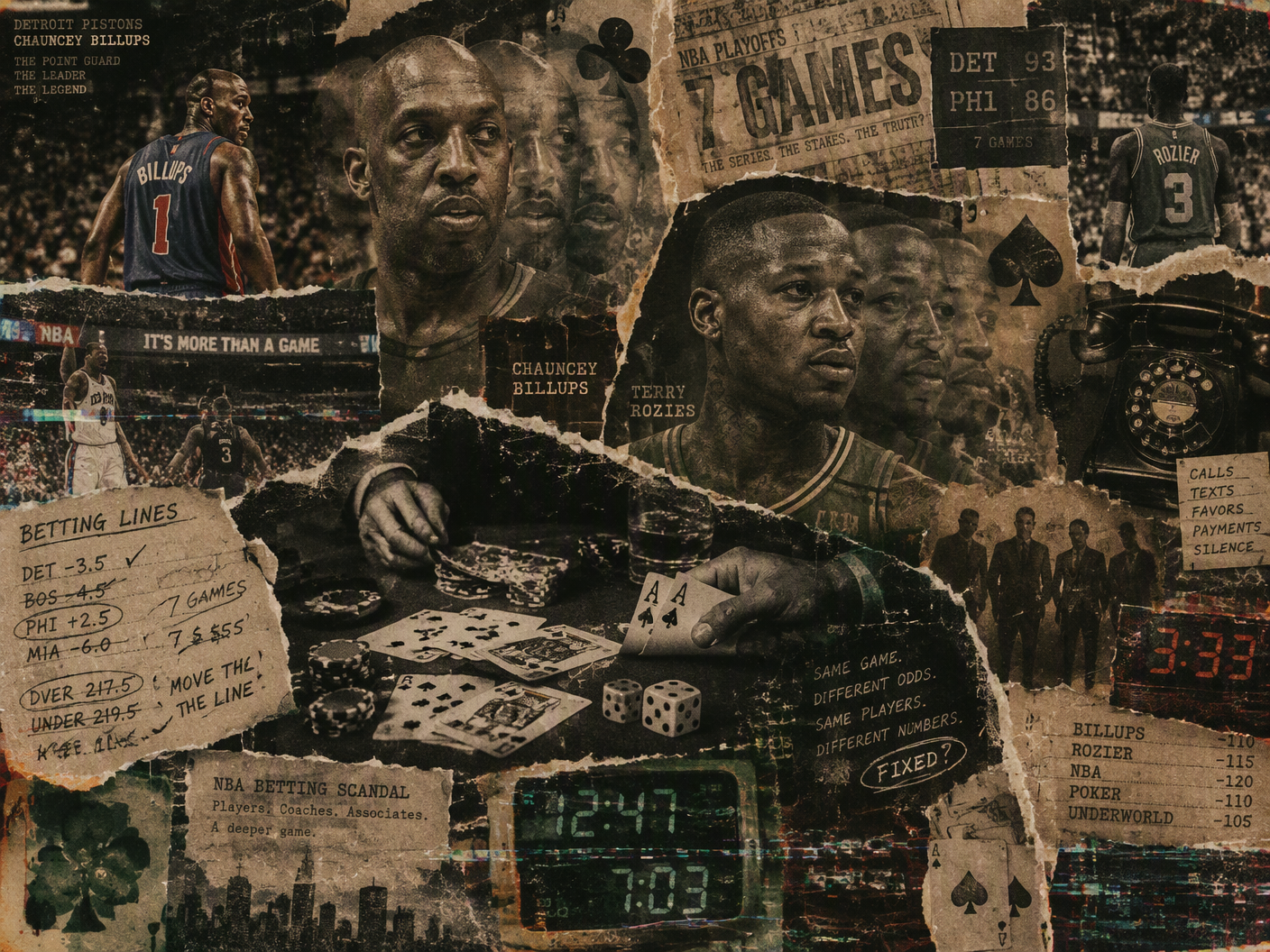
On October 23, 2025, federal authorities converted a long-running inquiry into two public criminal cases. Terry Rozier, a Miami Heat guard, was arrested in Orlando over alleged betting irregularities tied to NBA games. In Portland, federal agents arrested Chauncey Billups, the Trail Blazers head coach and a Hall of Fame former player, in a separate poker case. Damon Jones, a former NBA player, was also arrested in the broader investigation. The announcements came from federal authorities in New York and placed professional basketball inside two different gambling allegations at once.
The cases involved different alleged conduct. Rozier’s case concerned betting activity connected to games in which prosecutors identified unusual events and player information as part of a wider inquiry. Billups’s case concerned illegal poker games in which prosecutors alleged that technology gave favored players information unavailable to their opponents. Jones appeared in the federal sweep as a figure connected to both the poker and betting matters. The distinction was central: one prosecution focused on the integrity of NBA competition; the other focused on whether private games had been engineered to defraud their participants.
The betting investigation reached back to seven NBA games played between February 2023 and March 2024. Prosecutors placed those games inside the case against Rozier and associates, turning ordinary basketball events into potential evidence of a hidden exchange: what happened on the court, what information was available beforehand, and whether anyone used that information for a wager. The public accusation did not resolve those questions. It gave them a federal venue, named defendants, and a criminal theory that could be tested through litigation.
One game became a fixed point in the public chronology. Rozier left a Charlotte Hornets game against the New Orleans Pelicans after nine minutes because of a sore right foot. The event had a routine basketball explanation when it occurred: a player exited with an injury. In the later betting case, that early departure acquired a second meaning for investigators because a short appearance can affect wagering markets tied to individual performance. The injury itself remained a game fact; the alleged betting significance belonged to the prosecution.
The poker prosecution described a more elaborate operation. Federal authorities alleged that illegal games were equipped with X-ray tables, high-tech glasses, and other cheating technology designed to reveal information concealed from ordinary players. The alleged advantage was not a superior reading of an opponent or a lucky sequence of cards. It was an engineered view of the game. Prosecutors said the arrangement targeted victims in private gambling settings and produced approximately $7 million in losses.
Christopher Raia, the FBI assistant director in charge of the New York field office, characterized the alleged poker operation as a fraud scheme rather than an isolated dispute between gamblers. Federal authorities said members and associates of the Bonanno, Genovese, and Gambino crime families were involved. That allegation gave the poker case an organized-crime dimension and explained why investigators treated the games as a coordinated enterprise. Billups’s arrest connected the NBA’s institutional leadership to the prosecution, while Jones was identified as a participant in the wider network under investigation.
The public exposure produced immediate consequences inside the league. Rozier and Billups denied the allegations. The NBA placed Billups on leave from his coaching position, removing him from the Trail Blazers while the federal case proceeded. Rozier’s status was likewise affected as the league confronted an active criminal prosecution involving a current player. Administrative leave was not a verdict. It was an exercise of employer authority under conditions in which the allegations had become impossible for the league to treat as private investigative material.
The sequence also showed how quickly a sporting fact can be transferred into a legal theory. Rozier’s nine-minute appearance, his sore right foot, and the timing of his exit became relevant because betting markets assign value to minutes, points, rebounds, and other measurable outcomes. Prosecutors alleged that information about a player’s likely performance could be converted into money before the public understood what was happening. The accusation therefore depended on more than the player leaving a game. It depended on intent, communication, wagers, and the movement of money.
The two arrests also exposed different forms of access. In the betting case, the alleged advantage came from proximity to NBA competition and knowledge of a player’s condition or expected participation. In the poker case, the alleged advantage came from equipment hidden inside the game itself. Both theories depended on information withheld from others. One involved a professional contest watched by millions; the other involved private tables where victims allegedly paid for the chance to play under rules that had already been altered.
Federal authorities announced the cases in New York, while the arrests occurred in separate cities: Rozier in Orlando and Billups in Portland. The geography reflected the scope of the investigation rather than a single local incident. NBA-related betting activity crossed game venues and jurisdictions. The poker allegations reached into a network that prosecutors associated with organized-crime families and technology-assisted cheating. Damon Jones’s presence in both matters further joined the investigations, even as the charges against the principal figures remained attached to different alleged schemes.
The cases did not end with the October announcements. A superseding indictment was reported in May 2026, extending the life of the federal proceedings and showing that the initial arrests were not the final procedural stage. Rozier and Billups continued to face allegations rather than convictions. The seven games remained part of the betting prosecution’s stated frame, while the poker case retained its claims of technological cheating, organized-crime connections, and approximately $7 million in losses. The legal consequences were immediate; criminal responsibility still required adjudication.
Investigative Dossier & Evidence
Read the companion investigation notes, verified source claims, and primary documents.
Read the Companion Notes & Evidence Record →