
Scandals & Feuds ·
The NCAA Decision That Stopped SMU Football
The NCAA barred SMU from playing in 1987 after finding repeated cash-payment violations. The university chose to sit out 1988, then returned with a team heavy on freshmen.
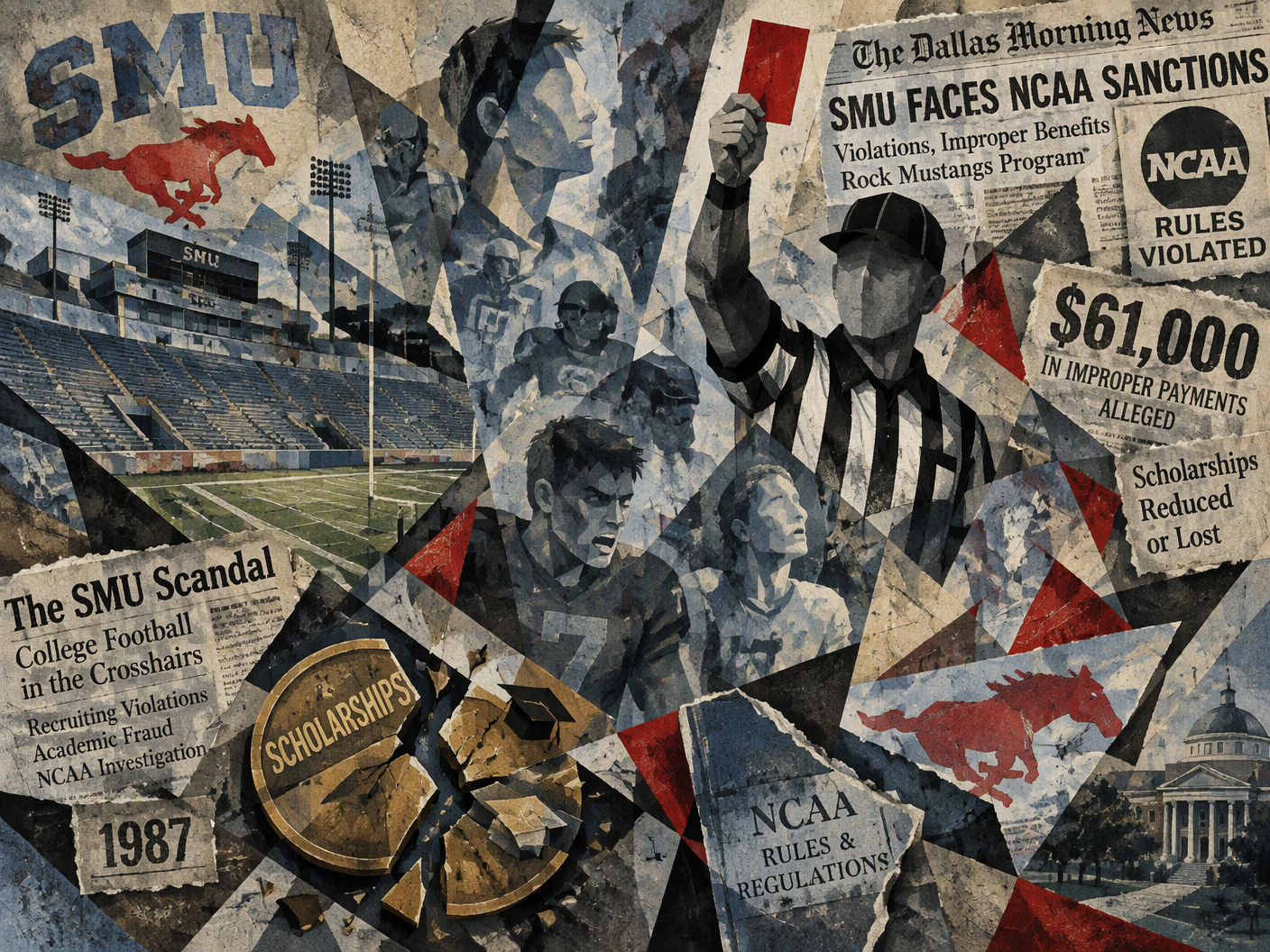
On February 25, 1987, the NCAA barred Southern Methodist University from playing football that year. Its finding was specific: 21 football student-athletes had received approximately $61,000 in cash, with help from athletics department staff members, from funds provided by an athletics representative. SMU was a repeat major violator. The sanctions allowed a restricted season in 1988, but the university later chose not to play. Football returned in 1989.
The investigation had begun with a former football player. According to the NCAA Committee on Infractions report, an enforcement representative interviewed him and his mother on October 21, 1986, about possible major violations. Eight days later, SMU’s faculty athletics representative, Lonnie Kliever, contacted the enforcement staff and pledged the university’s cooperation. University representatives and NCAA staff went on to share the work of interviewing people and gathering evidence.
The payments had continued despite earlier enforcement action. The committee reported that the money came from an outside athletics representative already disassociated from the program for involvement in an NCAA infractions case. At a February 13, 1987, hearing, SMU agreed that key members of its football coaching and athletics administrative staffs, along with another person for whose actions it was responsible, had committed repeat major violations.
That admission brought the program under rules adopted in 1985 for a second major violation within five years of the start of a major penalty. The committee described the mandatory sanctions available under those rules as the so-called “death penalty.” But it also had discretion to impose something less severe. SMU’s cooperation mattered: the enforcement staff joined the university in asking that no football season be canceled. SMU proposed dropping two nonconference games in each of two seasons; the staff proposed dropping all nonconference games for two years.
The committee did not preserve the 1987 season. It praised the university’s “extraordinary efforts to uncover wrongdoing,” yet said football could be rebuilt only under carefully controlled conditions. Its sanctions differed from the full prescribed repeat-violator penalties: SMU retained its NCAA voting privileges and ability to serve on committees. On the field, however, the restrictions were extensive. There would be no games or scrimmages in 1987, and practices would be limited to conditioning. Scholarship, recruiting and coaching limits accompanied television and postseason bans.
For 1988, SMU could play only seven games, none at home. The university elected to cancel that season too. One player’s response captured the immediate disorientation. “At first it’s shock. Then you get mad,” defensive back Jimmy Young, a redshirt freshman, told the Fort Worth Star-Telegram. “It’s hard to pinpoint who all you’re mad at. You’re mad at the school. You’re mad at the NCAA.”
Almost every player transferred, according to a 1996 Associated Press account. The team assembled for the 1989 return included more than 70 freshmen, many of them walk-ons recruited from the student body. Thirteen players suffered knee injuries requiring surgery that season; trainer Cash Birdwell said the usual number was about three or four. SMU finished 2–9. Tom Rossley, an assistant that year, recalled the scale of the task: “We were just worried about how to score a touchdown . . . we’d figure out how to win later.”