
Scandals & Feuds · 2000s-2020s
The Brains, the Mortality Study, and the NFL’s $765 Million Settlement
From Dave Duerson’s 2011 brain donation to postmortem CTE findings and the NFL’s 2013 settlement with roughly 4,500 former players and estates, the record traces how neurological injury became a scientific, personal, and financial crisis.
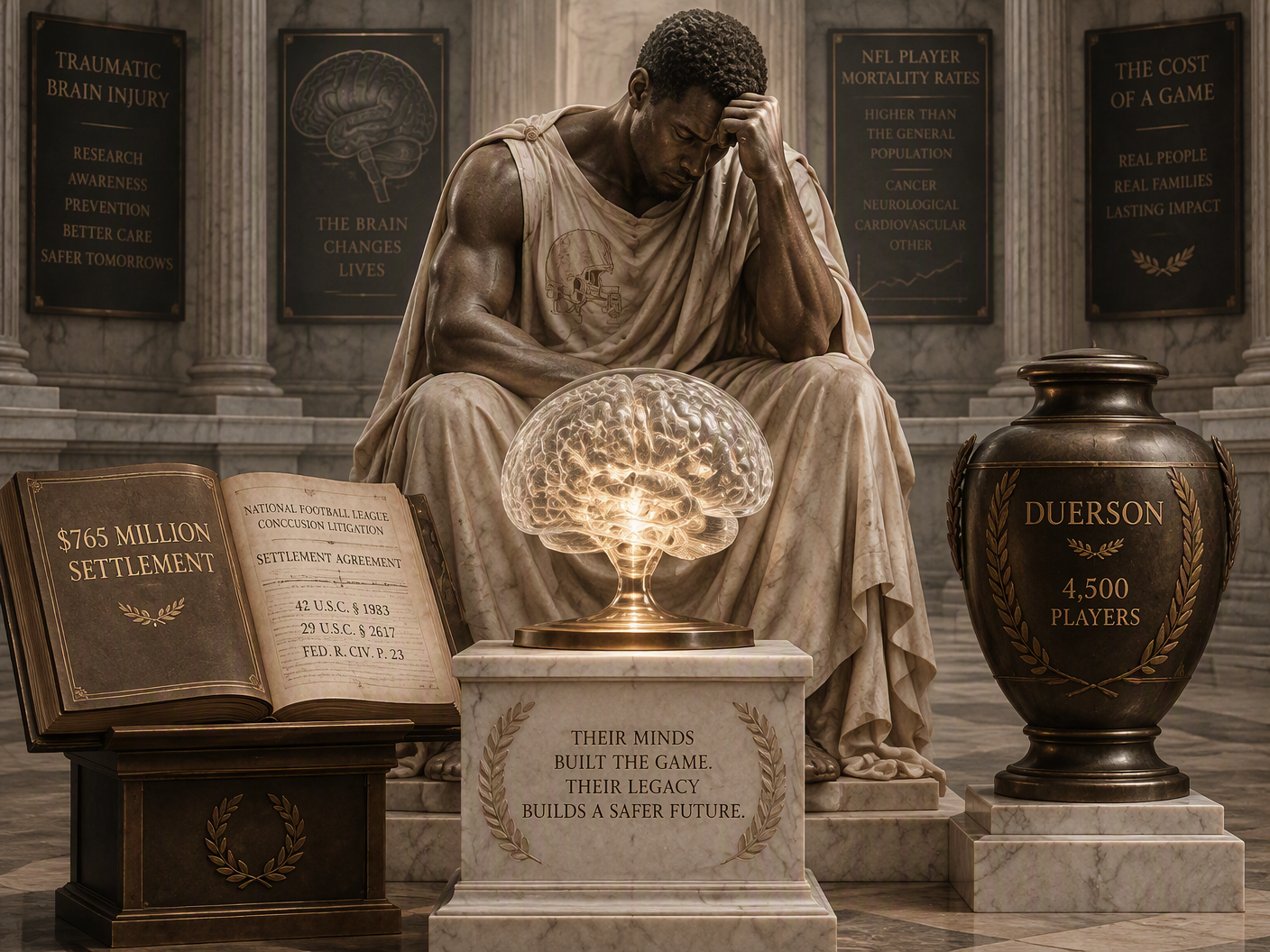
On February 17, 2011, Dave Duerson killed himself in his Florida apartment and left instructions about what should happen next. The former NFL safety asked that his brain be given to researchers studying head injuries. Duerson had spent his professional life in a sport built around repeated collisions, but his final request placed the question beyond the field: what had those impacts done to the organ that could no longer speak for itself? His brain became part of a growing body of donated tissue through which researchers were trying to identify a disease that could not be confirmed during life.
Researchers who examined Duerson’s brain concluded that he had advanced chronic traumatic encephalopathy, or CTE. The diagnosis gave physical form to a condition associated with memory loss, depression, violent mood swings, and other changes in cognition and behavior. It also carried a strict medical boundary. A brain autopsy was necessary to identify CTE and distinguish it from Alzheimer’s disease or amyotrophic lateral sclerosis, commonly known as ALS. For families trying to understand a former player’s decline, certainty arrived only after death, when treatment and explanation could no longer alter the outcome.
The scientific question had already begun moving through a different channel. Between 1959 and 1988, researchers followed 3,439 former NFL players who had completed at least five seasons. The study did not examine an individual brain; it measured causes of death across a defined group. When the Centers for Disease Control and Prevention summarized the work through its National Institute for Occupational Safety and Health blog in 2012, the results showed a three-times-higher risk of death from neurodegenerative disorders than in the general United States population.
The same study reported an even higher figure for two particular diseases. The former players faced four times the general population’s risk of dying from Alzheimer disease and ALS. Those numbers described mortality, not the interior condition of every player who had worn an NFL uniform. They nevertheless changed the scale of the discussion. The issue was no longer confined to isolated stories of men whose memories, moods, or judgment had altered after retirement. A cohort measured in thousands had produced a pattern that public health officials considered significant enough to publish.
The study also found that the players lived longer on average than the average American male. That result sat beside the elevated risk of neurodegenerative death, rather than replacing it. Longevity answered one question; cause-specific mortality answered another. Former professionals could outlive the average man overall while remaining more likely to die from particular neurological diseases. The distinction mattered because football’s health consequences did not present as a single, uniform life expectancy. They appeared through different diseases, different ages, and different families confronting the aftermath of a career whose physical cost extended beyond retirement.
Duerson’s donation connected those population figures to a human case. His death had been immediate and final; the examination of his brain was slower, conducted by specialists working after the fact. The resulting diagnosis placed a name on changes that had been difficult to measure while he was alive. It also made the brain bank an important institution in the emerging research: former players and their families could contribute tissue, while scientists compared the structures found after death with the symptoms described during life.
By then, former players and their estates were pursuing claims against the NFL over football-related brain injuries. In 2013, the league and lawyers representing about 4,500 former players or estates announced a settlement valued at $765 million. The agreement converted years of medical disputes and litigation into a financial arrangement involving the institution that had organized professional football and the people who had played under its rules. The announcement did not end the scientific work. It established that the legal consequences had become large enough to require a settlement on a national scale.
The settlement also changed the practical position of families seeking recognition and assistance. A former player’s illness could now enter a formal process tied to benefits, claims, and eligibility rather than remain solely a private medical crisis. The full terms and the resolution of every individual claim belonged to that legal process, not to the public announcement alone. Yet the central fact remained: the NFL had reached an agreement with thousands of former players and estates over brain-injury litigation, placing financial responsibility alongside the growing body of medical concern.
Research continued through donated brains, and the numbers grew. A July 28, 2017 update described work by Boston University and Veterans Affairs researchers who found signs of CTE in nearly 90 percent of the 200 brains they examined. Among the specimens from NFL players, the proportion was 110 of 111. These were postmortem findings from donated brains, not examinations of every former professional. Their importance lay in the way they extended the inquiry from death certificates and population statistics into the tissue itself, where researchers could identify the disease’s physical signatures.
The Boston University and VA findings brought renewed attention to the range of damage associated with CTE. Memory loss, depression, violent mood swings, and other cognitive and behavioral issues described the human terrain around the pathology. Families had encountered those changes as conduct, confusion, or withdrawal before researchers could study their causes. The diagnosis could clarify a brain after death, but it could not be made with certainty in a living person. That boundary shaped both the medical debate and the experience of former players whose symptoms had no definitive test.
Across six years, the question moved through four forms. Duerson’s request made brain donation an act of personal intention. The NIOSH cohort study measured elevated neurodegenerative mortality among thousands of former players. Autopsy research identified CTE in donated specimens, including Duerson’s and the later Boston University sample. The 2013 settlement translated the injury dispute into a $765 million legal resolution involving roughly 4,500 claimants. Each stage answered something different, and none erased the others: population data, individual pathology, family experience, and institutional liability occupied separate parts of the same history.
The enduring arrangement was therefore both medical and legal. CTE remained a disease diagnosed through examination of the brain after death, while mortality research continued to describe risk across groups rather than determine the fate of every player. The public record preserved distinct pieces of the dispute: Duerson’s brain-donation request, the cohort’s mortality findings, postmortem diagnoses in donated specimens, and the NFL’s announced settlement with former players and estates. That settlement created a legal route for compensation, but its announcement did not resolve every individual claim or turn the research findings into one explanation for every illness. What remained was a documented sequence of medical findings, player and family claims, and an institutional response that took financial form.
Investigative Dossier & Evidence
Read the companion investigation notes, verified source claims, and primary documents.
Read the Companion Notes & Evidence Record →