
Violence & Brawls · 500s
The Nika Riots and the Chariot Factions That Turned Constantinople Violent
In Constantinople in 532, rivalry between Blue and Green chariot-racing supporters became a riot remembered for its exceptional death toll. The episode shows how a sporting faction could become a civic force, while the surviving historical account leaves the precise number of dead uncertain.
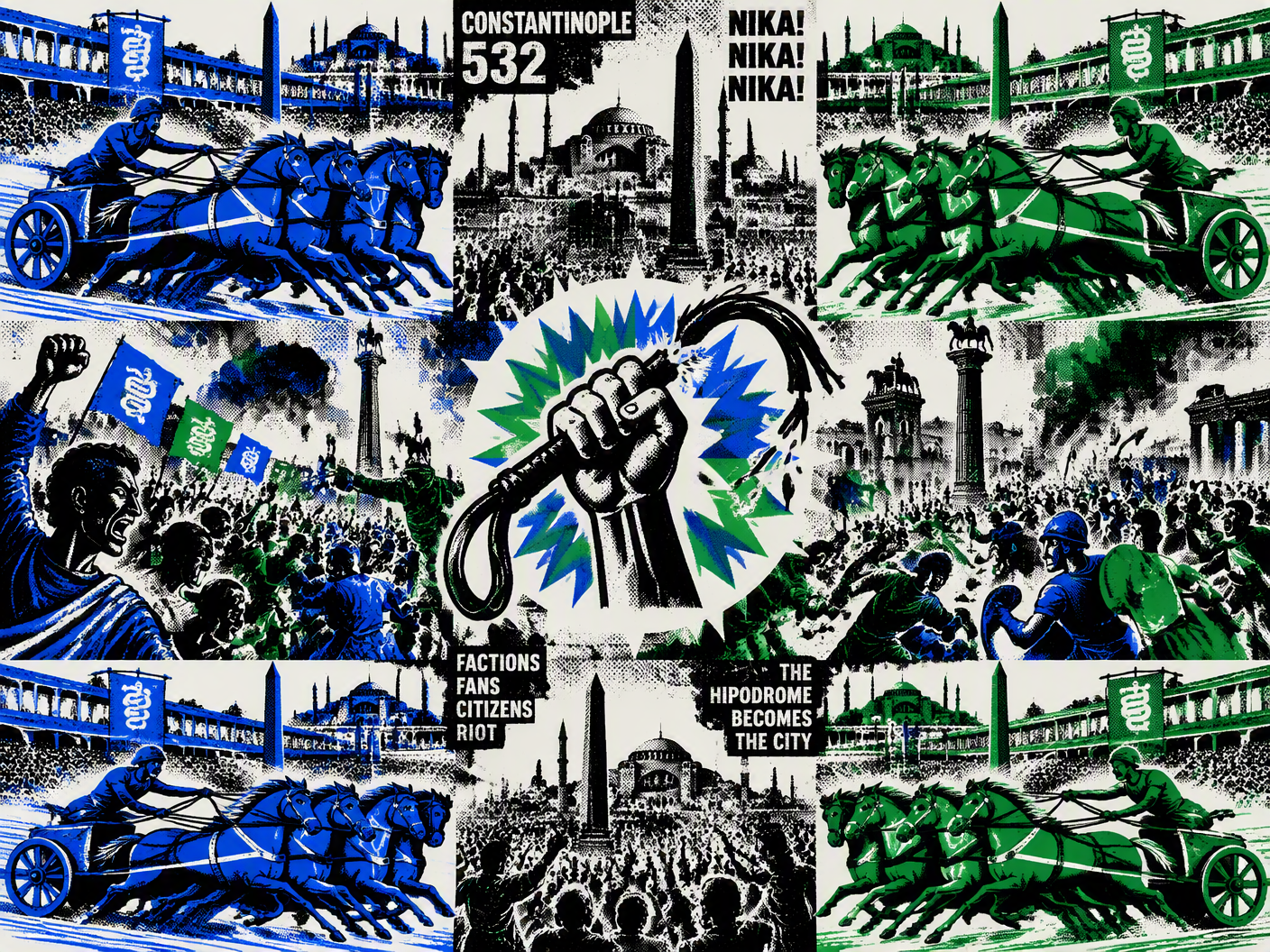
The trouble began with the colors. In Constantinople, Blue and Green supporters carried the loyalties of the chariot track beyond the race itself, into the streets and the public life of the city. In 532, that rivalry became the Nika riots. The Hippodrome stood at the center of the conflict, but the disorder did not remain inside a sporting enclosure. A quarrel between racing factions became a civic crisis. The names belonged to teams. The consequences belonged to everyone around them.
The Blues and Greens were not casual spectators with a passing interest in horses. Their allegiance gave public anger a shape and a language. Each faction had its own place in the city's chariot culture, and the division was sharp enough to turn competition into alignment. When the riots came, the teams supplied more than color in a crowd. They supplied the identities through which people gathered, opposed one another, and pushed a sporting dispute into the political life of Constantinople.
The transformation was the important act. A race-day rivalry could be loud, partisan, and dangerous without becoming a citywide breakdown. The Nika riots crossed that line. The event is remembered as one of the clearest examples of fan violence attached to sport in the Roman world, not because the chariots were unusually fast or the factions unusually theatrical, but because supporters carried their contest into public disorder. The arena had given the conflict its vocabulary. The city absorbed the cost.
The historical account places the riots in Constantinople in 532 and calls them especially deadly. Later summaries have put the deaths in the tens of thousands. That figure gives the episode its scale, but it also hangs over the story as a number without a surviving contemporary ledger behind it. The dead remain a mass in the telling: not a list of names, not a sequence of individual funerals, but a population swallowed by a riot whose precise human total cannot be fixed.
That uncertainty does not make the violence small. It changes what can be said about it. The Nika riots were not a minor disturbance at the edge of a race. They became a major public crisis, tied directly to the Blue and Green factions and remembered for the number of people said to have died. The exact toll is unsettled. The connection between the riot and the chariot supporters is not. In the surviving account, the colors are the first handles on the disaster.
Roman authorities understood that chariot racing could produce more than entertainment. When riots involving racing supporters broke out, officials frequently canceled sporting events. The cancellation was a practical response to a practical danger: remove the gathering, remove the contest, and perhaps deny the factions another meeting place. It was not a cure for the loyalties that made the crowd volatile. The Blue and Green supporters could be kept from the track. Their rivalry remained in the city.
That recurring response tells its own story about power. Authorities did not treat racing unrest as harmless noise. They treated it as a threat capable of interrupting public order, and they used the sport's schedule as one of the few direct levers available to them. A canceled event could close the gate and empty the stands. It could not erase the factions, settle their grievances, or recover people already lost. The official answer began with the calendar because the calendar was what officials could control.
The Nika riots therefore belong to two histories at once. They are part of Constantinople's political crisis in 532, and they are part of the longer history of spectators who make a team allegiance into a public identity. The first history explains why the event mattered to the city. The second explains why the episode still travels through accounts of sports violence. The chariot teams did not cause every pressure inside Constantinople. They gave those pressures a crowd, a banner, and a meeting point.
Centuries later, the pattern still appeared in altered clothes. In Los Angeles in 2000, about 10,000 fans gathered outside the Staples Centre after the Lakers won the title. The gathering became a riot. The setting was modern, the sport was different, and the factions had no chariots to follow. The movement was familiar: celebration gathered bodies together, loyalty sharpened the crowd, and the public space became the place where sport's emotional charge met police and civic order.
The comparison does not shrink the distance between imperial Constantinople and modern Los Angeles. It marks the recurring pressure point. A sporting crowd can be assembled by allegiance before it is assembled by command. Once the contest ends, the loyalty does not necessarily end with it. In 532, Blue and Green supporters carried that loyalty into the Nika riots, an outbreak remembered as especially deadly and associated with tens of thousands of deaths. Authorities learned to cancel races. They did not learn how to cancel belonging.
Investigative Dossier & Evidence
Read the companion investigation notes, verified source claims, and primary documents.
Read the Companion Notes & Evidence Record →