
Scandals & Feuds · 2000s
Dublin–Tyrone at Omagh: The Brawl, the Bans and the Appeal
A fourth-minute melee began an afternoon that produced four dismissals and a widening GAA disciplinary case. Within weeks, an appeal had undone seven player suspensions, leaving Colin Holmes as the only player whose ban stood.
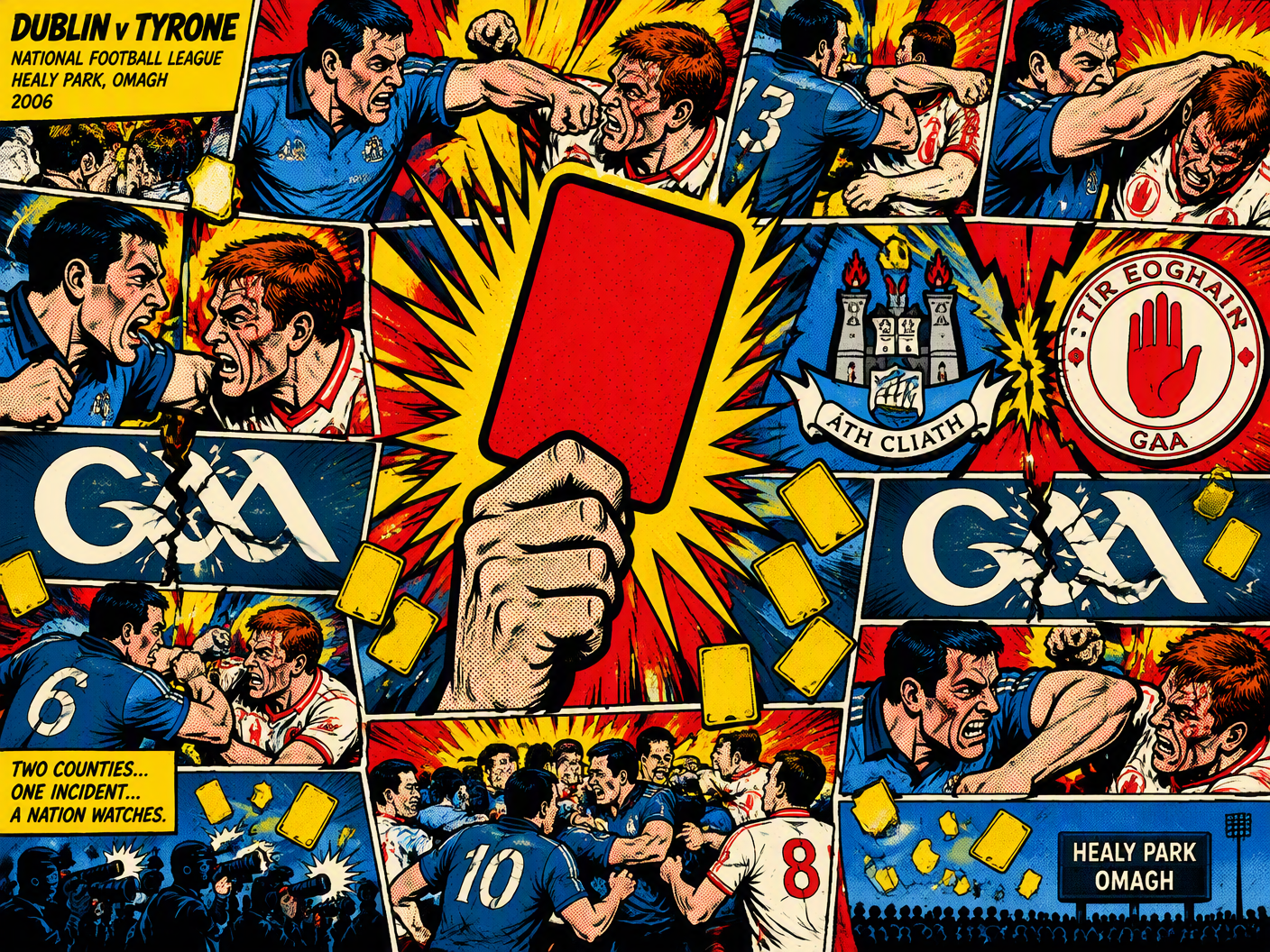
On 5 February 2006, four minutes into Dublin’s National Football League match against Tyrone at Healy Park in Omagh, as many as eighteen players became involved in a melee. The league opener had barely begun, and referee Paddy Russell already faced disorder extending well beyond an isolated confrontation between opponents. Further brawls followed. By the end of the afternoon, Russell would have sent off four players and issued fourteen yellow cards. His decisions on the field would begin a disciplinary process that continued into March.
The dismissals were divided equally between the teams. Dublin lost Alan Brogan and Denis Bastick; Tyrone lost Colin Holmes and Stephen O’Neill, the 2005 Footballer of the Year. O’Neill went off after a second yellow card. Four expulsions supplied a stark measure of Russell’s intervention, but they did not describe four identical offences. The basis for each dismissal would become important once the immediate task of refereeing the game gave way to the separate task of deciding who should remain excluded from playing afterward.
Dublin won 1-9 to 1-6. That result settled the fixture while leaving the consequences of the fighting to the Gaelic Athletic Association, whose disciplinary bodies could act beyond the referee’s match-day decisions. For the two teams, the afternoon therefore ended with different kinds of unfinished business: the league campaign would continue, but player availability and county responsibility would now be considered elsewhere. The fourteen cautions and four sendings-off were substantial interventions during the game. They would not be the extent of the association’s response to Omagh.
The next day, Russell submitted his match report. It clarified that Brogan had been dismissed for a second yellow card, while Holmes had been sent off for striking with the fist. During the match, both decisions had removed a player from the field. Afterward, they placed the two men on different disciplinary paths. Brogan’s dismissal arose from accumulated cautions; Holmes’s straight red card identified a direct act of violence. The difference would outlast the broader proceedings that were about to draw seven other players into the case.
By 9 February, the GAA’s Central Disciplinary Committee had banned Holmes for four weeks. The committee also continued examining footage of the match, extending its attention beyond the decisions Russell had made during play. There were now two stages to the response: a punishment already imposed on Holmes and a continuing examination that could bring further sanctions. The referee’s authority had operated amid the disorder itself. The committee could revisit the afternoon afterward, using the recorded action to consider a wider range of players and conduct.
On 18 February, that wider examination produced suspensions for seven players. Tyrone’s Michael Magee, Owen Mulligan and Kevin Hughes were sanctioned, as were Dublin’s Bryan Cullen, Ciarán Whelan, Kevin Bonner and Alan Brogan. The list reached beyond the four men sent off at Healy Park. Brogan, already dismissed during the match, now faced a further period away from competition; other players faced exclusion through the committee’s subsequent action. What had begun with Russell’s decisions in Omagh had become a broader exercise of the association’s disciplinary authority.
The committee also fined the Dublin County Board and the Tyrone County Board €10,000 each. These penalties extended the consequences from named players to the bodies responsible for the county teams. Individual suspensions and county fines operated differently: one excluded a player from participation, while the other imposed a financial burden on an organisation. Together, the decisions made the committee’s response both personal and institutional. Neither county emerged from the February proceedings carrying only the sporting result, and responsibility was being addressed on both sides of the fixture.
Yet the Central Disciplinary Committee was not the final authority in this sequence. The suspensions went before the Central Appeals Committee, moving the dispute from the imposition of punishment to the review of those decisions. That change of forum mattered to every player facing a ban. The February sanctions had announced who would be kept out; the appeal would determine whether those exclusions survived. The association that had extended its intervention beyond the match also provided a route by which its own disciplinary action could be overturned.
In March, the Central Appeals Committee struck out the seven suspensions on a technicality. Magee, Mulligan, Hughes, Cullen, Whelan, Bonner and Brogan were no longer subject to those bans. The reversal changed the practical outcome of the wider disciplinary proceedings: the committee’s February decision to exclude them no longer stood. A process that had expanded from four match-day dismissals to a larger group of suspended players had narrowed again on appeal. Holmes remained the exception, his four-week punishment resting on the straight red card for striking.
The lasting division was between what happened at Healy Park and what punishment endured beyond it. Dublin’s victory remained a 1-9 to 1-6 result in a match marked by repeated fighting, fourteen yellow cards and four dismissals. The wider suspensions belonged to a different sequence: imposed in February, struck out in March. Holmes alone ultimately remained suspended. Omagh’s disciplinary afterlife thus turned on the distinction already present in Russell’s report the day after the game—the straight red card that supported a surviving ban while the broader sanctions failed on appeal.
Investigative Dossier & Evidence
Read the companion investigation notes, verified source claims, and primary documents.
Read the Companion Notes & Evidence Record →