
Scandals & Feuds · 1990s
The WWF Firearm Angle at Brian Pillman’s Home
On November 4, 1996, WWF television presented Steve Austin approaching Brian Pillman’s home, where Pillman displayed a handgun before the feed broke away amid reported gunfire. Retrospective accounts describe Kevin Kelly’s reported fear, network backlash, and apologies from the WWF and Pillman, but do not establish whether the weapon was loaded, whether shots were fired, or who authorized every production decision.
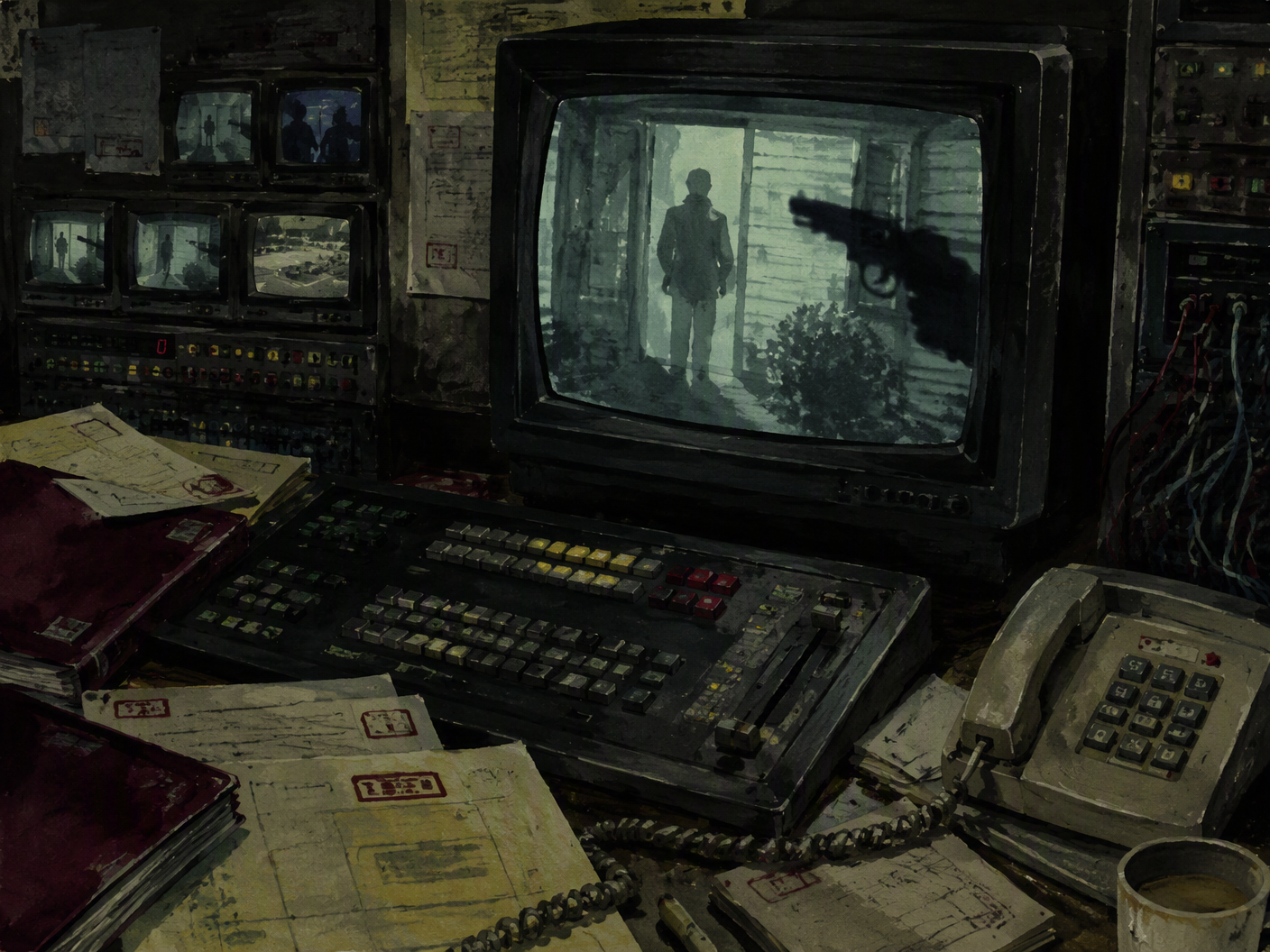
The decisive moment took place outside the wrestling ring. On November 4, 1996, WWF television carried Steve Austin’s feud with Brian Pillman to Pillman’s home, where Pillman displayed a handgun as Austin approached. The feed then went dark amid reported gunshots or explosions and reactions from people inside the house. The program presented a domestic firearm threat through images associated with an unfolding emergency.
A wrestling arena supplies its own signals: ropes, lights, referees, entrances, and a crowd gathered to watch a contest. A private residence supplied none of those assurances. The segment placed the audience at a threshold, with a performer, a visitor, a gun, and hurried movement inside the house. The Austin-Pillman storyline remained the organizing structure, but the setting made the feud look as though it had escaped the controlled geography of television wrestling.
Pillman’s “Loose Cannon” persona had been associated with performances that blurred scripted wrestling and apparent reality. Retrospective accounts connect that persona to the angle’s broader context, in which an ongoing wrestling storyline was presented through the visual language of an uncontrolled event. That context places the Austin-Pillman feud within Pillman’s established performance style, but it does not establish the private chain of approvals behind the firearm segment.
The broadcast showed Austin arriving at the location and moving toward Pillman. Inside, Pillman displayed or pointed the handgun while people associated with the production reacted around him. The broadcast transmitted the appearance of an uncontrolled confrontation rather than an athletic exhibition. While surviving accounts document the televised presentation, participant recollections, and subsequent reactions, the internal authorization and creative direction behind the segment remain unrecorded in the surviving documentation.
Then the feed went dark. Retrospective descriptions say the transmission was disrupted amid reported gunshots or explosions, with reactions from people inside the home forming the final impression of the scene. The interruption did not resolve the confrontation; it left the outcome uncertain while the program continued. Nothing in the available accounts establishes that the gun was loaded or that actual shots were fired. What is established is narrower: WWF television presented the appearance of a firearm emergency and left the audience with no visible boundary between the scene and the danger it imitated.
Kevin Kelly, who participated in the segment, later said that he was frightened during the filming. His description places fear inside the production, not only in the audience’s response. Kelly’s recollection describes a participant navigating an apparent threat from within the performance. His account is personal testimony about what he experienced. It does not, by itself, establish the safety conditions, instructions, or authorization structure under which the scene was made.
Kelly later said that Pillman armed himself after learning Austin was coming to the location, describing the weapon as a safety measure. That explanation reflects how one participant recalled the scene within the ongoing storyline, but it does not supply a formal corporate record. Without contemporaneous production logs, the public accounts cannot establish how far authorization extended beyond the performers in the room.
Later accounts report that the angle caused problems with USA Network officials. The reported network reaction is not an on-the-record USA Network finding or contemporaneous internal document. It establishes that subsequent accounts described concern among officials at the broadcaster, but not the precise nature of that concern, which officials expressed it, or what decisions followed.
The WWF and Pillman later apologized after the angle generated criticism. Retrospective reports also attribute to Vince McMahon an acknowledgment that the company had gone too far, although the original statements and their precise wording are not reproduced in the available material. The apologies document a response to the criticism. They do not identify who made the underlying decisions or establish the full sequence between the broadcast, the reported network reaction, and the public statements.
The angle has persisted in retrospectives as an example of late-1990s television wrestling presenting an apparent confrontation in a domestic setting. By taking a storyline outside the arena and presenting a firearm at a private residence, the broadcast presented the appearance of an emergency on television. Retrospective accounts record the reaction from USA Network officials and the subsequent public apologies, but the private planning and internal authorization behind the broadcast remain undocumented in the surviving record.
The public record therefore supports a bounded conclusion. WWF television presented an apparent firearm confrontation at Pillman’s home; the feed broke away amid reported gunfire; Kelly later described personal fear during filming; later accounts reported friction with USA Network; and the WWF and Pillman issued apologies. The available sources substantiate a televised performance that drew reported criticism and network concern, but do not establish a real attack, a loaded weapon, or actual gunfire. The episode reflects the boundary between televised performance and documented reality: WWF television presented an apparent armed emergency, but the surviving record establishes only the broadcast, the participant recollections, the reported network concern, and the public apologies.
Companion notes
The Evidence Boundary Around “Pillman’s Got a Gun”
The supplied material documents the televised presentation, participant recollections, broadcaster friction, and subsequent corporate apologies. It reveals a structural absence of institutional governance: no contemporaneous production records, weapons protocols, or executive authorization exist in the surviving record to establish how corporate leadership and broadcast partners managed participant risk or public accountability.
What the public accounts establish
The Attitude Era and Brian Pillman reference pages describe the November 4, 1996 Raw segment as a confrontation at Pillman’s home: Austin arrived, Pillman displayed or pointed a handgun, and the feed faded or was disrupted amid reported gunshots or explosions. Wrestling Inc. And 411Mania provide substantially similar chronology. Taken together, these accounts establish what WWF television presented. They do not establish the physical status of the weapon, the reality of the confrontation, or the occurrence of actual gunfire. [S1], [S2], [S3], [S4], [S5]
The same material places the segment inside the Austin-Pillman feud and connects Pillman’s “Loose Cannon” persona to a performance strategy built around uncertainty between scripted wrestling and apparent reality. That context supports an interpretation of deliberate ambiguity. It does not prove that every apparent mishap was planned, that the production lost control, or that the scene represented an actual assault. [S2], [S4]
Participant testimony and production governance
Wrestling Inc.’s accounts of Kevin Kelly’s recollections record his participation and his later description of being frightened during filming. His testimony reflects a participant describing the scene from within the production. However, it remains a retrospective personal account rather than a contemporaneous production record or institutional inquiry. [S3], [S5]
Kelly also said that Pillman armed himself during the segment as a safety measure after learning that Austin was coming to the location. While Kelly offered this explanation for the weapon, his account does not establish who authorized the firearm, what safety procedures existed, or who controlled the production. The supplied material contains no contemporaneous corporate record testing that explanation. [S3]
Broadcaster backlash and institutional response
Wrestling Inc. and 411Mania report that the segment created problems with USA Network officials. Those accounts document reported backlash and recollections of network friction, but they represent retrospective journalism rather than an on-the-record USA Network finding or contemporaneous internal document. While the reports describe broadcaster concern, no formal inquiry or contemporaneous corporate record is included in the available sources. [S3], [S4], [S5]
The available reporting also says that Pillman and the WWF apologized after criticism and attributes an acknowledgment to Vince McMahon that the company had gone too far. The original statements are not reproduced in the supplied material. Their exact wording, audience, and institutional scope therefore remain uncertain, and the surviving accounts do not document the internal deliberations or authorization that preceded them. [S1], [S2], [S3]
Provenance and institutional responsibility
The supplied source base consists of two Wikipedia reference pages, two Wrestling Inc. reports substantially based on Kevin Kelly’s recollections, and a 411Mania retrospective. The available material does not include contemporaneous production logs, internal executive minutes, or formal institutional records. In the absence of primary production documentation, repetition across these retrospective accounts cannot establish who conceived, authorized, or controlled every element of the segment. [S1], [S2], [S3], [S4], [S5]
The available record documents a broadcast performance and retrospective testimony rather than contemporaneous internal production logs. While participant recollections describe individual actions and reactions on scene, the internal creative directives, authorization, and institutional control behind the angle remain unrecorded in the surviving accounts. [S1], [S2], [S3], [S4], [S5]
Bounded conclusion
The supplied material supports a narrow account: WWF television presented an apparent firearm confrontation at Pillman’s home; the feed broke away amid reported gunfire; Kelly later described fear and a safety rationale; later reporting described network trouble and apologies. It does not prove a loaded weapon, actual shots, a real-world attack, or the complete production chain. The unresolved questions surrounding internal authorization, creative control, and the completeness of retrospective accounts should remain explicit in any publication based on this record. [S1], [S2], [S3], [S4], [S5]
Source key
The associated evidence packet contains visible source URLs, source roles and the complete claim ledger.