
Point Shaving & Fixes · 2010s
The Catania Match-Fixing Arrests and the Federation’s Demotion
In June 2015, police arrested Catania’s president and two senior football officials amid allegations that matches had been bought and players paid. Two months later, the Italian Football Federation relegated the club to Italy’s third tier, deducted 12 points, and banned the executives at the center of the case.
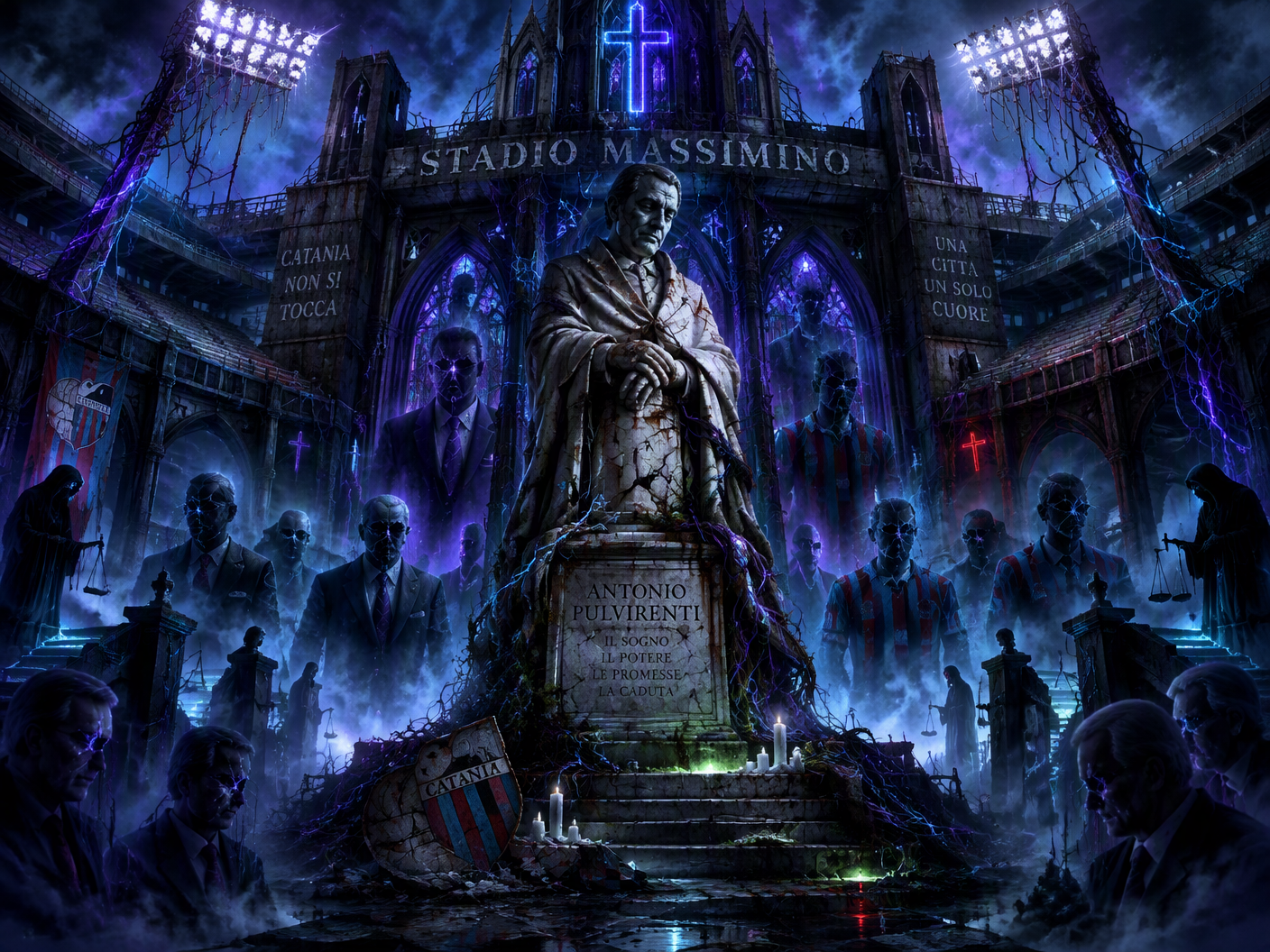
The sirens reached Catania before the football season had finished collapsing. On June 23, 2015, police arrested president Antonino Pulvirenti with six other people in a match-fixing investigation tied to Catania’s Serie B matches. The club had been living inside the bright machinery of Italian football—floodlights, television money, the vibrating concrete of the Stadio Massimino—and now its executive offices were part of a criminal inquiry. The accusation was fraud in sporting competition. A phrase as cold as a metal door. Behind it sat the possibility that games had been purchased, players paid, and an entire club’s public performance converted into a private transaction.
The June arrests were not the first tremor. On May 19, police had arrested 50 people in a broader Italian football match-fixing probe, a nationwide sweep that moved through the sport’s hidden corridors—betting networks, intermediaries, officials, men who understood that a single nervous defender or compromised goalkeeper could bend an evening toward a fortune. For three decades, Italian football had carried the voltage of this possibility. The stadium sold uncertainty as entertainment. The gamblers sold certainty in back rooms. By late June, the investigation had narrowed its beam onto Catania and the men who ran it.
Pulvirenti was the club’s president, the public face of the institution, the executive whose name belonged on announcements and hospitality suites. Pablo Gustavo Cosentino, Catania’s deputy chief executive, was arrested alongside him. Daniele Delli Carri, the former director of sport, was also taken into custody. Seven people were arrested in all. The police action tore through the normal hierarchy of football: not a disgruntled substitute at the edge of the squad, not a peripheral bettor, but men positioned near the club’s command center. The investigation had reached the level where decisions were made, relationships maintained, and consequences—until then—managed.
Catania’s public prosecutor, Giovanni Salvi, gave the case its most combustible outline. At least five matches had been fixed, he said; possibly six. Money had been given to players. The numbers moved through the country like a charge in the air, multiplying the scandal from one compromised fixture into a pattern. Five games meant repetition. Six meant a system with memory, contacts, and a working method. Salvi’s statement belonged to the investigative stage, but it changed the scale of the story. The question was no longer whether one game had been touched. It was how many times the machinery had turned.
The accusation struck at football’s central illusion: that the ninety minutes could be trusted because the players were trapped inside the same uncertainty as everyone watching. Fans arrive carrying statistics, rituals, scarves, family arguments. They surrender themselves to the goal that comes from nowhere, the late equalizer, the goalkeeper’s impossible reach. But match-fixing does not need to control every second. It needs only a hinge—a result, a margin, a moment when the supposedly spontaneous game becomes an instrument. Around Catania, the suspicion now gathered like smoke in a locked room.
For Pulvirenti and Cosentino, the sporting world that had given them authority now possessed its own machinery of punishment. The Italian Football Federation, known by its initials FIGC, could not simply wait for a criminal case to reach its final page. It governed the competitions, the licenses, the standings, the right of a club to occupy a place among its peers. That separation mattered. Police arrests opened an investigation. Salvi described what prosecutors believed had happened. The federation would decide what Catania’s conduct meant for the competition itself—and whether the club could remain where it was.
The answer arrived in Rome on August 20. FIGC relegated Catania to the third tier of Italian football and deducted 12 points for the following season. The punishment did not merely alter a table. It ripped the club out of Serie B, lowered its revenue, damaged its recruitment, and forced every player, coach, employee, and supporter to inhabit the consequences of an executive scandal. A club that had operated under the heat of professional ambition was pushed downward by federation decree. The future became arithmetic: a lower division, a points deficit, and a season beginning already in debt.
FIGC also turned its sanctions toward the men who had occupied Catania’s executive rooms. Pulvirenti received a five-year ban from football activities and a €300,000 fine. Cosentino received a four-year ban and a €50,000 fine. The figures were blunt, almost industrial: years removed from the sport, money taken from the people who had held power inside it. Pulvirenti’s five-year absence reached beyond a single club or season. Cosentino’s four-year ban carried the same message in a slightly different measure. The federation was not treating the affair as a bad night at the office. It was treating it as a breach of the game’s operating order.
The sanctions also exposed the difference between two kinds of judgment. Criminal investigators had arrested Catania officials over suspected match-fixing and prosecutors had described payments to players and multiple fixed matches. FIGC then imposed sporting penalties through its own disciplinary process. Those events established investigation and punishment inside football; they did not amount to a criminal conviction of Catania or its officials. The exact count in Salvi’s statement—at least five, possibly six—remained the prosecution’s investigative allegation rather than a final judicial number. The scandal carried two clocks, and they did not stop at the same moment.
By August, the bright surface of the sport had been replaced by paperwork, bans, and a club dragged toward the third tier. The stadium still existed. The shirts still existed. Somewhere, the grass waited under the same hard Italian sun. But the meaning of a Catania fixture had changed. Every result now carried the shadow of the arrests; every executive decision invited the question of what had been bought, who had been approached, and who had been expected to remain silent. The federation’s ruling supplied the consequence the table could display. It could not restore the uncertainty that match-fixing had taken away.
The case began with a national sweep of 50 arrests, tightened around seven people in Catania, and ended this period with a club demoted and its senior figures barred from football. Between those points stood Salvi’s account of five or six fixed matches and money moving toward players. The public drama was built from arrests and penalties, but the human price spread farther than the names on the federation’s decision: supporters lost a season’s horizon, employees inherited a damaged institution, and the players were left to perform beneath a cloud they had not all created. Catania’s fall was measured in divisions and points. Its echo remained in the empty space where trust had been.
Investigative Dossier & Evidence
Read the companion investigation notes, verified source claims, and primary documents.
Read the Companion Notes & Evidence Record →