
Doping & Drugs · 1990s
The Toothpaste Defense Germany Rejected to the IAAF’s Ban
Dieter Baumann’s positive nandrolone tests produced a laboratory explanation, a German suspension withdrawal, an international ban, and consequences for athletes who competed against him.
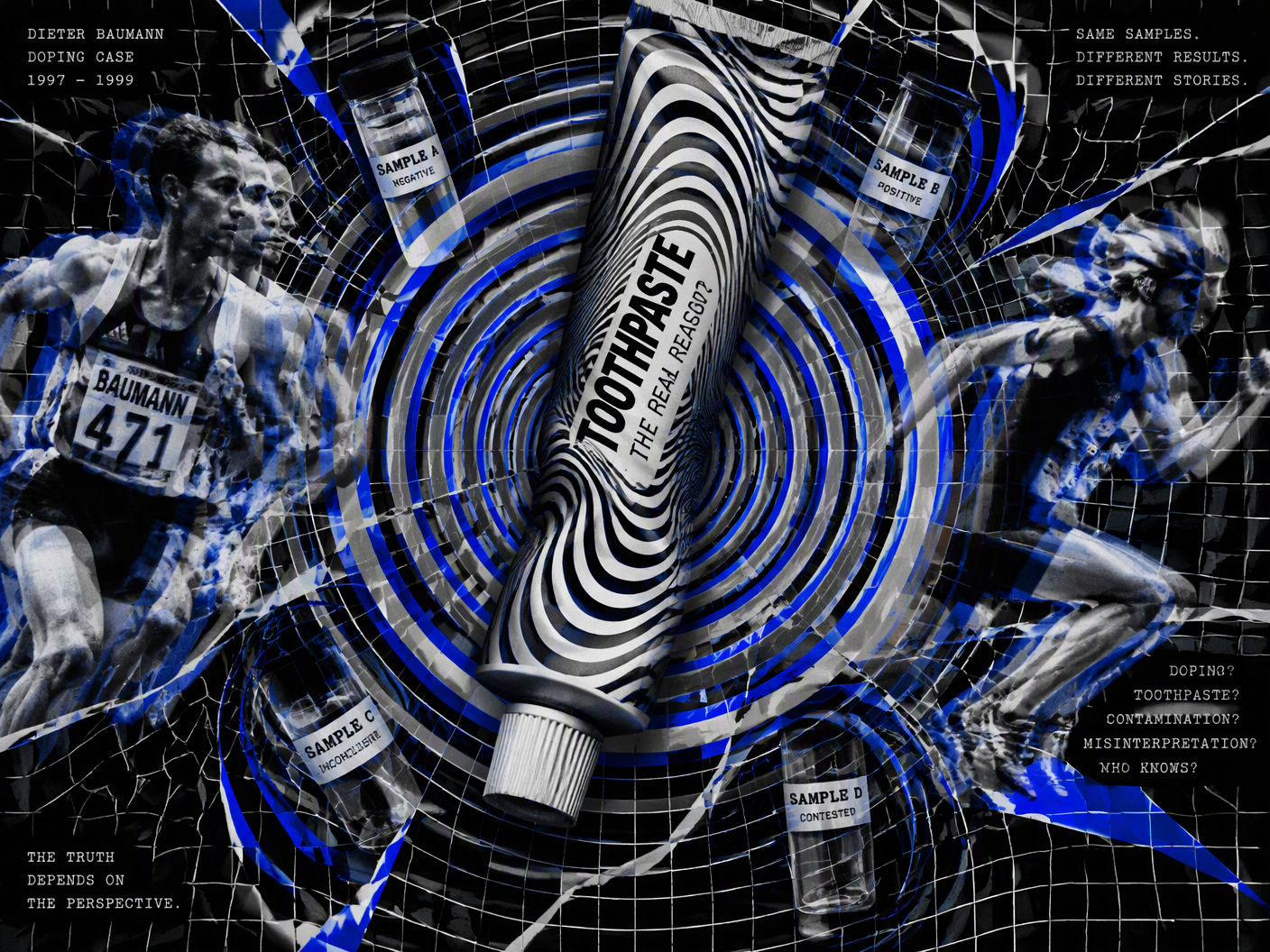
On 18 September 2000, the IAAF Arbitration Panel imposed a two-year ban on Dieter Baumann for a doping offence. The IAAF statement said the panel found that he had committed doping offences on 19 October and 12 November 1999. The CAS award records that the sanction led to the removal of Baumann’s Olympic accreditation; the IAAF said he was ineligible until 21 January 2002.
The case turned on the samples behind that sanction. From the 19 October A-sample, the IOC laboratory in Kreischa reported 19-norandrosteron at 23.2 ng/ml and 19-noretiocholanolon at 5.1 ng/ml. The CAS award also records that the B-sample tested positive for nandrolone metabolites. The result was therefore contested not only as a finding, but as evidence whose meaning institutions would assign differently.
A possible source emerged in the home search. On 29 and 30 November, IOC laboratory employees in Cologne took food substitutes and cosmetics from Baumann’s house while looking for a source of the positive findings. On 1 December, an Elmex toothpaste tube from the house was found to contain norandrostendion. The award also records an excretion test in which a test person produced nandrolone metabolites after using specially prepared toothpaste containing norandrostendion. The experiment demonstrated a possible route; it did not identify anyone responsible for the tube.
On 2 December, Baumann reported to the Tübingen public prosecutor’s office that unknown persons had committed an offence and said his toothpaste had been manipulated. The BBC reported that the prosecution admitted it had no evidence supporting that claim. Germany’s athletics federation nevertheless removed Baumann’s suspension on 23 June 2000, saying the necessary suspicion for a doping offence did not exist. Its legal committee treated the handling of the urine probes as the key defect and wrote that the positive samples were no longer usable as proof.
The IAAF panel reached the opposite conclusion, and its decision followed Baumann beyond the original sanction. In its February 2001 enforcement statement, the IAAF recorded that Baumann competed at the Dortmund indoor championships while declared ineligible. The statement also specified that the seven named competitors who ran against him were treated under Rule 53.1(ii). The toothpaste explanation had shifted the case from a positive test to a dispute over proof; the international ban made that dispute consequential for everyone on the track.
Investigative Dossier & Evidence
Read the companion investigation notes, verified source claims, and primary documents.
Read the Companion Notes & Evidence Record →