
Violence & Brawls · 1982
The Lions’ ‘99’ Call and the Boet Erasmus Retaliations
During the 1974 British and Irish Lions tour of South Africa, a retaliatory call turned individual confrontations into a collective response. The tactic became inseparable from two violent matches at Boet Erasmus, even as later folklore carried the number beyond rugby.
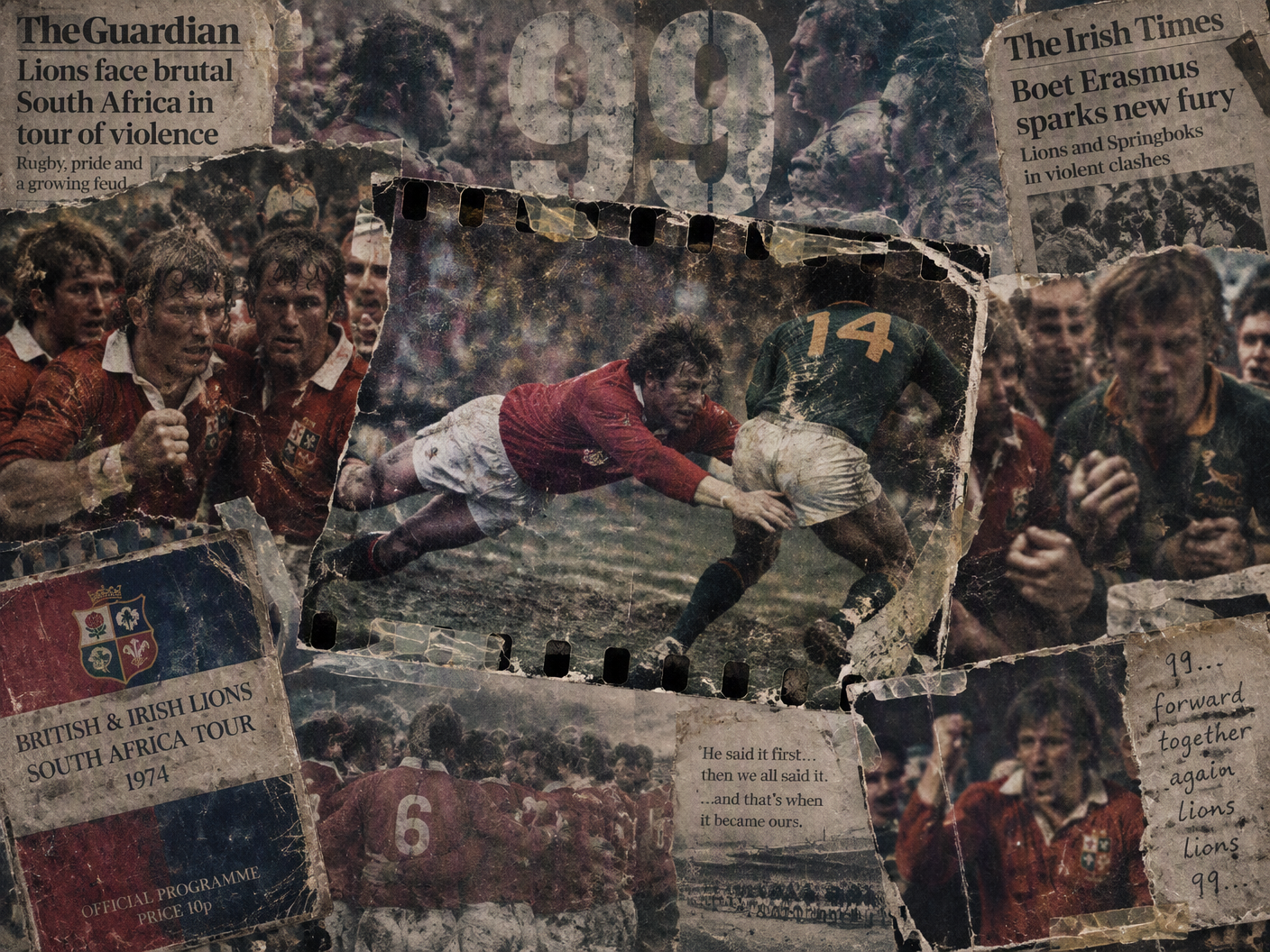
On 13 July 1974, at Boet Erasmus Stadium in Port Elizabeth, J. P. R. Williams came forward from full-back and tackled Moaner van Heerden after the South African lock had booted a Lion lying on the ground. The incident belonged to a match already marked by violent exchanges, but it also expressed the principle Willie John McBride had attached to the Lions’ tour: when one Lion was struck, the others were to answer. The call was “99.” Its meaning was simple and collective—every Lion joined the retaliation and hit the nearest opponent.
McBride, the Lions captain, became the figure associated with introducing the call during the South African tour. It was not presented as a written law of rugby or a formal disciplinary instruction. It was a team tactic, carried by word of mouth and applied in the instant when a confrontation threatened to isolate one player. The number converted that isolation into obligation. A fight involving two men could become a movement across the field, with forwards, backs, and players far from the original incident drawn toward it.
The first clear Boet Erasmus episode came on 25 May, when the Lions met Eastern Province. Gordon Brown was involved in the violence after a South African player was butted while on the ground, and the match moved into a physical altercation. The episode was not a separate interruption to the tour; it formed part of the way the contest was being played and answered. Before the match, South Africa coach Johan Claassen had reportedly instructed Eastern Province to “batter the Lions into submission.” The phrase gave the fixture an intention that the ensuing collisions made visible.
The players entered that match within a tour whose sporting stakes were still being settled. On 8 June at Newlands in Cape Town, the Lions won the first Test 12-3, with Phil Bennett and Gareth Edwards among the figures named in the contest. The result established their authority on the field, but it did not settle the physical character of the tour. A side could dominate the score and still be required to answer the next collision. The rugby and the violence advanced together, each supplying the conditions for what followed.
When the teams returned to Port Elizabeth for the third Test, the earlier pattern had acquired a larger stage. Van Heerden was involved in the decisive confrontation after kicking a Lion on the ground. Williams, stationed at full-back, ran across the pitch to tackle him. The distance mattered: this was not a collision confined to players already locked together. It was a deliberate movement from the edge of the field toward the incident, the kind of response the “99” call was designed to produce.
Other Lions were drawn into the exchanges, including Bobby Windsor, while McBride stood at the center of the team identity that made retaliation collective rather than individual. The third Test ended 26-9 to the Lions. The score was official and precise; the violence became the match’s enduring description. Later rugby histories placed the Boet Erasmus Test among the most violent matches in the sport’s history, not because the result was uncertain, but because the contest joined a major international fixture to repeated on-field assaults and reprisals.
That distinction shaped the tour’s afterlife. The Lions were not merely remembered as a team that won a series; they were remembered as a side that had organized its response to violence. The “99” call offered a compact explanation for scenes that otherwise appeared chaotic. It named a method: no player would face an attack alone, and the nearest opponent could become the immediate target. The method also erased distance and hierarchy. A full-back could leave his position; a forward could enter a quarrel already in progress.
The fourth Test took place on 27 July at Ellis Park in Johannesburg and ended 13-13. That draw completed a four-match series in which the Lions won three Tests and drew one, a 3-0-1 result in their favor. The series table supplied one kind of conclusion. The matches supplied another. Victory, draw, and retaliation occupied the same account, but they did not mean the same thing. The Lions’ competitive success could be measured in points and results; the conduct that accompanied it remained a separate inheritance.
The number traveled after the tour. In 1982, a later shinty folklore account placed a “99” call at South Inch in Perth during a Tayforth match against Kyles Athletic. Fr. Eugene O’Sullivan was associated with the fixture and was reported as having been sent off for punching an opponent; Tayforth won 4-1. The comparison linked a Scottish field sport to the South African rugby story through a shared idea of collective retaliation. The episode belonged to folklore rather than the official 1974 match results, but it showed how quickly a team signal could become sporting language.
What endured from Boet Erasmus was therefore not one isolated blow, nor a single scoreline. It was the memory of a touring side that answered violence with a prearranged summons, and of a captain whose name became attached to the call. The 1974 Lions won their series, and the official results remain 12-3, 26-9, and 13-13 across the decisive Tests. Alongside those figures stands “99,” a number that preserved the tour’s central contradiction: collective loyalty could protect a player, while the same loyalty enlarged every confrontation it entered.
Investigative Dossier & Evidence
Read the companion investigation notes, verified source claims, and primary documents.
Read the Companion Notes & Evidence Record →