
Scandals & Feuds · 2010s
The Brush-Head Dispute That Rewrote Elite Curling
New brush fabrics and directional sweeping turned equipment into a competitive and regulatory fault line during the 2015-16 season. The dispute reached the Stu Sells Toronto Tankard final between Glenn Howard and Mike McEwen before the World Curling Federation imposed a single fabric standard for sanctioned events.
By the 2015-16 season, a curling brush was no longer a neutral tool. New brush-head fabrics changed how sweepers could affect a stone’s path, and teams began using techniques described as directional sweeping. The change moved equipment from the edge of strategy to its center. Skips had to decide not only how their teams would play the ice, but which fabric their sweepers would place against it. The dispute would draw in leading rinks, divide players over acceptable equipment, and force the sport’s international governing body to write a rule for a problem that technology had created.
The technology had entered elite curling during the 2014-15 season. Brad Gushue’s team adopted the new brush-head design and used sweeping methods that exploited the fabric’s directional properties. Glenn Howard responded by calling his broom supplier and asking for rival brush heads. The competition was no longer limited to stones, ice speed, and tactical decisions. Manufacturers were developing products for teams that believed a brush could influence the line and distance of a moving stone in ways older equipment could not.
The response came from inside the playing ranks. On October 14, 2015, twenty-two teams signed a statement saying they would not sweep with brooms that used directional fabric. Glenn Howard, Brad Jacobs, Brad Gushue, and Jennifer Jones were among the prominent skips associated with the sign-on effort. The statement did not settle the technical question. It made the disagreement formal, however, and showed that leading teams were prepared to challenge the equipment standards while the season was still underway.
The World Curling Federation then acted at an international event. At the Pacific-Asia Championships in Almaty, Kazakhstan, the federation temporarily banned the controversial brooms in November 2015. The decision converted a player dispute into a governing-body problem. A brush head that was available in one competition could be prohibited in another, leaving teams to prepare for different rules depending on the event. The issue was no longer simply whether a particular product offered an advantage. It was whether the sport could maintain a common competitive standard while its equipment changed faster than its regulations.
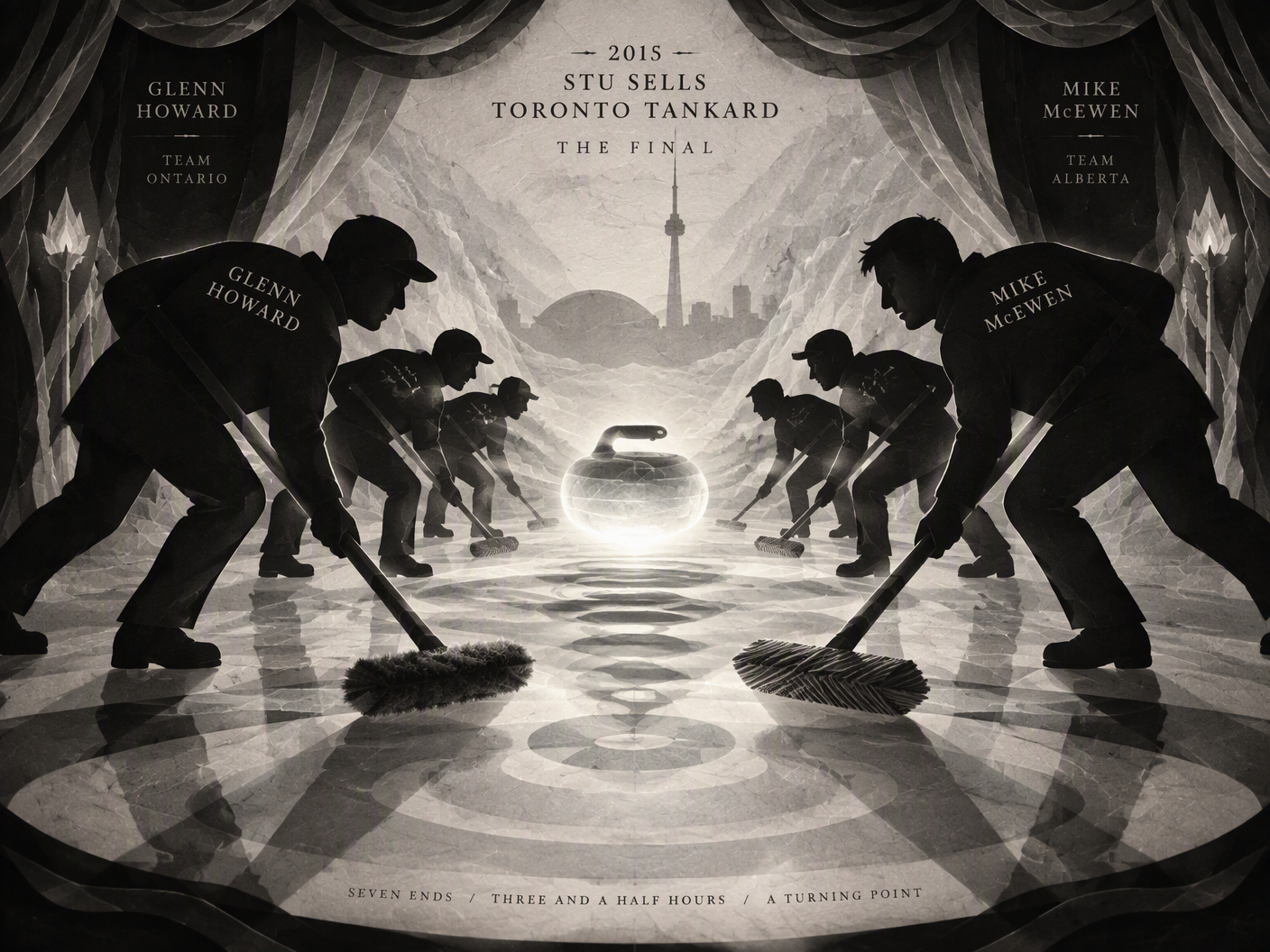
The dispute had already reached Toronto when Howard and McEwen met in the Stu Sells Toronto Tankard final. Their match lasted seven ends and approximately three and a half hours. That duration made the final an unusually visible expression of the conflict: elite teams were competing while the sport argued over the physical tools used to sweep. The brush heads were not an incidental detail. Both Hardline icePad heads and Balance Plus Black Magic heads appeared among the equipment used at the event, placing rival technologies inside a high-level final.
Howard and McEwen entered the final from different sides of a market that had become part of the sport’s tactical vocabulary. Howard had been involved in developing rival heads after the directional-fabric dispute intensified. McEwen’s team used Hardline brush heads. The equipment did not determine every shot, and the final did not produce a disciplinary finding against either rink. But the match demonstrated why the argument had become difficult to contain: teams could arrive at the same sheet with different brush technologies and different assumptions about what sweeping should do.
For the players, the conflict concerned technique as much as material. Traditional sweeping could alter a stone’s speed and trajectory through pressure, friction, and timing. Directional fabric expanded the argument by allowing sweepers to work with the nap or orientation of the brush surface. That distinction gave equipment makers a direct role in performance. It also created a governance question that could not be answered by asking whether a broom was legal in the ordinary sense. The federation had to decide which physical characteristics belonged inside sanctioned competition.
The temporary ban in Kazakhstan did not end the dispute. Nor did the October statement signed by the twenty-two teams. The competing products remained part of the conversation, and the Toronto final preserved the disagreement in a match that required hours to complete only seven ends. The controversy spread because no single body had yet established a uniform technical standard. Players could object to directional fabric, teams could adopt newer heads, and event organizers could face an equipment question that had previously been left to ordinary manufacturer specifications.
In May 2016, the issue was taken to Kemptville, Ontario, where curlers and researchers from the National Research Council gathered for a sweeping summit. They tested more than fifty brush heads and sweeping techniques. The summit treated the dispute as a measurable technical problem rather than a matter to be settled by reputation or player preference. Researchers and top curlers examined how different materials and motions interacted with the ice, creating a basis for a rule that could apply across sanctioned events.
The federation’s answer came before the 2016-17 season. The World Curling Federation decided that sanctioned competitions would allow only one standard fabric. The rule removed the most consequential equipment distinction from tournament choice, even though teams and manufacturers had driven the dispute into public view. It also replaced temporary event-by-event decisions with a common specification. The sport had spent a season discovering that a brush head could alter competitive practice. It ended that cycle by narrowing what every sanctioned team could use.
The Toronto final remained the clearest human-scale expression of the conflict: Glenn Howard and Mike McEwen playing seven ends over three and a half hours while rival brush-head technologies occupied the same competitive space. No criminal case emerged from the match, and no individual curler received a formal misconduct finding in connection with it. The consequence was institutional instead. A dispute that began with product development, team adoption, and player resistance reached a governing body, a research summit, and a new equipment rule that applied to everyone who entered sanctioned competition.
Investigative Dossier & Evidence
Read the companion investigation notes, verified source claims, and primary documents.
Read the Companion Notes & Evidence Record →