
Scandals & Feuds · 2010s
Armando Galarraga’s Perfect Game Lost on Jim Joyce’s First-Base Call
On June 2, 2010, Armando Galarraga retired 26 consecutive Cleveland batters before umpire Jim Joyce ruled Jason Donald safe in the ninth inning. Joyce apologized, Michigan issued a symbolic proclamation, and Major League Baseball left the official result unchanged.
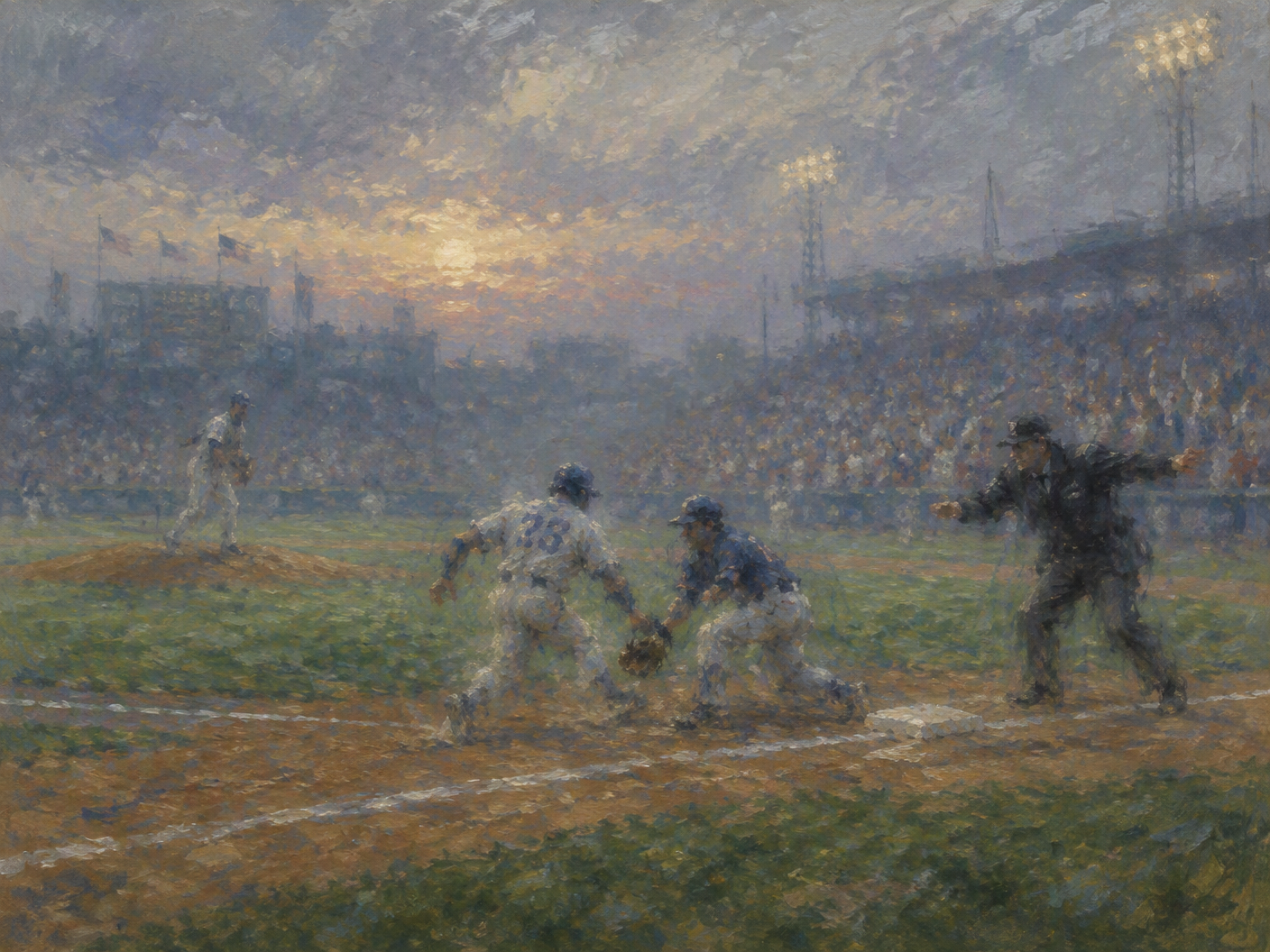
Jim Joyce ruled Jason Donald safe at first base in the ninth inning, ending Armando Galarraga’s perfect-game bid with one motion. The Detroit Tigers pitcher had retired the first 26 Cleveland Indians batters at Comerica Park on June 2, 2010. Donald’s ground ball reached first as Galarraga covered the bag, and Joyce made the call that separated a perfect game from an official one-hit shutout. The play was close. The consequence was exact. A single judgment altered the statistical record of a night in which Galarraga had otherwise removed every batter from the game.
Galarraga had carried the bid into the final inning without allowing a baserunner. The Tigers led the Indians, and each completed out reduced the remaining work to a smaller number: three outs, then two, then one. Donald’s ball created the only hit charged against Galarraga. The pitcher completed the game, and Detroit won 3–0. The scorebook gave him a one-hit shutout, a result that preserved the team victory while denying the individual achievement that had been within reach until Joyce’s ruling.
Joyce later said he had gotten the call wrong. That admission fixed the central dispute in unusually direct terms: the umpire who made the judgment acknowledged that the judgment was incorrect. Galarraga had not been beaten by a batter reaching safely on a clean hit or by a defensive error. Donald was credited with reaching first because Joyce ruled him safe. The call remained part of the game’s official sequence even after the umpire withdrew his confidence in it.
The immediate response belonged to the two men whose decisions and performance had collided at first base. Galarraga and Joyce met after the game, with Tigers manager Jim Leyland facilitating the encounter. Joyce apologized to the pitcher. Galarraga accepted the apology and told reporters, “Nobody’s perfect.” The sentence applied to the umpire’s mistake, but it also described the narrow human margin inside the episode: one man had made an error at the moment another was pursuing an achievement defined by the absence of error.
Galarraga’s response did not change what had happened to the game, but it changed the shape of the aftermath. He understood that Joyce’s decision had cost him the official designation, yet he did not turn the meeting into a public confrontation. Joyce’s apology also did not erase the call. It established accountability between the participants without granting either man authority over the league’s statistical record. The pitcher could accept the umpire’s regret. Neither could rewrite the result.
The following day, Michigan Governor Jennifer Granholm issued a proclamation declaring that Galarraga had pitched a perfect game. The document supplied a state-level answer to a dispute that baseball’s own rules had left intact. It honored the performance as a perfect game in political and civic language, but it did not replace the official scorebook or alter the result maintained by Major League Baseball. Granholm could recognize the achievement. She could not change the league’s ruling.
Major League Baseball commissioner Bud Selig did not reverse Joyce’s call. The league therefore preserved the formal distinction between what viewers believed they had seen and what its records could officially state. Galarraga had retired 26 batters in succession, completed the next play under an incorrect safe ruling, and finished with a one-hit shutout. The governor’s proclamation gave the performance a public title. MLB’s decision left the official record with a different one.
That decision placed authority in the hands of the league’s recordkeeping system rather than in the later admission of the umpire who had made the call. Joyce’s statement answered the question of whether he believed the ruling was correct. It did not provide a procedure for changing the game. Selig’s refusal to reverse the call meant that the error could be acknowledged, discussed, and honored outside the ledger while remaining embedded inside it. The incident became a conflict between correction and finality.
Galarraga and Joyce later became associated through a book project about the episode, making them business partners. In June 2011, Major League Baseball barred Joyce from umpiring games involving Galarraga’s team. The restriction did not punish Joyce for the original call, which had already become a settled part of the game’s history. It addressed the later relationship and the league’s concern about an umpire sharing a business connection with a player whose team he might officiate.
The arrangement showed how the consequences moved after the game ended. Joyce’s mistake produced an apology; Galarraga’s restraint produced a durable public association; Granholm’s proclamation supplied symbolic recognition; and MLB retained control over the official result. Each response operated at a different level. The participants could acknowledge the error, a state could declare what it believed had occurred, and the league could still refuse to amend its records. No single response controlled the entire meaning of the night.
What remained was a 3–0 Tigers victory, a one-hit shutout, and an official record that stopped short of perfection. Galarraga had completed the performance people meant when they called it a perfect game, but Major League Baseball did not award that designation and did not reverse Joyce’s ruling. The umpire’s admission preserved the human truth of the missed call. The scorebook preserved its institutional consequence. Both survived: the apology at first base’s edge, and the lost perfect game in the league ledger.
Investigative Dossier & Evidence
Read the companion investigation notes, verified source claims, and primary documents.
Read the Companion Notes & Evidence Record →