
Doping & Drugs ·
The Doping Case Armstrong Chose Not to Contest
USADA imposed a lifetime ban for Armstrong’s doping violations involving the U.S. Postal Service team. He later admitted his own drug use while disputing parts of the agency’s account.
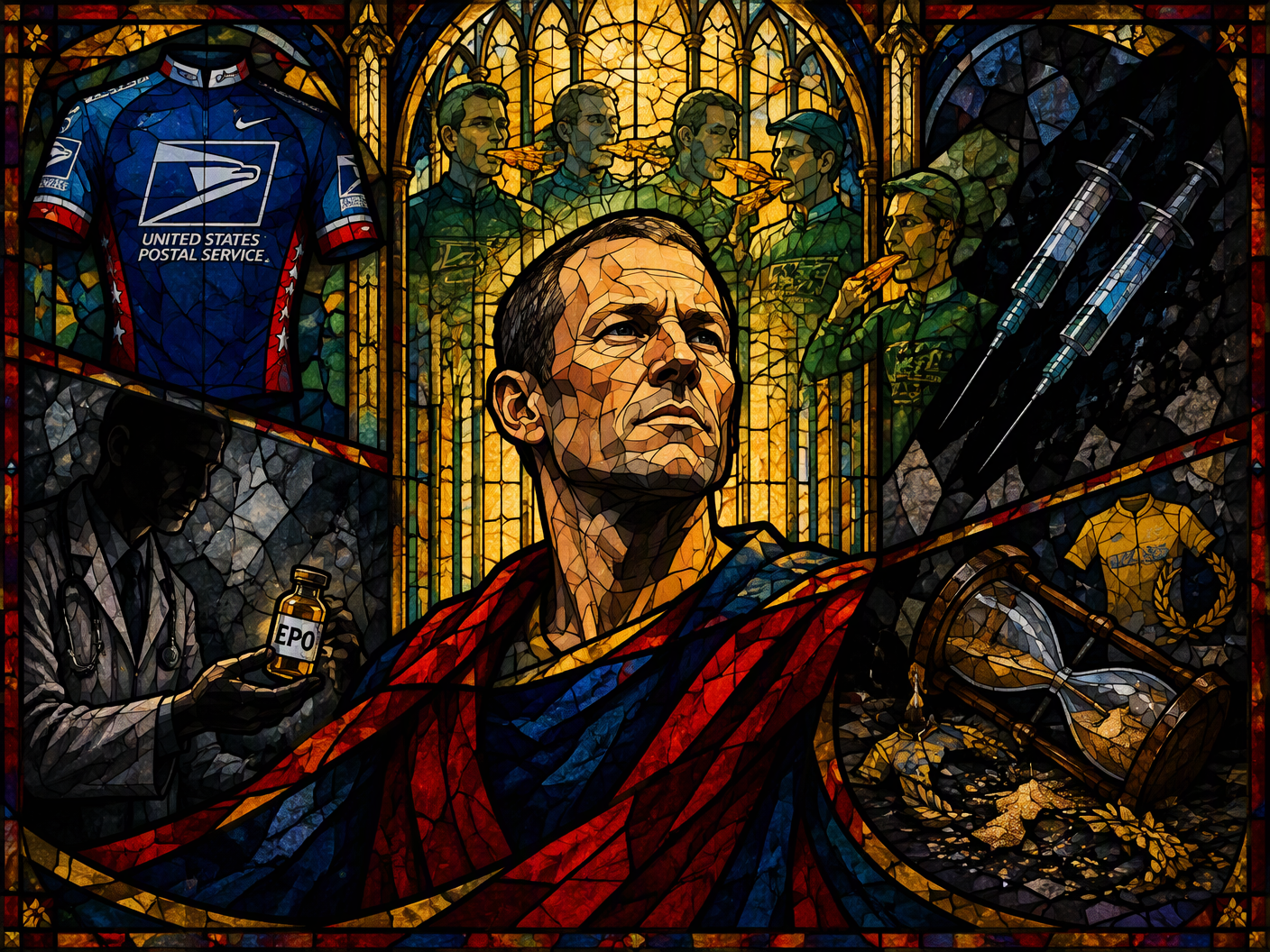
Lance Armstrong chose not to take the U.S. Anti-Doping Agency’s case against him to an arbitration hearing. On August 24, 2012, the agency announced the consequence: a lifetime ban and disqualification of his competitive results from August 1, 1998, onward, including titles, prizes and winnings. USADA sanctioned him for doping violations arising from what it described as a conspiracy within the U.S. Postal Service cycling team. Because he declined arbitration, the evidence was not tested in that proceeding.
The case did not begin with a positive drug test. In its reasoned decision, USADA explained that anti-doping rules allowed violations to be proved by “any reliable means.” The agency said it had laboratory evidence that corroborated its witnesses but would have been prepared to proceed without it. Its account of the team-run scheme rested on more than 1,000 pages of evidence, including sworn testimony from 26 people, financial payments, emails, scientific data and laboratory results.
Some of that testimony concerned the practical work that made doping possible. According to USADA’s decision, Jonathan Vaughters recalled team doctor Pedro Celaya openly handing out EPO to team members in 1998. Team employee Emma O’Reilly recalled being asked by another employee to transport testosterone. The agency also reported that Armstrong required her to dispose of used syringes after the Tour of the Netherlands.
In his January 2013 interview with Oprah Winfrey, Armstrong admitted using banned substances and blood transfusions. Asked whether he had used banned substances or blood doped in all seven of his Tour de France victories, he answered, “Yes.” He described his own regimen as EPO, transfusions and testosterone. Of his years of denial, he said: “I viewed this situation as one big lie that I repeated a lot of times.”
The admission did not resolve every part of USADA’s account. The agency said scientific data showed blood manipulation during his return to the Tour in 2009. Armstrong told Winfrey that he had last doped in 2005 and denied doping or receiving blood transfusions in 2009 or 2010. He also rejected the sweeping comparison Winfrey put to him—that the team’s program was the most sophisticated, professional and successful sport had seen—while acknowledging that it was professional and “definitely smart, if you can call it that.”
He accepted that he had been the team’s leader but denied giving a direct order to dope. Asked about former teammate Christian Vande Velde’s statement to USADA that Armstrong had threatened to remove him from the team unless he conformed to the doping program, Armstrong said, “That’s not true.” He said there had been expectations of fitness and that some teammates had not doped. “If I do it I’m leading by example so that’s a problem,” he added.
Armstrong singled out former teammate George Hincapie’s account as decisive for his own standing. “My fate was sealed,” he told Winfrey. He called Hincapie the most credible voice in the case and said he did not fault him. Asked separately whether he had been a bully, Armstrong answered yes. “I tried to control the narrative,” he said, “and if I didn’t like what someone said I turned on them.”