
Tragedy · 2010s
The Death Behind ONE Championship’s Hydration Weigh-In Rules
After Chinese fighter Yang Jian Bing died in the Philippines on 11 December 2015, ONE Championship changed its weigh-in system, banning dehydration-based weight cutting and introducing hydration testing before bouts. The reform made an athlete’s fluid balance a regulated condition of competition.
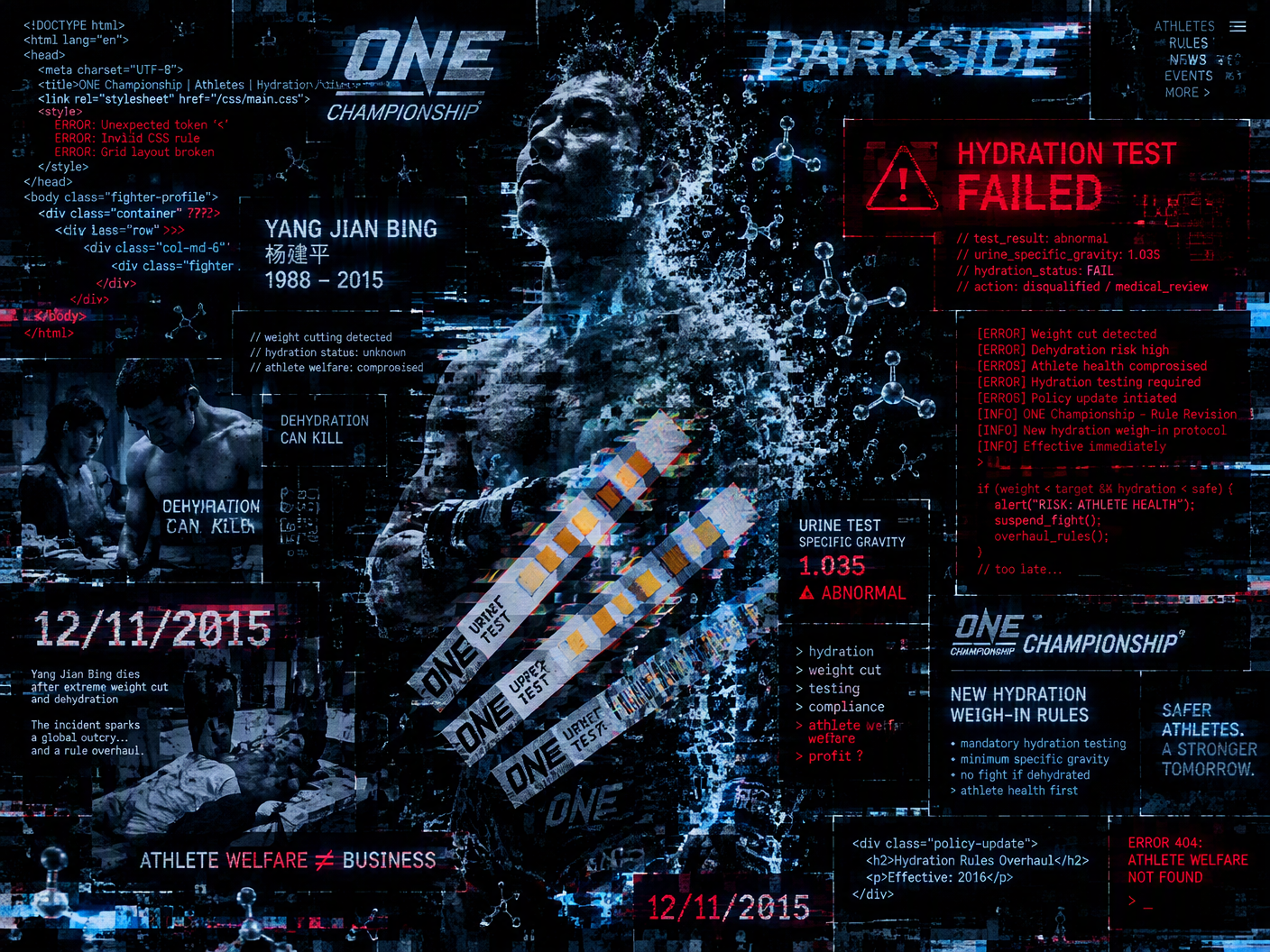
ONE Championship changed its weigh-in system after 21-year-old Chinese fighter Yang Jian Bing died in the Philippines on 11 December 2015. The fatality was attributed to dehydration caused by weight cutting. Afterward, the promotion banned dehydration-based weight cutting and required fighters to pass hydration testing before they competed. The policy did not merely alter the scale used at weigh-ins. It changed the condition that determined whether an athlete could enter the bout: making weight was no longer enough if the fighter had depleted the body to reach it.
Weight cutting has long allowed fighters to compete below their ordinary body mass by removing water before an official weigh-in and replenishing it afterward. ONE Championship’s response placed a limit on that sequence. A fighter could no longer treat dehydration as a private preparation method that ended when the number on the scale was accepted. The promotion made hydration part of eligibility. That decision followed a death, not a routine revision to event regulations.
The revised protocol uses urine specific gravity testing. The test measures the concentration of a urine sample, giving officials a way to determine whether an athlete has retained sufficient fluid rather than reaching the required weight through severe dehydration. Fighters must remain verified as hydrated up to three hours before their bouts. The rule therefore extends beyond the ceremonial weigh-in. It creates a medical checkpoint close to competition, when a fighter’s condition still carries direct consequences for whether the contest proceeds.
That timing matters because the old incentive ran in the opposite direction. The lower the target weight, the greater the pressure to remove fluid quickly, and the greater the potential advantage after rehydration. ONE Championship’s policy made the most dangerous part of that calculation subject to inspection. Officials were not simply asking whether a fighter had reached a contracted division. They were testing whether the fighter had reached it in a condition the promotion would accept.
Yang’s death became the event attached to that change. His name stands at the point where a familiar competitive practice met an irreversible physical consequence. The public account identifies dehydration from weight cutting as the cause and places his death in the Philippines on 11 December 2015. The administrative response followed: ONE Championship prohibited dehydration cutting and built hydration verification into its weigh-in system.
The promotion later added another layer of formal athlete testing. In August 2022, ONE Championship announced an anti-doping partnership with International Doping Tests & Management. The organization was identified as a subsidiary of Drug Free Sport International. Anti-doping controls and hydration rules address different risks, but they belong to the same institutional pattern: the promotion increasingly defined fighter eligibility through tests administered before competition rather than leaving preparation entirely to athletes, coaches, and corner teams.
The hydration reform also became part of a business that continued to expand. On 26 November 2023, ONE chairman and CEO Chatri Sityodtong was associated with plans for more than 60 events in 2024, with mixed martial arts returning to the forefront of the calendar. The promotion did not shrink its schedule after adopting the rule. It carried the hydration system into a larger event program, making the policy part of ongoing operations rather than a temporary response to one canceled bout.
That expansion placed athlete safety inside a commercial structure built around frequent events and contracted appearances. Fighters had financial reasons to accept bouts, remain available, and make weight. The rule changed one of the terms under which that work occurred: dehydration could no longer be used as an accepted route to a division. The test became an operational gate between the contract and the cage.
The promotion’s financial arrangements later drew separate criticism. On 31 March 2023, LowKickMMA reported on a leaked ONE Championship contract identifying strawweight fighter Anelya Toktogonova. The agreement listed $1,300 to show and the same $1,300 to win. Those figures concerned compensation, not the death of Yang Jian Bing or the introduction of hydration testing. They belong to the broader question of how fighters bear the physical and economic risks of professional competition, but they do not explain the weigh-in reform.
The sequence is therefore precise. Yang Jian Bing died on 11 December 2015 after dehydration from weight cutting was identified as the cause. ONE Championship responded by banning dehydration cutting and requiring urine specific gravity testing to verify hydration up to three hours before a bout. In August 2022, it added an anti-doping partnership with International Doping Tests & Management, a Drug Free Sport International subsidiary. By late 2023, the policy operated inside a promotion planning more than 60 events for the following year.
The final consequence was not a new slogan about fighter welfare. It was a measurable alteration in who controlled the decision to compete. Under the revised system, a fighter’s declared weight could be rejected if the hydration test failed. A practice once managed through private preparation became subject to promotion officials, urine samples, and a deadline three hours before the bout. Yang’s death supplied the turning point; the rule supplied the institution’s answer.
Investigative Dossier & Evidence
Read the companion investigation notes, verified source claims, and primary documents.
Read the Companion Notes & Evidence Record →