
Violence & Brawls · 2nd century AD
Trajan’s Victory Games and the Bodies Rome Prepared for Spectacle
In 108–109 AD, Trajan’s celebrations of victory over Dacia were linked to gladiatorial games on an extraordinary scale. Later evidence from Ephesus shows how the men who entered Rome’s arenas belonged to an organized combat class: often enslaved, rigorously trained, heavily fed, and medically maintained.
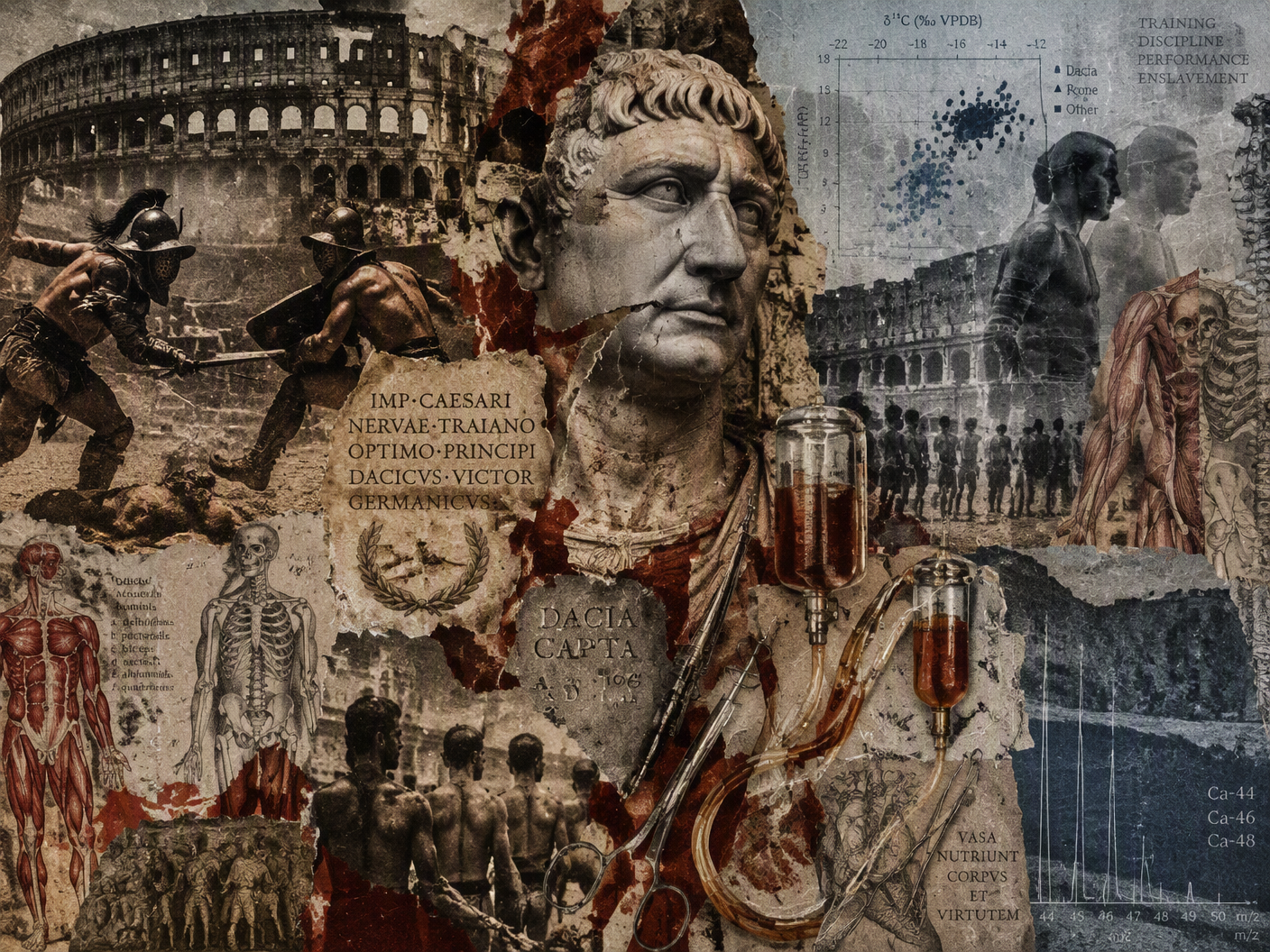
In 108–109 AD, after the Roman victory in Dacia, Emperor Trajan marked the conquest with games that extended across 123 days. Ten thousand gladiators were used in the celebrations, along with 11,000 animals. The figures belong to the scale of imperial spectacle rather than to a surviving daily account of its administration. They show what Rome chose to place before its population: organized violence prolonged over months, supplied with human combatants and animals in numbers large enough to turn victory into a recurring public institution.
The games carried the authority of the emperor, but the individual men who fought within them occupied a more complicated position. Most gladiators were slaves, drawn into a profession in which bodily skill could produce public distinction without producing personal freedom. Their value lay in preparation and repeat performance. Rome did not simply send untrained captives into an arena. It maintained schools, instructors, feeding systems, and medical care capable of keeping combatants alive and useful for the next appearance.
That arrangement made the gladiator both person and investment. Training had to build strength, speed, and the controlled responses required by different forms of combat. Food had to support bodies expected to work under extreme physical demands. Injuries had to be treated because a fighter who survived could remain economically valuable. The care was therefore not freedom from violence. It was care organized around continued performance, a distinction that shaped the daily existence of men whose bodies belonged, in law or practice, to others.
The physical consequences of that system were carried beyond the arena. In 1993, a cemetery containing gladiator burials was discovered at Ephesus, in what is now Turkey. The cemetery was later dated to the second and third centuries AD, placing its dead within the same broad imperial world that had made Trajan’s games possible. The graves did not preserve the spectacle itself. They preserved the remains of people who had passed through a social category defined by combat, discipline, dependence, and public display.
The Ephesus dead could be studied through chemistry as well as archaeology. Researchers analyzed 53 individuals for stable isotope ratios, using the composition of human remains to examine aspects of their lives. A smaller group of 35 individuals was examined for strontium-to-calcium, or Sr/Ca, ratios. These measurements did not restore names, voices, or complete biographies. They provided a narrower kind of testimony: physical traces left by different patterns of nourishment and the environments in which bodies had been formed and maintained.
Within that study, the gladiator sample showed significantly higher Sr/Ca ratios than the contemporary Roman inhabitants used for comparison. The result placed a chemical difference between the arena population and other people living in the same wider Roman world. It gave material shape to the description of gladiators as heavily fed for demanding work. The men were not merely figures in an imperial pageant; their bodies carried evidence of a regimen that distinguished them from ordinary urban inhabitants.
The feeding of gladiators has sometimes been reduced to a phrase about strength, but the broader arrangement was more exacting. Their diet was high in energy, their training rigorous, and their medical attention expert. Each element answered the same institutional need: to prepare a human body for combat and restore it when combat damaged it. The system could produce survival, skill, and even celebrity while leaving the underlying relationship intact. A well-maintained fighter could still be an enslaved man.
The contrast between Trajan’s celebrations and the Ephesus cemetery also reveals the distance between imperial intention and individual experience. At Rome, the games could be counted in days, gladiators, and animals, the units by which victory became visible to a population. At Ephesus, the evidence is reduced to burial remains and laboratory measurements. One scale records the state’s appetite for spectacle. The other records the bodily conditions imposed on a class of people whose labor made that spectacle possible.
The Ephesus findings belong to a defined sample, not to every gladiator who fought under Roman rule. The 53 isotope analyses and 35 Sr/Ca analyses illuminate the people buried in that cemetery and the comparisons made within that study. They do not provide a universal menu for the empire, nor do they identify the origin, legal status, or complete life history of every individual. Their force lies in the limit: a particular population can be examined without turning it into an explanation for all arena cultures.
Trajan’s games therefore endure in two forms. The first is imperial scale: 123 days, 10,000 gladiators, and 11,000 animals attached to the celebration of victory in 108–109 AD. The second is the slower physical evidence from Ephesus, where chemical signatures distinguish gladiators from contemporary Romans and connect public entertainment to controlled diets, severe training, and medical maintenance. Rome’s spectacle required more than an arena. It required an enduring system for preparing human bodies to enter it.
Investigative Dossier & Evidence
Read the companion investigation notes, verified source claims, and primary documents.
Read the Companion Notes & Evidence Record →