
Tragedy · 2020s
Tua Tagovailoa, the 2022 Clearance and the NFL’s Concussion Protocol
Tua Tagovailoa’s documented head injuries in college, the NFL, and 2024 culminated in the September 2022 sequence that forced the league and players’ union to revise their concussion rules. The Dolphins’ decision to return him to the Buffalo game became the central procedural event in that response.
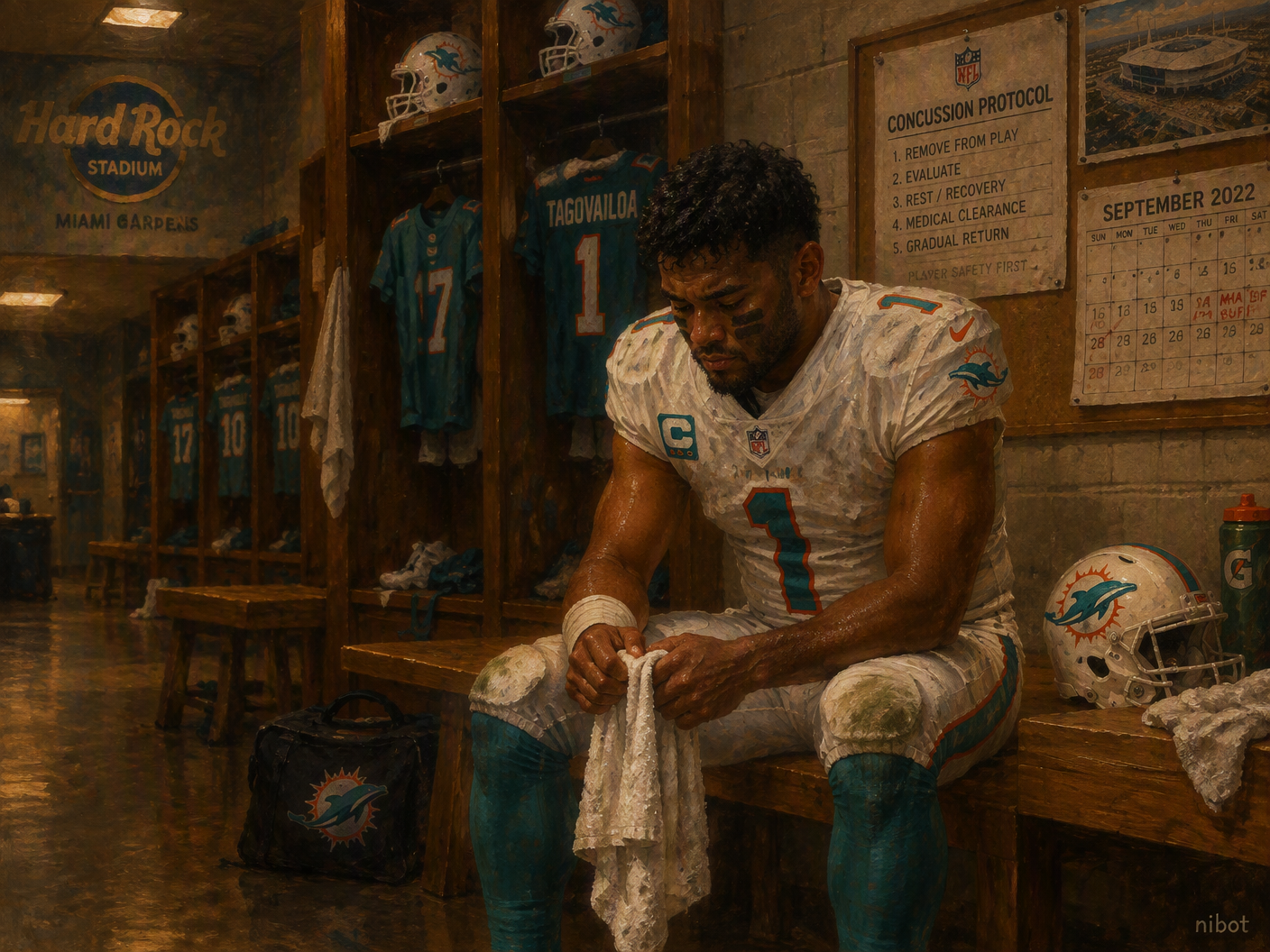
On September 29, 2022, at Paycor Stadium in Cincinnati, Josh Tupou tackled Tua Tagovailoa and drove him to the ground. Tagovailoa’s hands tightened beside his face in a fencing response, an involuntary posture that turned a disputed football decision from four days earlier into a question the league could no longer leave inside the boundaries of one team’s medical judgment. The Dolphins quarterback was taken from the field and entered concussion protocol. In the days that followed, the NFL and NFLPA altered the rules governing when a player could return.
The sequence had begun on September 25 at Hard Rock Stadium in Miami Gardens. Against the Buffalo Bills, Tagovailoa’s head struck the turf. He left the game after showing unsteady movement, then returned after halftime. At the time, Tagovailoa said he believed the problem was back spasms, and the Dolphins initially treated it that way. The return to play became the defining decision of the episode—not because the moment supplied a simple medical answer, but because the later Cincinnati injury placed that decision under a much harder light.
The Buffalo game had followed a career already marked by head trauma. In 2019, while playing for Alabama, Tagovailoa suffered a concussion on the same play as the hip injury that ended his season. That earlier incident did not settle the meaning of what happened in Miami three years later. It did establish that the discussion surrounding Tagovailoa’s health had a history before he became the center of the NFL’s most consequential concussion-policy dispute of 2022.
Four days after the Buffalo game, the immediate facts were different from the earlier uncertainty. Tupou’s tackle sent Tagovailoa to the ground, and the fencing response followed. The visual evidence of his arms and hands fixed the play in public memory, but the institutional consequence moved through less visible channels: a medical designation, a review of the clearance process, and a confrontation between the league’s competitive calendar and its obligations to injured players. Tagovailoa’s body had become the point at which those competing responsibilities met.
The NFL and NFLPA responded by changing the concussion protocol. Ataxia—loss of balance or coordination—was added to the list of no-go symptoms, conditions that required a player to be removed rather than evaluated for a quick return. The change recognized that unsteady movement could not remain a judgment left to interpretation at the edge of a game. The NFLPA also fired the unaffiliated neurotrauma consultant involved in Tagovailoa’s Week 3 clearance after the Buffalo game. Administrative action followed the Cincinnati injury, but it did not erase the decision made four days before.
The policy revision did not end Tagovailoa’s exposure to head impacts. On December 25, 2022, he sustained another concussion against the Green Bay Packers. By then, the September sequence had acquired a formal afterlife: the concussion protocol had been amended, the consultant’s role had ended, and Tagovailoa’s repeated injuries had become part of the public account of how professional football handled neurological risk. The game against Green Bay added another injury to that account, separate from the question of who had made the earlier clearance decision.
Nearly two years later, the same problem returned to the Dolphins’ schedule. On September 12, 2024, in Miami Gardens, Tagovailoa took a hit to the head during another game against Buffalo and exited. The Dolphins later ruled the injury a concussion. This time, the team’s designation placed the injury within the established language of the revised protocol. The event also connected the 2024 season to the unresolved public meaning of 2022: every subsequent return carried both an immediate medical decision and the accumulated weight of what had happened before.
Tagovailoa remained away from the field for six weeks. During that interval, the practical question was not whether he could still perform as an NFL quarterback; his career had already answered that question. It was when the Dolphins would permit him to resume the work that had produced his livelihood and his injuries. The decision belonged to the contemporary return-to-play process, shaped by team physicians, league rules, and the player’s own participation. On October 27, 2024, at Hard Rock Stadium, he returned against the Arizona Cardinals.
His return did not close the medical history. It placed the latest injury beside the 2019 Alabama concussion, the September 25, 2022 Buffalo episode, the September 29 Cincinnati injury, the Christmas Day concussion against Green Bay, and the September 2024 Buffalo concussion. Those events were not interchangeable. The first Buffalo incident was initially understood through Tagovailoa’s account of back spasms; the Cincinnati game produced the fencing response; the later injuries received concussion designations. Sequence mattered because the institutions involved had acted at different points with different information.
What endured from the 2022 controversy was not a single verdict on Tagovailoa’s health or a final answer to every question surrounding his clearance. It was a revised rule: ataxia became a no-go symptom, and the consultant associated with the Week 3 clearance lost his position. The NFL and NFLPA thus converted one player’s consecutive injuries into a change in the operating standard for others. Tagovailoa continued to play under that standard, returning in October 2024 after six weeks away, while the events that produced it remained fixed in the protocol’s language.
Investigative Dossier & Evidence
Read the companion investigation notes, verified source claims, and primary documents.
Read the Companion Notes & Evidence Record →