
Scandals & Feuds · 2010s–2020s
USC’s NCAA Sanctions and the Reggie Bush Record Dispute
The NCAA sanctioned USC in 2010 across football, men’s basketball, and women’s tennis, including a two-year football postseason ban and the vacatur of 14 victories. The penalties later became the foundation for disputes over Reggie Bush’s Heisman Trophy, NCAA language, and the release of internal investigative documents.
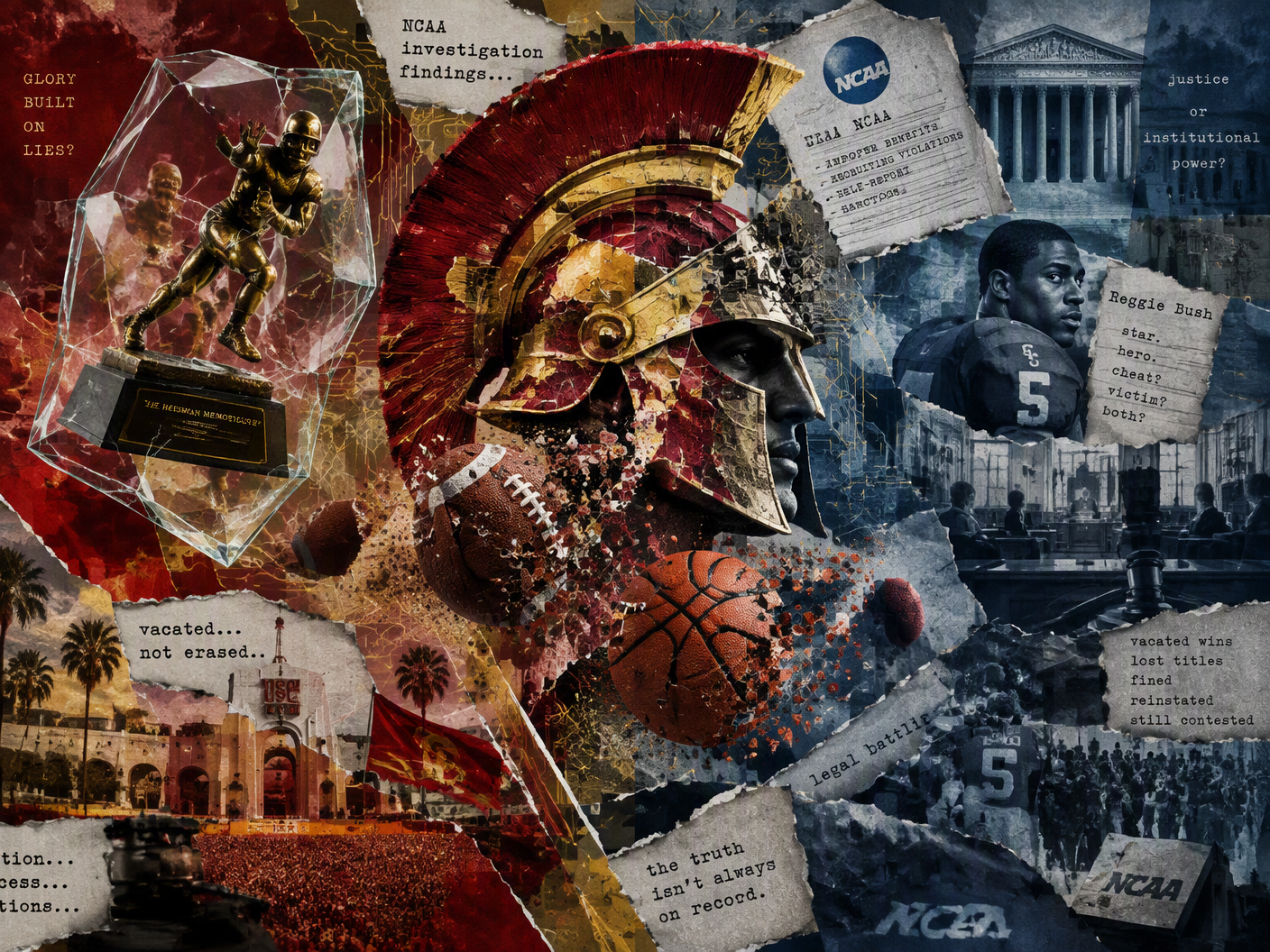
The NCAA announced its sanctions against USC on June 10, 2010. Football received a two-year postseason ban, and 14 victories were vacated. Men’s basketball and women’s tennis were also swept into the disciplinary action. The announcement converted years of benefit allegations into institutional penalties that altered USC’s official results and postseason access. It also fixed the dispute to Reggie Bush, the former USC running back whose eligibility had been examined during the investigation, even though the sanction itself addressed the university’s athletic programs rather than issuing a criminal judgment against him.
The inquiry had grown out of allegations that surfaced between 2006 and 2009. Reggie Bush was connected to claims involving improper benefits during his USC career, while later allegations involving basketball player O.J. Mayo expanded the matter beyond football. The NCAA merged the football and basketball issues into one probe. That decision placed separate athletes, sports, and institutional responses inside a single enforcement file, allowing the university’s handling of eligibility questions to be measured alongside the conduct attributed to individuals.
USC acted on the basketball matter before the NCAA issued its broader penalty. On January 3, 2010, the university retroactively declared Mayo ineligible for the 2007–08 season and vacated all 21 victories from that campaign. The ruling erased the season’s results from USC’s official accounting. It also showed how eligibility enforcement worked in practice: once an athlete was deemed ineligible after the fact, the consequences moved backward through the schedule, changing wins that had already been played and recorded.
The football consequences were larger in their institutional reach. The NCAA’s two-year postseason ban removed USC from the championship pathway for two seasons, while the 14 vacated victories revised the program’s historical results. The sanction did not merely fine an athletic department or suspend a single player. It transferred the cost of the case onto coaches, teammates, future teams, and the university’s official record. USC had to carry the penalty after the players at the center of the allegations had moved beyond college football.
Bush responded to the NCAA episode through the Heisman Trophy. On September 14, 2010, he voluntarily gave back the award he had won for the 2005 season. The Heisman Trust left that year’s trophy vacant. Bush’s decision did not resolve every disputed fact surrounding the investigation, but it changed the public status of the most visible honor attached to his college career. The trophy became an administrative object in a continuing dispute: first surrendered, then held in suspension by the organization that had awarded it.
A second legal conflict developed around Todd McNair, USC’s former running backs coach. McNair sued the NCAA for defamation in a case tied to the investigation. On November 21, 2012, Los Angeles Superior Court Judge Frederick Shaller ruled that NCAA materials in the case tended to show ill will or hatred and characterized the investigation as malicious. The ruling gave McNair access to a judicial description of the internal material, while leaving the larger dispute inside civil litigation rather than converting it into a criminal proceeding.
The fight over the documents continued after that ruling. In February 2015, the California Second District Court of Appeal held that the NCAA could not seal hundreds of pages of internal emails and other documents filed in McNair’s defamation lawsuit. The decision concerned public access to the litigation file. It did not itself determine every factual question raised by McNair’s claims, but it prevented the NCAA from keeping the underlying material entirely behind a court seal. The investigative dispute acquired a second life through document access.
Bush’s own dispute returned more than a decade after he surrendered the trophy. In July 2021, the NCAA used the phrase “pay-for-play” in a statement concerning his USC records. Bush filed a defamation lawsuit against the association in August 2023, challenging that description. The filing made the NCAA’s language part of the controversy. The question was no longer limited to what penalties USC had received in 2010; it also concerned whether a later public characterization of Bush’s conduct crossed the line into a legally actionable false statement.
The Heisman Trust changed the trophy’s status on April 24, 2024. It announced that the 2005 award would be returned to Bush. The decision reversed the organization’s earlier position, which had left the trophy vacant after Bush relinquished it in 2010. The reversal did not erase USC’s sanctions, restore the 14 vacated football victories, or decide Bush’s defamation case. It addressed the award itself, separating the Heisman’s institutional judgment from the NCAA’s continuing language and legal dispute.
By 2024, three official actions occupied the same history without producing a single final answer. USC had vacated Mayo’s 21 basketball wins and absorbed NCAA penalties across three sports. Bush had surrendered the Heisman, then received it back after the Trust reconsidered its position. The appellate court had opened hundreds of pages of McNair litigation documents, while Bush’s defamation suit remained a challenge to the NCAA’s 2021 wording. The sanctions remained established institutional consequences; the later disputes concerned how responsibility and meaning would be assigned to them.
Investigative Dossier & Evidence
Read the companion investigation notes, verified source claims, and primary documents.
Read the Companion Notes & Evidence Record →