
Point Shaving & Fixes · 1970s
Black Mist: The Baseball Bans and Motorcycle-Racing Fixes That Reached Nippon Professional Baseball
Between 1969 and 1971, Japanese investigators and Nippon Professional Baseball uncovered a fixing scandal that crossed from baseball into flat-track motorcycle racing. The league answered with lifetime bans, season-long suspensions, and permanent exclusions, while arrests revealed the involvement of both players and organized crime.
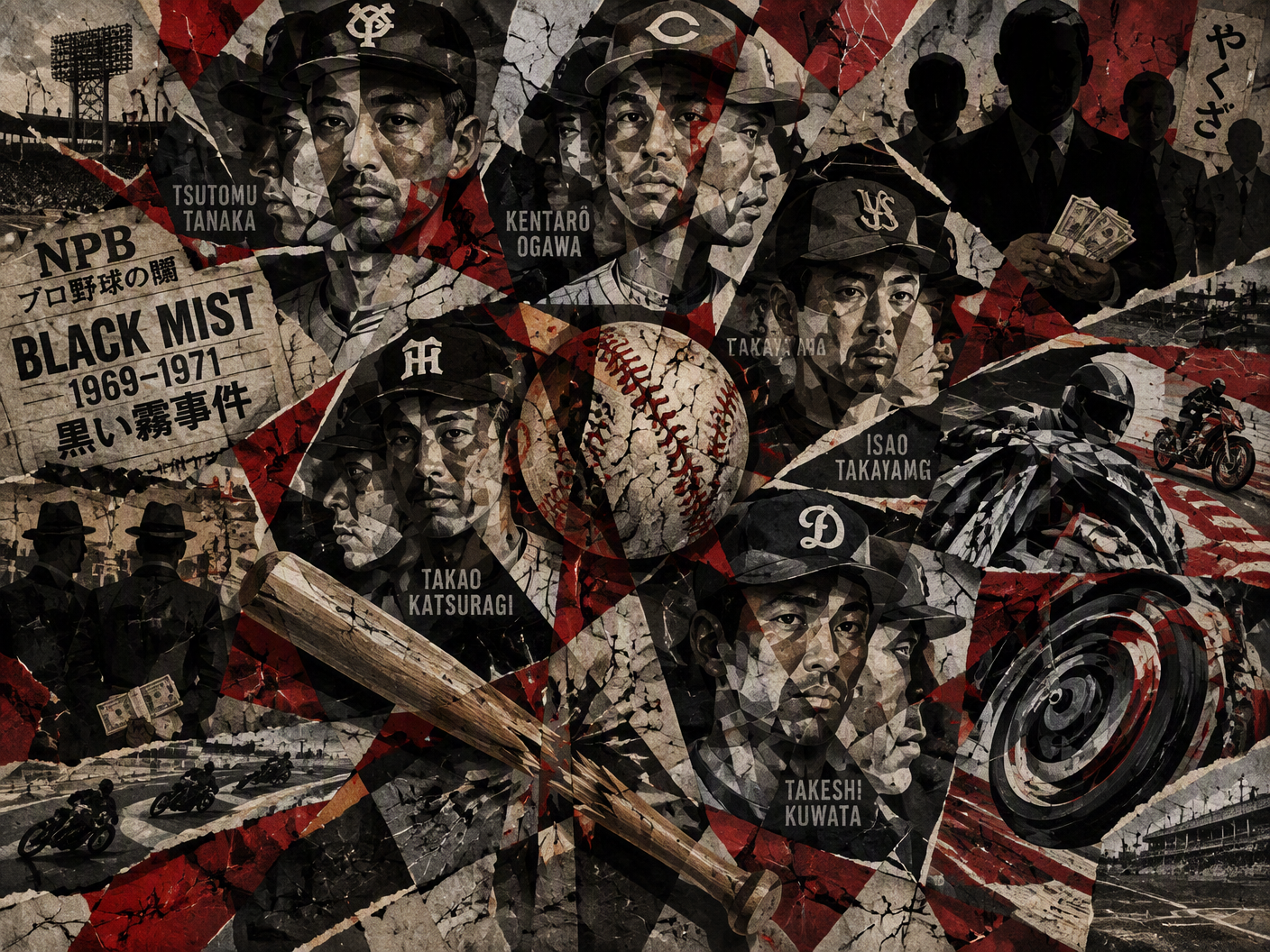
On October 7, 1969, the Nishitetsu Lions confronted a fact that could not be reduced to a bad performance or a player's private indiscretion: pitcher Masayuki Nagayasu had taken bribes from a yakuza clan to throw games. The finding placed money and organized crime inside the competitive act itself. A pitcher had not merely violated a club instruction. He had accepted payment to alter the result that spectators, opponents, and the league treated as genuine.
The Nishitetsu investigation created the first decisive break in the scandal. On November 28, the Nippon Professional Baseball executive committee banned Nagayasu from the league for life. The punishment removed him from professional baseball and established the sanction that would define the crisis: permanent exclusion rather than a fine, a short suspension, or a private reprimand. The league had identified conduct it considered incompatible with continued membership.
The case did not remain confined to one pitcher or one club. By 1970, the Black Mist scandal had opened a second route into Japanese sport: flat-track motorcycle racing, where competitors and intermediaries were drawn into fixing investigations. The overlap mattered because it exposed a common vulnerability. Gambling interests did not need to control an entire league. They needed access to participants who could influence an event and a system that paid attention only after the result had been compromised.
On April 22, 1970, authorities arrested three people in the flat-track fixing case: Chunichi Dragons pitcher Tsutomu Tanaka, Taiyō Whales pitcher Isao Takayama, and Hirotaka Fujinawa, identified as a yakuza member. The arrests connected professional baseball players to the racing investigation and gave the scandal a criminal dimension beyond the league's internal discipline. Police action now accompanied the NPB's earlier decision to expel Nagayasu.
A few weeks later, Chunichi Dragons pitcher Kentarō Ogawa was arrested for taking part in the flat-track fixing. His case showed how the scandal had moved across institutional boundaries without leaving the baseball roster behind. Ogawa was not a racing official or a distant associate. He was an active professional pitcher whose name had entered an investigation into the manipulation of another sport.
The NPB executive committee responded on June 3 by banning Ogawa from baseball for life. The sequence was direct: arrest in the racing case, then permanent exclusion from the baseball league. The committee treated participation in the fixing scheme as grounds to end a player's professional career, even where the relevant conduct reached beyond the field on which he earned his salary.
The broadest baseball disciplinary action came on May 25, 1970. The executive committee banned Masaaki Ikenaga, Yoshinobu Yoda, and Akio Masuda from baseball for life. Ikenaga had been among the players summoned to testify before receiving his ban. His name would remain attached to the scandal for decades, and in 2005 he was later reinstated. The reinstatement changed his status; it did not erase the original decision that had removed him from baseball.
The same May 25 action drew a line between permanent exclusion and temporary punishment. Kimiyasu Murakami and Kazuhide Funada were suspended until the end of the 1970 season rather than banned for life. That difference revealed the committee's attempt to grade responsibility through its sanctions. The Black Mist response therefore consisted of several penalties—lifetime bans, fixed-term suspensions, and warnings—applied to multiple players as the investigation expanded.
The racing branch continued after the April arrests and the May baseball sanctions. On September 8, Yakult Swallows infielder Takeshi Kuwata was arrested in the flat-track scandal. His arrest extended the list of baseball players caught in the orbit of motorcycle-racing fixing and confirmed that the investigation had not ended with the first group of defendants. The scandal's footprint now reached players from Nishitetsu, Chunichi, Taiyō, and Yakult.
By the period identified as 1969–1971, Black Mist had become a combined case of baseball game-fixing and flat-track motorcycle-racing corruption. The league's public response was measurable: Nagayasu, Ikenaga, Yoda, Masuda, and Ogawa received lifetime bans; Murakami and Funada lost the remainder of the 1970 season; other players received suspensions or warnings. Several people were arrested in the racing investigation. Those actions established the scandal's official footprint, while the surviving materials do not establish criminal convictions for every named player.
A later baseball controversy provides an unintended contrast. In March 2005, Miami Marlins veteran outfielder Lenny Harris called for tougher steroid penalties and said a player who used steroids should be banned. Pitcher and union representative Josh Beckett supported stricter drug testing and said he wanted to clear his name. Mike Lowell, Al Leiter, and Jeff Conine were also quoted discussing congressional hearings on steroid use and advocating stronger testing or punishment. Their comments concerned policy, not a finding that any of the five players had used steroids.
Investigative Dossier & Evidence
Read the companion investigation notes, verified source claims, and primary documents.
Read the Companion Notes & Evidence Record →