
Scandals & Feuds · 1950s
The State Names Imposed on Budapest’s Football Clubs—and the 2024 Derby They Outlasted
In Communist-era Hungary, authorities reassigned the names, colours, and institutional affiliations of major Budapest clubs, placing inherited local identities inside the state’s administrative system. Ferencváros later returned to its historic name, won the 1964/65 Fairs Cup, led the 1987–1988 attendance table, and defeated Újpest 2–0 at the Groupama Aréna on 19 May 2024.
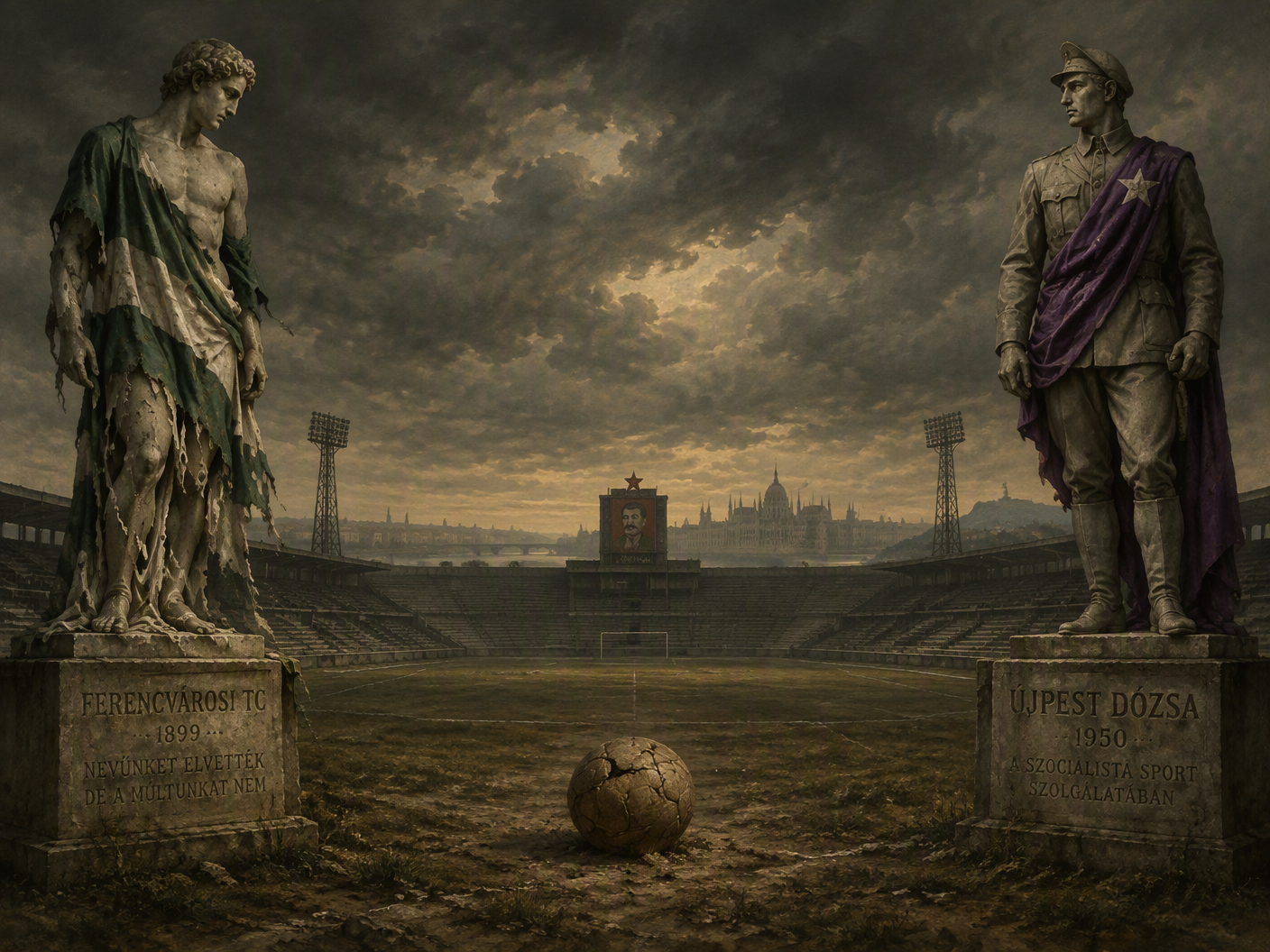
The change arrived through the names painted above the turnstiles. During the 1950s, Ferencváros became Édosz SE and lost the green and white colours by which generations of Budapest supporters had recognized it. Újpest became Dózsa SE. Budapest Honvéd, previously associated with Kispesti AC, was placed under the ministry of defense. The intervention did not alter only a club’s stationery. It reassigned the public identities of prominent football institutions to the political organizations that governed Communist Hungary.
Ferencváros had been founded in Budapest in May 1899, according to FIFA’s historical club profile. That date matters because it places the club’s origin more than half a century before the state remade its official identity. The green and white colours belonged to a tradition already established in the capital, not to a symbol invented for a new administrative entity. When Édosz replaced Ferencváros, the state changed the label under which the club operated; it did not create the community that label had represented.
The three cases did not carry the same institutional meaning. Ferencváros was renamed and stripped of its colours. Újpest received the Dózsa designation. Honvéd was connected to the defense ministry, giving its football identity a direct relationship with the state’s military structure. Together, the changes show the administrative reach of the period without proving that every Hungarian club experienced an identical transformation. The political system could make a club’s formal name answer to an institution outside the ground, even when supporters continued to attach older meanings to the team.
Football did not stop when the names changed. Ferencváros competed under the altered identity and later won the Fairs Cup in the 1964/65 season, a result listed in FIFA’s club history. The victory did not restore the colours removed in the 1950s or erase the administrative decision that had produced Édosz SE. It did, however, expose the limit of political renaming. The club’s competitive life continued, and its international achievement became part of the same history as the state’s attempt to recast it.
The other identity at the center of the story was Újpest. Ferencváros and Újpest were both Budapest clubs, and a historical derby reference describes their meeting as the major derby of Hungary. That description gives the rivalry a civic geography: two clubs from the same capital, carrying different institutional histories into the same contest. Their significance did not depend on the temporary names alone. It survived the period in which administrators tried to make those names speak for the state.
By the 1987–1988 NB I season, Ferencváros appeared again under its historic name and led the league’s average-attendance table. The figure was 17,933. It is a measurement from one season, not a census of Hungarian football or a direct record of what every spectator believed. Its importance is narrower and more concrete: decades after the club had been renamed and stripped of its colours, Ferencváros drew the largest average crowd in the country’s top division.
That attendance number marks the difference between administrative power and popular attachment. A ministry could assign an affiliation. An official could replace a name. A colour could disappear from the club’s sanctioned presentation. None of those decisions automatically determined which side of Budapest people would continue to follow. The 17,933 average cannot reconstruct individual memories or prove a single shared response to the Communist period. It does show that Ferencváros retained exceptional drawing power after the state’s most visible intervention in its identity.
The chronology therefore resists two easy conclusions. Ferencváros was not untouched by the political system: its name and colours were changed. Nor did the change destroy the club’s sporting existence: it later won a European competition and remained a major public attraction. The club’s 1899 foundation, its 1964/65 Fairs Cup victory, and its 1987–1988 attendance leadership belong to different moments and prove different things. Taken together, they show continuity under pressure rather than a simple disappearance followed by a clean restoration.
On 19 May 2024, Ferencváros defeated Újpest 2–0 at the Groupama Aréna, Nemzeti Sport reported. The match was played under the historic names rather than Édosz and Dózsa. Its score settled one modern meeting, not the meaning of a century of rivalry. But the setting made the institutional history visible: the clubs that had once been assigned state identities were again competing as Ferencváros and Újpest, the names by which the Budapest derby is most widely known.
The durable sequence is precise. Ferencváros began in Budapest in May 1899. Communist-era authorities renamed it Édosz SE and removed its green and white colours; Újpest became Dózsa, while Budapest Honvéd was linked to the defense ministry. Ferencváros won the Fairs Cup in 1964/65, drew an average of 17,933 spectators in the 1987–1988 NB I season, and beat Újpest 2–0 at the Groupama Aréna on 19 May 2024. The imposed names belonged to the machinery of the state. The rivalry outlasted the machinery.
Investigative Dossier & Evidence
Read the companion investigation notes, verified source claims, and primary documents.
Read the Companion Notes & Evidence Record →